
While inflation is one of the main risks cited by many financial analysts, protecting savings against rising prices remains a major concern for investors. Even when it slows, inflation continues to erode purchasing power and can reduce the real return of certain investments.
To guard against it, stocks, diversified ETFs, inflation-linked bonds, or certain real estate investments can be interesting solutions. Gold, commodities, and even cryptocurrencies can also present opportunities, without offering systematic protection against rising prices.
But which investments should be favored depending on the economic context and which should be avoided? Café de la Bourse explains how to protect your wealth against inflation, but also how some investments can allow you to profit from it.
What investments to prioritize and which to avoid in an inflationary period? Café de la Bourse’s quick-reference table of opinions
There is no investment capable of protecting systematically against inflation. Some investments aim to deliver returns above price rises, others can benefit directly from an inflationary environment. Even assets often presented as alternatives to traditional currencies, such as Bitcoin, do not guarantee purchasing power protection.
Conversely, some assets become less attractive when prices and interest rates rise. Here is a summary table of the main solutions, their advantages, and the risks to know before investing.
| Category | Investment | Benefit in inflationary periods | Main risk |
|---|---|---|---|
| Protect | Stocks of solid companies | Some companies can pass cost increases on to their selling prices | Lower profits and valuations |
| Protect | Diversified equity ETFs | Exposure to multiple sectors and firms likely to resist inflation | Broad market declines |
| Protect | Inflation-linked bonds | Capital or interest adjusted according to a price index | Sensitivity to real rates and purchase price |
| Protect | Diversified life insurance | Possible combination of euro funds and unit-linked units | Insufficient yield or capital loss on unit-linked units |
| To profit from | Commodities | Some commodities can appreciate as their prices rise | High volatility and potential price reversals |
| To profit from | Gold | Diversification and potential safe-haven value in times of uncertainty | No income and significant fluctuations |
| To profit from | SCPI | Some rents may be indexed to inflation | Drop in share prices and non-guaranteed income |
| To profit from | Real estate crowdfunding | Some projects offer higher rates when financing conditions tighten | Developer default, delays and capital loss |
| To profit from | Bitcoin and cryptocurrencies | Scarcity of Bitcoin and diversification potential amid monetary concerns | Very high volatility, no guaranteed inflation protection and potential capital loss |
| To monitor / avoid | Fixed-rate classical bonds | Fixed coupons may become insufficient against inflation | Negative real return and price drop if rates rise |
| To monitor / avoid | Shares of fragile or heavily indebted companies | Limited capacity to absorb cost and rate increases | Deterioration of margins, profits and stock price |
| To monitor / avoid | Non-yielding cash | Immediate availability of money | Gradual loss of purchasing power |
What is inflation and how does it work?
The inflation rate corresponds to the generalized and sustained rise in consumer prices. In other words, with the same amount of money, you buy progressively fewer goods and services. Thus, this phenomenon felt by households in their daily expenditures also directly concerns savers. When prices rise, investments must yield enough to compensate for this increase, otherwise wealth loses value in terms of purchasing power.
How does inflation form?
Inflation does not come from the same place all the time. It can be caused by demand that is too high relative to what firms are able to produce, but also by an increase in production costs. And sometimes, several factors accumulate.
There are generally four major mechanisms:
- Demand-pull inflation: when households consume more and firms cannot meet this demand, prices can rise. This is especially likely during a strong economic rebound.
- Cost-push inflation: an increase in energy prices, raw materials or wages can push firms to raise their prices to preserve profitability.
- Imported inflation: when goods bought abroad become more expensive, this rise can spill over into prices in France. A fall in the euro against the dollar can, for example, amplify the phenomenon.
- Inflation expectations: if firms expect a durable increase in their expenses and employees demand higher pay to preserve purchasing power, a dynamic of rising prices and wages can take hold.
The energy crisis of 2022 nicely illustrates these mechanisms. The surge in gas and oil prices first weighed on energy bills, before feeding through to transportation, industrial production and food products.
The main components of inflation
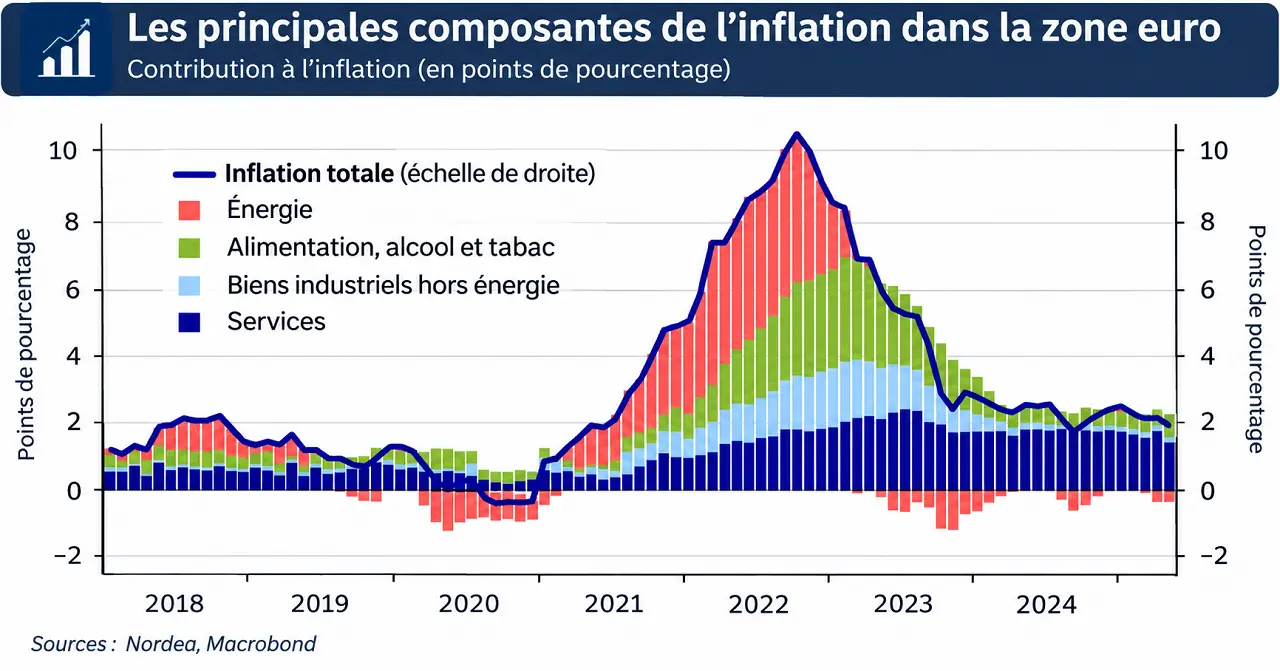
To limit these tensions, central banks have an important tool: policy rates. By raising interest rates, the European Central Bank (ECB) makes borrowing more expensive, which tends to slow consumption and investment. Conversely, a rate cut can support economic activity.
How is inflation measured?
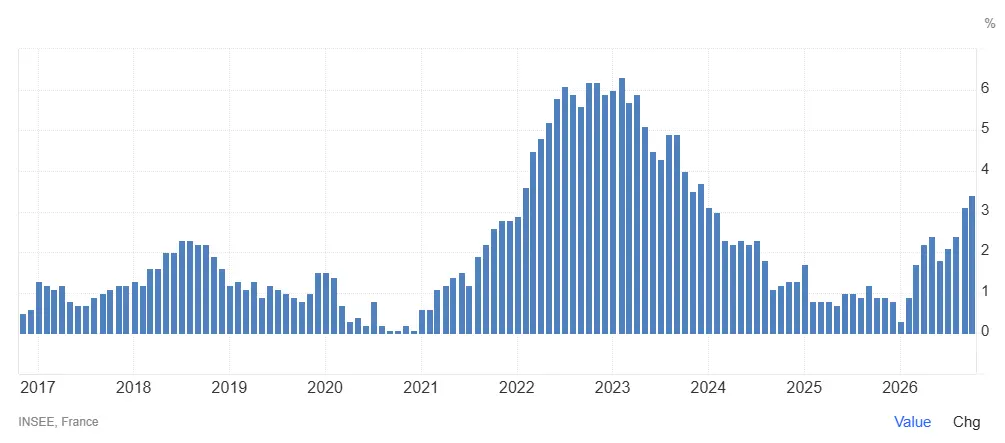
In France, it is INSEE that measures every month the evolution of prices through the consumer price index (CPI). To construct this indicator, the institute tracks prices of a representative basket of goods and services that reflect household spending: food, energy, transport, housing, health, leisure, etc.
The figure most often cited corresponds to price changes over twelve months. Thus, 3% inflation means prices measured by the index have risen by 3% on average compared with the same period a year earlier.
Inflation in Europe from 2016 to 2026
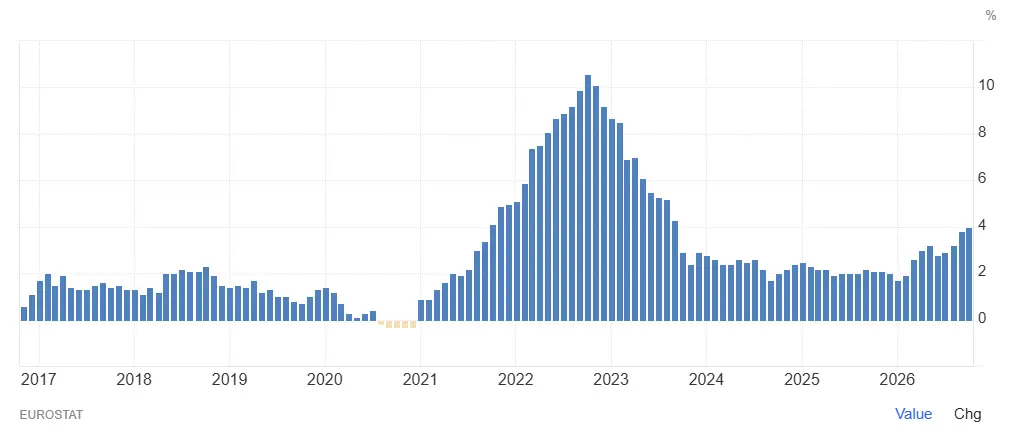
To better understand, imagine a household that spends €1,000 per month on a basket of goods and services. With 3% inflation, this same basket would theoretically cost €1,030 a year later. If prices rise another 3% the following year, the bill would reach €1,060.90. Price increases thus compound from year to year.
It is also important to distinguish between inflation slowing down and falling prices. When the inflation rate moves from 5% to 2%, prices continue to rise, just more slowly. This is called disinflation.
Inflation in France from 2016 to 2026
Deflation is the opposite phenomenon: a generalized and lasting fall in consumer prices.
Finally, to compare figures across European countries, the harmonized index of consumer prices (HICP) is used. This indicator is notably the reference for the ECB, whose objective is to maintain inflation at 2% over the medium term.
Why not confuse inflation with a currency devaluation?
Inflation is often associated with a loss of value of a currency. Yet the two notions do not refer to the same thing.
Inflation corresponds to a general rise in prices in an economy. Devaluation occurs when a country decides to lower the official value of its currency relative to another, in a fixed or administered exchange-rate system.
In the case of the euro, whose value moves freely against the dollar, we speak more of currency depreciation.
Suppose the euro falls from 1.10 dollars to 1 dollar. A US product priced at $110 used to cost €100 for a European buyer. After this euro depreciation, it would cost €110, even though the dollar price of the product has not changed.
This is one reason a currency that depreciates can contribute to higher prices for imported goods, especially for energy and commodities. But the two phenomena do not necessarily go hand in hand: a country can experience inflation without its currency losing value on the foreign exchange market.
For an investor, the distinction is worth making. Inflation reduces the purchasing power of savings, while currency movements can influence the value of international investments, up or down.
Why protect your savings and investments against inflation?
Inflation affects not only household budgets. It can also cause savers to lose money without realizing it. Because preserving capital does not necessarily preserve value. An investment can earn interest and still prove to be losing if prices rise faster. For investors, the challenge is therefore to find profitable investments, capable of doing better than inflation, after costs and taxes are taken into account.
How does inflation reduce the real value of your savings?
With inflation, the problem is not necessarily that your capital decreases, but that it buys fewer and fewer things.
A worker whose pay remains stuck at €2,000 per month loses purchasing power as prices rise. The same goes for a saver who leaves money in a non-interest-bearing account.
Imagine €10,000 left in a current account for five years. With a constant 3% inflation per year, those €10,000 would have about €8,626 in today’s purchasing power. That represents a loss of €1,374, even though the account balance has not moved.
And this loss can become substantial over a longer period, especially for investors planning retirement or seeking to transfer wealth. Keeping cash on hand is, of course, necessary to deal with unexpected events, but letting all of your savings sit idle for years can end up costing a lot.
What is the difference between nominal return and real return on an investment?
An investment that yields 2% per year may seem attractive, especially if it carries little risk. But if inflation reaches 3% over the same period, the stated return is not enough to compensate for rising prices.
That is the difference between nominal return and real return. The first is the performance of an investment before accounting for inflation. The second measures what the investor actually gained, or lost, in purchasing power.
Take an investment of €10,000 earning 2% per year. After twelve months, the capital reaches €10,200, i.e., €200 of gains. Yet, with 3% inflation, these €10,200 have a purchasing power lower than that of the €10,000 initially invested.
The real return calculation measures this gap:
Real return = [(1 + nominal return) / (1 + inflation) − 1] × 100
In this example, the real return is −0.97%. The investor did gain €200 on the investment, but he lost nearly 1% of purchasing power.
Also be mindful of fees and taxes. An investment that yields 4% with 3% inflation may look profitable, but the situation changes if fees and taxes absorb part of the return.
To judge an investment’s profitability, the advertised rate alone is not enough. What matters is what remains for the investor after inflation, fees, and any taxes.
What investments to choose to protect against inflation?
When faced with inflation, not all investments are equally valuable. Some aim to achieve returns above price increases, while others offer more direct protection of purchasing power. Equities, ETFs, inflation-linked bonds, or life insurance: each solution has advantages but also risks to know before investing.
Investing in stocks: can the stock market protect against inflation?
In the long run, equities can constitute an interesting protection against inflation. Some companies indeed possess pricing power (pricing power) that allows them to pass on rising costs to their customers without overly penalizing sales.
This is especially true for certain companies in consumer staples, healthcare, or luxury sectors. But beware, not all stocks withstand inflation equally well. A rise in interest rates can also weigh on their valuations. Stock selection remains essential.
*Your capital is at risk. See terms on the site.
Investing in ETFs: how to diversify your portfolio in the face of inflation?
ETFs allow investing in dozens, or even hundreds, of stocks through a single financial product. An ETF tracking the MSCI World, for example, provides access to a broad range of international companies, some of which may resist inflation better than others.
There are also sector ETFs, notably in energy or commodities, which can benefit from certain inflationary periods. However, diversification limits company-specific risk, but does not protect against a broad market downturn.
Investing in inflation-linked bonds: an effective protection?
Unlike traditional bonds, inflation-linked bonds provide for an adjustment of the principal or interest based on the evolution of a price index.
In France, the state issues OATi, linked to French inflation, and OAT€i, linked to euro area inflation. These securities can help preserve the purchasing power of capital, especially when held to maturity.
However, you must monitor their purchase price and the evolution of real interest rates, which can lead to losses if sold early.
Choosing life insurance: which riders to favor during inflation?
A life insurance investment should not be composed solely of a euro fund. Consider spreading your capital between a secure euro fund and units of account that carry risks but may be more remunerative.
This diversification makes sense when inflation exceeds the yield of euro funds. Units of account allow investment in equity funds, ETFs or property-backed instruments, with higher long-term performance potential.
The right balance depends on your investment horizon and risk tolerance. Unlike euro funds, units of account do not guarantee capital.
Be careful to select one of the best life insurances that will allow you to benefit from a high-performing euro fund, a broad range of UC, and attractive fees.
What investments to choose to profit from inflation?
While inflation penalizes some investments, it can also create opportunities. Several asset classes can benefit from rising prices, notably commodities and certain real estate investments. Cryptocurrencies, particularly Bitcoin, are sometimes presented as an alternative to currency depreciation, though their effectiveness remains highly debated. It’s also crucial to pick the right moment to invest, because high inflation does not guarantee better performance.
Investing in commodities: how to profit from rising prices?
Oil, gas, industrial metals, and agricultural products can directly benefit from rising prices. In inflationary periods, these commodities are sometimes among the first to appreciate, especially when inflation stems from supply tensions.
To gain exposure, investors can use exchange-traded commodities (ETCs) or sector ETFs focused on the industry. However, commodity prices are highly volatile and also depend on global growth, demand, and geopolitical tensions.
Investing in gold: a safe haven that benefits from inflation?
Gold has historically been considered by investors as a safe haven against inflation. Its main advantage is that it does not depend directly on the results of a company or the creditworthiness of a government.
In times of economic or monetary uncertainty, investors can turn to the yellow metal to diversify their wealth. Yet gold does not automatically rise when inflation accelerates. Its price also depends on the dollar, real interest rates, and global demand. It also generates no income.
Investing in cryptocurrencies: can Bitcoin protect against inflation?

Bitcoin is often presented as a kind of digital gold, capable of protecting investors against inflation. Why? Primarily because its quantity is limited to 21 million units. Unlike traditional currencies, whose money supply can grow according to central bank policies, new bitcoins cannot be created at will.
On paper, the argument can be appealing. If a currency gradually loses purchasing power, an asset with a fixed supply could become more sought after. This is indeed one of the reasons some investors turn to Bitcoin when they begin to doubt the value of traditional currencies.
But in reality, things are a bit more complicated. Bitcoin has never demonstrated that it can durably protect against inflation. Look at what happened in 2022: as consumer prices surged in many countries, Bitcoin’s price fell sharply. Cryptocurrencies remain, above all, highly sensitive to financial market movements, interest rates, and investors’ appetite for risk.
You should also avoid putting all cryptocurrencies in the same basket. The 21-million cap applies only to Bitcoin. Other crypto assets operate under different issuance rules, sometimes without a fixed cap. Their behavior in the face of inflation can therefore be very different.
Should you therefore exclude cryptocurrencies from your portfolio? Not necessarily. They can fit into a diversification strategy, especially for investors willing to take on significant risk. But it would be prudent not to rely on Bitcoin, or any other cryptocurrency, to preserve purchasing power on its own. Volatility remains substantial and losses can be significant, even when inflation is high.
Investing in SCPI: can real estate income keep up with inflation?
SCPI can take advantage of inflation through rent indexing on some commercial leases that move with prices. An increase in rents can thus support distributions to shareholders.
A SCPI is invested in numerous real estate assets with different characteristics (offices, retail, warehouses, etc.), in different locations, with different tenants.
Nevertheless, caution is warranted: rising interest rates can weigh on property values and thus on the price of shares. Distributions are not guaranteed.
Be careful to select the best SCPI that show attractive yields, a high-quality real estate portfolio, good diversification, and competitive fees.
Investing in real estate crowdfunding: an opportunity in inflationary times?
Real estate crowdfunding allows financing real estate projects, usually in the form of debt, in exchange for a fixed return.
When interest rates rise, some projects may offer higher returns to attract investors. But inflation can also raise the cost of materials, workmanship and developers’ financing, which can squeeze profitability.
Delays in repayments and capital losses are therefore real risks. A promised return is never a guarantee of protection, even when it far exceeds inflation.
What investments should be avoided when inflation rises?

When prices surge, the first reflex is often to look for where to put money to limit the damage. But one must also look at investments that are likely to suffer from the situation. For between higher prices and higher rates, some assets can quickly lose their appeal. This is especially true for fixed-rate bonds and stocks of companies weakened by inflation.
Why can fixed-rate bonds lose value?
The main drawback of a fixed-rate bond in an inflationary environment is that its coupon does not move. Take a bond that pays 2% interest per year. If inflation rises to 4%, the real yield becomes negative.
But that is not the only problem. When interest rates rise, bonds already outstanding typically lose value. An investor who wants to sell before maturity may incur a capital loss.
Should one give up on bonds entirely? No, especially if they were purchased at a favorable price. The yield at purchase, remaining duration, and the credit quality of the issuer remain decisive.
Why do some stocks suffer more from inflation?
Imagine a company whose production costs rise by 15%, without being able to raise its prices by the same amount. Its margin shrinks, profits may fall, and investors may end up penalizing its stock on the market.
The risk is even higher for highly indebted companies when rates rise. Growth companies, particularly those whose valuations rely on profits expected many years ahead, can also be penalized.
In this context, we would place more emphasis on the financial solidity of companies, their ability to maintain margins, and of course their stock market valuation.
The information from Cafedelabourse.com and its publications is provided for educational purposes. They do not constitute investment recommendations in any way. The reader must study the risks before carrying out any transaction. They are solely responsible for their investment decisions.
Past performance is not indicative of future results. Investing in equities carries a risk of capital loss.
All of our information is, by its nature, generic. It does not take into account your personal situation and does not constitute personalized recommendations for executing transactions and cannot be equated with investment advisory services, nor with any incentive to buy or sell financial instruments. The reader is solely responsible for the use of the information provided, and no recourse against the publishing company Cafedelabourse.com is possible. The publishing company’s liability cannot be engaged in case of error, omission, or ill-timed investment.
