
Bitcoin is going through a difficult period at the end of 2026. While BTC is currently trading slightly below $60,000, the question now is whether the crypto market is experiencing a mere correction or whether it has entered a new bear market.
Why is Bitcoin falling? How far can Bitcoin’s price go down? What are the forecasts of major banks for late 2026 and 2027?
Discover our fundamental analysis and our technical analysis of Bitcoin, as well as our view on how to invest in and trade BTC in the current market conditions.
Why is Bitcoin’s price falling in late 2026?
Bitcoin’s decline in late 2026 does not appear tied to a single event, but rather to a buildup of bad news over several weeks. The macroeconomic context is becoming less supportive of risk assets, while concerns surrounding technology stocks on Wall Street are spilling over into the cryptocurrency market.
Added to this are crypto-specific difficulties, notably a retreat of institutional investors and forced selling that amplifies pressure on BTC’s price. The lack of new buyers also makes rebounds harder, even after several weeks of decline.
Among the main reasons explaining Bitcoin’s drop in late 2026, the following can be cited:
- Concerns about another rise in the Federal Reserve’s policy rate in December 2026
- Strengthening of the US dollar against major currencies
- Massive outflows of capital from Spot Bitcoin ETFs
- Concerns about an AI bubble bursting
- Loss of investor confidence following the Binance hack in late October 2026
- Massive liquidations of long positions with leverage
- Sales of Bitcoin by major mining companies, notably to finance diversification into artificial intelligence
Marc’s Comment:
The Binance hack was probably the single most important trigger for Bitcoin’s price drop. Several factors were already unfavorable to the cryptocurrency market, and this event could have been the straw that broke the camel’s back, hastening sales in an already fragile market.
Bitcoin: a simple correction or the start of a new bear market?
With a 56% decline from its last all-time high, there is little doubt that Bitcoin is in a new bear market. That said, this situation is not necessarily surprising, nor even particularly worrying when one steps back to view Bitcoin’s historical price evolution. Bitcoin has evolved since its creation in relatively regular cycles, notably driven by halvings, which occur roughly every four years.
As can be seen on Bitcoin’s Rainbow Chart below, BTC is now moving in the lower part of the rainbow. This logarithmic chart helps put Bitcoin’s price in perspective with its long-term historical trend. In previous cycles, these price zones have often corresponded to market troughs, preceding a gradual rebound in Bitcoin’s price.
It is also interesting to note that we are currently halfway between the 2024 halving and the expected 2028 halving. Historically, this period has often been marked by phases of decline or consolidation, before Bitcoin gradually regains upward momentum as the next halving approaches.
Bitcoin Rainbow Chart
However, it is prudent to be cautious with this cyclical reading of the market. Bitcoin’s behavior around the 2024 halving did not perfectly reproduce that of previous cycles. The evolution of the macroeconomic context and the arrival of institutional investors could also modify the dynamics of these cycles.
Nevertheless, if Bitcoin were to replicate a pattern similar to previous cycles, a gradual move higher as we approach the 2028 halving would be entirely feasible. The Rainbow Chart remains a historical-reading tool and not a reliable forecasting model for Bitcoin’s price.
What are the forecasts of banks and analysts for Bitcoin at the end of 2026 and in 2027?
In such an uncertain market context, it is interesting to look at the forecasts from major banks and asset managers regarding Bitcoin’s price. If banks do not have more crystal balls than other investors, they nevertheless have teams of analysts who continually study financial markets, capital flows, and macroeconomic prospects.
Their forecasts thus provide an idea of the upside or downside potential they assign to Bitcoin over different horizons. Of course, these price targets should not be taken at face value, but rather to compare different viewpoints to form one’s own opinion.
Table of forecasts by banks and asset managers for Bitcoin price in 2027 and beyond

| Bank or Financial Institution | Bitcoin price target | Horizon | Forecast date or date of observation |
| Citigroup | $99,532 | November 2027 | November 18, 2026 |
| Standard Chartered | $100,000 | End 2026 | July 10, 2026* |
| JPMorgan | $266,000** | Not defined | February 1, 2026 |
| Cantor Fitzgerald | $112,000 | 12 months | October 16, 2026 |
| Clear Street | $93,000 | 12 months | October 20, 2026 |
| Mizuho | $73,000 | 12 months | September 15, 2026 |
| Bernstein | $150,000 | Mid-2027 | August 26, 2026 |
| VanEck | $100,000 | 2027 | August 20, 2026 |
| ARK Invest | $710,000 | 2030 | April 24, 2025 |
| Bitwise | $1,600,000 | 2036 | October 28, 2026 |
* Initial objective formulated in February 2026 and reaffirmed in July 2026
** Theoretical Bitcoin valuation estimate by comparison with gold price, not a BTC price target for a defined horizon
What emerges from these forecasts is that banks and asset managers remain broadly bullish on Bitcoin.
If Bitcoin price targets and time horizons sometimes differ considerably from one analyst to another, all the estimates presented are above the current $60,000 level at which BTC is trading. This provides some perspective on the current dip, even if there is no guarantee these targets will be reached.
Also read our article The 8 Best Apps to Track Crypto on Mobile
Technical analysis of Bitcoin: how far can BTC fall or rebound?

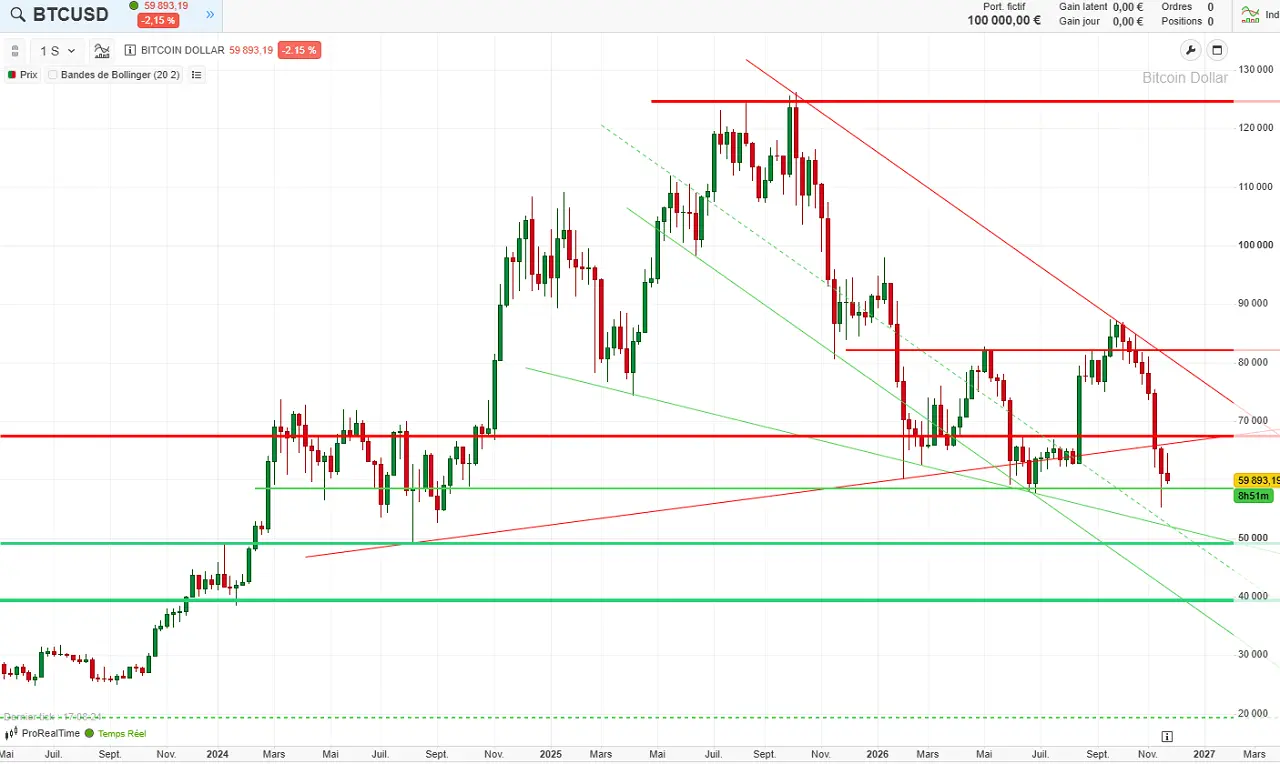
From a technical standpoint, Bitcoin’s price is currently around a major support zone between $58,000 and $60,000. This level will be particularly important to monitor in the coming days and weeks. If breached, the zone from $49,000 to $50,000 would, in our view, constitute the last line of defense before a potentially much sharper drop. Lower, the $39,500 level represents the last major horizontal support visible on our chart.
On the upside, breaking through the resistance at $67,500 would constitute an initial encouraging signal for Bitcoin’s price. However, one would need to move back above the zone of $82,000 to $84,000 to consider a genuine trend reversal. The final major resistance sits at $125,000, near Bitcoin’s all-time high.
We also observe a bearish channel on our chart. A breakout to the upside from this channel, accompanied by a move above $84,000, would strengthen the scenario of a bullish reversal for BTC. For now, technical signals remain clearly bearish, and a mere rebound would not be enough to overturn the current price trend for Bitcoin.
Daily technical analysis on BTC at the end of 2026
Is it time to invest or trade Bitcoin in the face of the decline? Café de la Bourse’s view
*Your capital is at risk. See terms on the site.
For those who already hold Bitcoin in their portfolio, the current BTC price decline can be an opportunity to implement a hedging strategy. It is particularly possible to use derivatives, such as options offered by brokers like IG or Interactive Brokers, to protect against a continued fall in BTC without having to sell your cryptocurrencies. Buying a put option, for example, can offset all or part of losses in the event of a Bitcoin drop, in exchange for paying a premium.
For more experienced traders, several strategies can also be considered:
- Bearish directional trading: taking short positions to try to profit from the continuation of the downtrend
- Bounce trading: exploiting technical rebounds near major support levels
- Breakout trading: taking advantage of market accelerations when breaking through a major support or resistance
- Volatility trading: using options to exploit Bitcoin’s volatility swings, regardless of market direction for certain strategies
The choice of strategy will, of course, depend on your trading experience, your mastery of derivatives, and your ability to manage risk. Pay particular attention to leverage, which can both amplify gains and losses.
If you are more of an investor than a trader, remember that patience is often key in the crypto world. You should neither give in to fear when Bitcoin prices fall, nor be carried away by FOMO (the fear of missing out) when the crypto market recovers. It is better to stick to a coherent long-term investment strategy aligned with your goals.
In an asset as volatile as Bitcoin, gradual investing, also known as DCA (Dollar Cost Averaging) offered by stock brokers like eToro or Trade Republic, can help smooth your purchase price and limit the risk of investing at the wrong moment, without eliminating the risk of capital loss.
How to invest in Bitcoin in practice in late 2026?

To invest in Bitcoin in 2026, two main options are available. The first is to buy cryptocurrencies directly from top crypto platforms. Notably, Bitvavo, Finst, Coinhouse, Bitpanda, Trade Republic, or eToro. Contrary to what some beginner investors might think, you do not need $60,000 to invest in Bitcoin. It is entirely possible to buy fractions of BTC for a few tens or a few hundred euros, depending on the amount you want to invest.
The second option is to invest in exchange-traded financial products, such as Bitcoin ETFs or, more precisely in Europe, Bitcoin ETPs, ETCs, and ETNs. This allows you to gain exposure to Bitcoin price movements from a regular brokerage account, without having to directly hold your cryptocurrencies. For this, you can turn to stock brokers like XTB, Saxo Bank, DEGIRO, Bourse Direct, or Freedom24, depending on the products available at each. Again, the unit price of these products typically allows investing with relatively modest amounts.
Finally, if you wish to diversify your investments within the cryptocurrency market, know that there are also crypto ETPs that replicate the performance of a basket of cryptocurrencies. You can thus invest simultaneously in Bitcoin, Ethereum, Solana, or XRP by purchasing a single financial product. This diversification, however, does not protect you against a generalized downturn in the cryptocurrency market.
The information from Cafedelabourse.com and its publications is provided for educational purposes. They do not constitute investment recommendations in any way. Readers should study the risks before making any transaction. They are solely responsible for their investment decisions.
Past performance is no guarantee of future results. Investing in equities presents a risk of capital loss.
All of our information is, by nature, generic. It does not take into account your personal situation and does not constitute personalized recommendations for the purpose of executing transactions and cannot be equated with financial investment advice, nor with any incentive to buy or sell financial instruments. The reader is solely responsible for using the information provided, and no recourse against Cafedelabourse.com’s publishing company can be made. The publishing company’s liability cannot be engaged in any case of error, omission, or inappropriate investment.
