
ETFs or trackers are exchange-traded investment products similar to mutual funds, except that they trade like stocks on an exchange such as Euronext Paris or the London Stock Exchange. There is a very wide variety of ETFs providing exposure to equities, indices, commodities, and even cryptocurrencies.
The growing popularity of ETFs has not escaped fixed income investing, and this article will explore what a bond ETF is, how a bond ETF works, and how to invest in this type of financial product on the stock market. We will also look at the advantages and disadvantages of bond ETFs, as well as our Top 5 bond ETFs that could be worth considering in 2026.
What is a bond ETF?
Similar to a stock ETF that invests in a basket of stocks selected by the fund manager (or the issuer), a bond ETF will invest in a selection of bonds. It can consist of a basket of corporate bonds, government bonds, or even a mix of both.
As with stock ETFs, bond ETFs can cover different sectors by investing in debt securities issued by companies active in one or more sectors. There are also bond ETFs limited to a single geographic area, such as the “Euro Corporate Bond” ETFs that are only invested in Europe.
“Bond” meaning “obligation” in English, this term is often used in the naming of bond ETFs.
Unlike stock ETFs, the time horizon is important for bond investments, and you will thus find bond ETFs investing over longer or shorter time frames, for example:
- ETF Bonds 0-3 years
- ETF Bonds 3-5 years
- ETF Bonds +10 years or +15 years
Generally, bond ETFs do not have an expiration date and performance will be indexed to gains from the buying and selling of bond titles by the manager, added to the interest received by the fund in the form of coupons.
However, the globally well-known issuer BlackRock has innovated by creating iBonds ETFs which have a maturity date at which the capital is repaid along with the interest. This recent innovation makes ETFs that operate closer than ever to a direct investment in bonds.
Often, this type of ETF operates on a distribution basis, not dividends here, but the coupons corresponding to the interest. Note that there are still a few accumulating bond ETFs that allow long-term investors to achieve better performance.
*Your capital is subject to risk. See terms on the site.
Why invest in a bond ETF?
The primary advantage of investing in bond ETFs is diversification. In fact, the theory is that bonds tend to move opposite to trends in the stock markets. Thus, a portfolio composed of bonds can help offset the periods of decline that major equity indices may experience, because historically bonds have often played a defensive role against stock markets, even though this correlation can vary depending on economic and monetary cycles.
Investing in bond ETFs can also be part of a reallocation strategy, especially during periods when interest rates are rising and this type of investment becomes attractive.
In extremely simplified terms, there are two market contexts:
- when interest rates are low and this benefits equity markets;
- when interest rates are high and this benefits bond markets.
Whether for a medium- or short-term strategy to capture a favorable economic context, or as part of a long-term investment to diversify, it is worthwhile to allocate a portion of capital to bonds.
While bonds typically require locking in a substantial amount, often exceeding EUR 10,000 (if not EUR 100,000), a bond ETF is much more accessible to all investors, both professionals and individuals, as there are many bond ETFs whose face value is only a few tens of euros.
The appeal of bond ETFs is therefore the democratization of a type of investment that was long inaccessible to smaller investors, previously the domain of wealth management firms.
How to choose the bond ETF to invest in?
Before you start investing in a bond ETF, you will need to take the time to determine what interests you in the wide bond market. Note that the debt market is the largest financial market in the world (far ahead of the stock market).
The first question you should ask yourself is whether you want to invest in government debt or corporate debt. By answering this question, you will have already completed half of the path in choosing your bond ETF. Nothing prevents you from choosing both!
Next, determine if you want to favor a geographic area over another.
Keep in mind that a wide range of solutions is available to investors, ranging from European corporate bonds to European government bonds, including their American equivalents.
If you can’t decide, it will always be possible to opt for an ETF offering global exposure, a bit like what a World ETF does for equities.
Then decide whether you want an ETF that pays interest or an ETF that capitalizes. This will largely be guided by your investment horizon. Thus, for a long-term investment, it could be wise to lean toward accumulation, whereas for a short-term investment, distribution would seem more logical.
With the two replication methods that exist, namely synthetic replication or physical replication, both will offer the same yield. Only bond ETFs with synthetic replication can be eligible for the PEA, while physically replicated ETFs will be the choice of those who want their investment to have a direct impact on the economic sector they have chosen.
If you choose an ETF on foreign markets, be aware that you will be exposed to currency risk, unless there exists an “EUR Hedged” version of the ETF you have chosen, in which case currency risk hedging will be integrated into the fund’s management.
To conclude, remember to compare the annual management fees which, depending on the products and issuers, can vary from 0.04% to 0.75% for this type of ETF.
How to buy a bond ETF in practice?
As with buying a stock on your broker’s platform from one of the best investment accounts or best PEA, you will be able to find a bond ETF by its Ticker or ISIN code. Thus, you can buy bond ETFs with an account opened with one of the best online brokers such as eToro or Freedom24 or a PEA opened with a stock broker such as Trade Republic, XTB or Interactive Brokers for bond ETFs or money market ETFs eligible for the PEA.
If you invest via a PEA account, make sure that the ETF you have chosen is eligible for the PEA. In fact, there is no bond ETF that is eligible for the PEA across all of the 1,139 European bond ETFs available. There is, however, a money market ETF that is eligible for the PEA; it is not purely a bond ETF, but it is the closest option if you are looking for an ETF with a very low risk for your PEA.
As with a stock purchase on the stock market, you can place a market order or a limit/stop order. Although this type of investment is more often used within a long-term “buy & hold” strategy, it is possible to set a Stop Loss and Take Profit.
Example of an order on a bond ETF
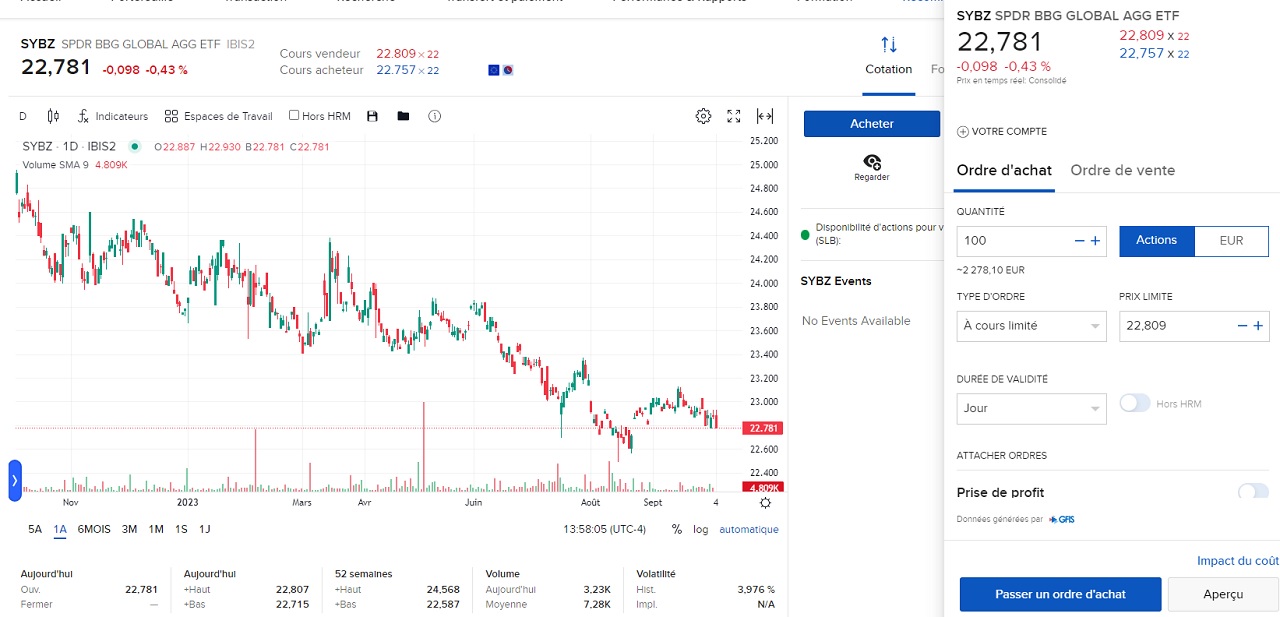
Check that the ETF you are about to buy is priced in EUR to avoid currency exchange costs, and make sure it is listed on a stock exchange from which orders with your brokerage are not too expensive.
What are the advantages and disadvantages of bond trackers? Café de la Bourse Review
The primary advantage of a bond ETF is the ability to invest easily and at a lower cost in dozens or hundreds of bonds, whereas making the same investment directly would usually require a capital of several hundred thousand euros at a minimum.
Bond ETFs allow you to diversify your portfolio across bonds that, in principle, move differently from stock markets. Bond ETF investing can also be considered less risky and more suitable for a short-term investment.
Among the drawbacks, you will find the high sensitivity of this type of investment to changes in the key interest rates set by central banks.
Also, the potential gains are often lower than what equity markets can offer.
In what bond ETF should you invest? Our Top 5 bond ETFs for 2026
Not all bond ETFs look alike.
Behind the fairly broad term “bond ETF,” there are, in fact, products that can behave very differently depending on the type of bonds held, their duration, their risk level, or the quality of the issuers.
That is precisely why we built this selection of the best bond ETFs for 2026. Rather than a uniform ranking, we chose five bond ETFs with complementary profiles, capable of addressing different needs and risk levels. Thus, we find both a very prudent government bond ETF and a convertible bonds ETF, naturally more dynamic.
To rank these bond ETFs from least risky to most risky, we mainly relied on their one-year volatility. This indicator measures the amplitude of price fluctuations of an ETF: the lower the volatility, the more stable the product is considered.
Bond ETF Ranking 2026
| ETF | Type | Volatility over 1 year | Performance over 1 year |
| ETF iShares EUR Government Bond 0-1yr | Government bonds | 0.21% | + 1.89% |
| ETF Amundi Euro Corporate SRI 0-3Y | Investment Grade corporate bonds | 0.86% | + 2.20% |
| ETF Xtrackers Target Maturity 2027 High Yield | High Yield dated ETF | 1.76% | + 4.33% |
| ETF SPDR Global Convertible Bond | Convertible bonds | 10.27% | + 33.38% |
| ETF Amundi PEA Euro Court Terme eligible PEA | Money market | 0.44% | + 1.99% |
Top bond ETF iShares EUR Government Bond 0-1yr UCITS ETF

The iShares EUR Government Bond 0-1yr UCITS ETF is invested in euro area government bonds with very short maturities between 0 and 1 year. This ETF is particularly defensive, designed to minimize volatility and sensitivity to changes in interest rates. Through this short-term approach, it almost resembles an enhanced cash management product while maintaining the relative safety of European Investment Grade sovereign bonds.
Who is the Top Bond ETF iShares EUR Government Bond 0-1yr for?
This ETF is primarily aimed at conservative investors who want to secure part of their portfolio, reduce overall volatility of their investments, or temporarily park cash with a very low level of risk.
Profile of the iShares EUR Government Bond 0-1yr UCITS ETF
- Name : iShares EUR Government Bond 0-1yr UCITS ETF
- ISIN code : IE00B3FH7618
- Ticker code : EUN6
- TER (fees) : 0.07%
- Distribution policy : Distribution
- Replication mode : Physical
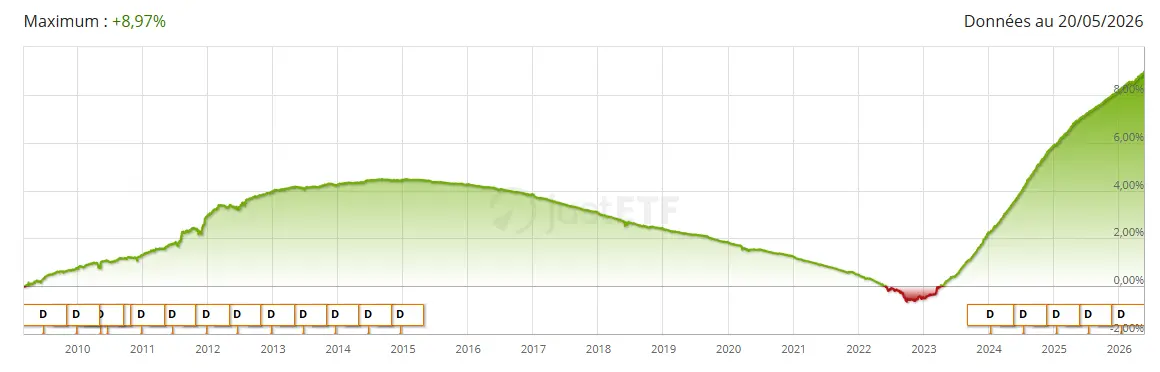
- Performance over 3 years : +8.6% approximately
iShares EUR Government Bond 0-1yr Performance
Top ETF obligataire Amundi Index Euro Corporate SRI 0-3Y UCITS ETF DR (C)

The Amundi Index Euro Corporate SRI 0-3Y bond ETF is invested in European Investment Grade corporate bonds with maturities between 0 and 3 years. The strategy of this bond ETF therefore favors financially solid companies while limiting interest rate risk through a short duration. The ETF also applies an ESG (responsible investment) approach, with an extra-financial selection of issuers.
Who is the Top Bond ETF Amundi Index Euro Corporate SRI 0-3Y UCITS ETF DR (C) for?
This ETF will suit investors seeking a compromise between security and potential return, with a lower risk than high-yield bonds while offering performance potential higher than short-term government bonds.
Identity sheet of the Amundi Index Euro Corporate SRI 0-3Y UCITS ETF DR (C)
- Name : Amundi Index Euro Corporate SRI 0-3Y UCITS ETF DR (C)
- ISIN code : LU2037748774
- Ticker code : ECRP3
- TER : 0.12%
- Distribution policy : Capitalisation
- Replication mode : Physical
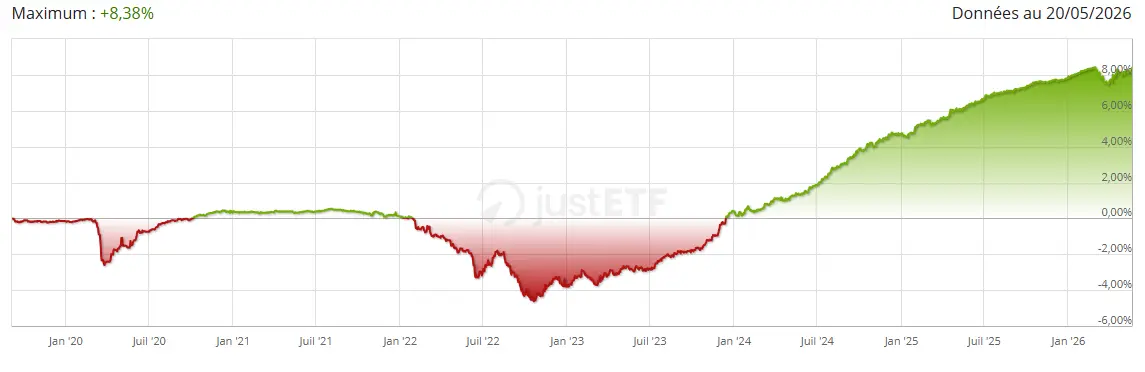
- Performance over 3 years : +11.5% approximately
Performance ETF Amundi Index Euro Corporate SRI 0-3Y UCITS
Top ETF obligataire daté Xtrackers II Target Maturity Sept 2027 EUR High Yield UCITS ETF
The Xtrackers II Target Maturity Sept 2027 EUR High Yield bond ETF is invested in a portfolio of European corporate bonds with a high-yield profile that gradually approaches maturity around September 2027. Its operation resembles that of holding a bond to maturity, with a portfolio that shortens over time. In exchange for a higher credit risk tied to the high-yield segment, this ETF aims to offer a higher potential return than classic Investment Grade bonds.
Who is the dated Xtrackers II Target Maturity Sept 2027 EUR High Yield ETF for?
This ETF is better suited for investors willing to accept a higher level of risk in search of yield, while maintaining relatively clear visibility on the investment horizon thanks to the targeted maturity.
Identity sheet of the Xtrackers II Target Maturity Sept 2027 EUR High Yield UCITS ETF
- Name : Xtrackers II Target Maturity Sept 2027 EUR High Yield UCITS ETF
- ISIN code : LU1109939865
- Ticker code : XHY1
- TER : 0.30%
- Distribution policy : Distribution
- Replication mode : Physical
- Performance over 3 years : +16.3% approximately
Performance ETF Xtrackers II Target Maturity Sept 2027 EUR High Yield

Top ETF obligataire SPDR FTSE Global Convertible Bond UCITS ETF EUR Hedged (Acc)

The SPDR FTSE Global Convertible Bond bond ETF is invested in global convertible bonds, i.e., bonds that can be converted into shares under certain conditions. This type of asset sits halfway between bonds and equities: it can benefit from a rise in stock markets while retaining a bond component. However, this hybrid structure results in significantly higher volatility than traditional bond ETFs.
Who is the SPDR FTSE Global Convertible Bond ETF for?
This ETF is aimed at dynamic investors who want to pursue greater potential returns and who are willing to accept volatility similar to that of certain equity ETFs.
Identity sheet of the SPDR FTSE Global Convertible Bond UCITS ETF EUR Hedged (Acc)
- Name : SPDR FTSE Global Convertible Bond UCITS ETF EUR Hedged (Acc)
- ISIN code : IE00BDT6FP91
- Ticker code : SPF1
- TER : 0.55%
- Distribution policy : Capitalisation
- Replication mode : Physical
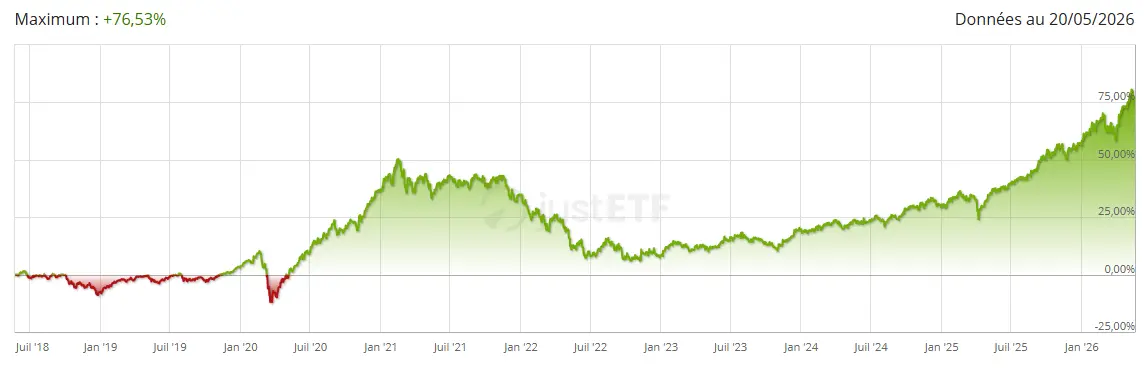
- Performance over 3 years : +57.4% approximately
Performance ETF SPDR FTSE Global Convertible Bond
Top money market ETF Amundi PEA Euro Court Terme UCITS ETF Acc

The Amundi PEA Euro Court Terme money market ETF cannot really be considered a bond ETF in the classic sense. It is more of a money market ETF, invested in the very short-term rates of the euro area. If we still chose to include it in this comparison of the best bond ETFs, it is simply because it is one of the PEA-eligible options that most closely resemble a defensive bond profile, with a generally limited level of risk. For investors who wish to temporarily secure a portion of their capital without exiting the tax framework of the PEA, this can therefore represent an interesting alternative.
This ETF invests in the euro area money market through the Solactive €STR Overnight index. It therefore aims to replicate the performance of short European rates, with very low sensitivity to interest rate changes. Unlike a traditional bond ETF, this type of money market ETF prioritizes capital stability and liquidity, with historically very low volatility. It can thus form a defensive investment solution within a PEA.
To whom is the Amundi PEA Euro Court Terme ETF for?
This ETF will suit investors seeking a low-risk cash portion in their PEA, or those looking to secure a portion of their portfolio while waiting for better opportunities in the stock and bond markets.
Identity sheet of the Amundi PEA Euro Court Terme UCITS ETF Acc
- Name : Amundi PEA Euro Court Terme UCITS ETF Acc
- ISIN code : FR0013346681
- Ticker code : OBLI
- TER : 0.25%
- Distribution policy : Capitalisation
- Replication mode : Synthetic
- Performance over 3 years : +10% approximately
Performance ETF Amundi PEA Euro Court Terme

The information from Cafedelabourse.com and its publications is provided for educational purposes. It does not constitute investment recommendations. The reader must study the risks before carrying out any transaction. The reader is solely responsible for their investment decisions.
Past performance does not guarantee future results. Investing in equities involves capital loss risk.
All our information is, by nature, generic. It does not take into account your personal situation and does not constitute personalized recommendations for the purpose of executing transactions and cannot be equated with a financial investment advisory service, nor with any incitement to buy or sell financial instruments. The reader is solely responsible for using the information provided, with no recourse against the publisher Cafedelabourse.com. The publisher Cafedelabourse.com’s liability cannot be engaged in case of error, omission or unsuitable investment.
