
While many consider Bitcoin the starting point of the cryptocurrency revolution, Ethereum has played an equally important role in developing the blockchain ecosystem through the introduction of smart contracts. This innovation has notably enabled the emergence of decentralized finance (DeFi), NFTs, and many applications built on the blockchain.
Second only to Bitcoin in market capitalization, Ether (ETH), the cryptocurrency of the Ethereum network, holds a central place in the crypto universe. What are the characteristics of Ethereum? How does it differ from and resemble Bitcoin? What is the ETH price? How to invest in Ethereum in 2026, with what strategy and through which platforms? Also discover our forecasts for the evolution of Ethereum’s price in 2026.
The 5 things you absolutely need to know about Ethereum
- Ethereum is the second-largest cryptocurrency in the world after Bitcoin
- Ethereum is the reference blockchain for smart contracts
- The Ether (ETH) has no predefined maximum supply unlike Bitcoin
- Ethereum now operates with Proof of Stake
- Ethereum is at the heart of decentralized finance (DeFi)
Comparison: best crypto platform to invest in ETH
Find our selection of the best crypto platforms, all with PSAN status, to choose your crypto exchange or crypto broker according to your investor profile.
| Top crypto brokers | Current offers | View offers |
|---|---|---|
| €15 offered in Bitcoin after your first trade. Capital at risk* | ||
| Get up to $500 of free assets. Capital at risk* | ||
| Over 600 crypto-assets available on Bitpanda. Invest from €1. Capital at risk* | ||
 |
2.00% interest on your cash + invest from €1 in cryptos with no commission via an investment plan. Capital at risk* | |
| Welcome bonus of €25. The cheapest USDC pairs on the market (0.05%). Capital at risk* | ||
| €20 off in Bitcoin. Up to 93% cheaper fees for investing in cryptos. Capital at risk* | ||
| Up to $100 in rewards on sign-up. Capital at risk* |
*See terms on the site.
What is Ethereum?
Before diving deeper into how Ethereum works and why it has captured investors’ interest, here are the essential details to know about this blockchain and its cryptocurrency, Ether (ETH).
This at-a-glance profile lets you quickly reference the core characteristics of the Ethereum network, its ETH token, and the elements that today place it at the center of the cryptocurrency ecosystem.
| Category | Information |
| Name | Ethereum |
| Ticker code | ETH |
| Creator | Vitalik Buterin |
| Launch year | 2015 |
| Asset type | Cryptocurrency / Smart contract blockchain |
| Market capitalization (June 15, 2026) | $214 billion |
| Market cap rank | Global No. 2 |
| Circulating supply | 120,684,182 ETH |
| Max supply | Unlimited (see explanation below) |
| Consensus mechanism | Proof of Stake (PoS) |
| Average block validation time | Approximately 12 seconds |
| Transaction fees | Typically under $1 |
| Main competing blockchain | Solana |
| Primary use | Smart contracts, DeFi, NFT, asset tokenization, decentralized applications (dApps), staking |
Is the number of ETH truly unlimited?
Yes. However, since the implementation of the EIP-1559 upgrade, a portion of transaction fees is burned, which regularly reduces the circulating supply.
Depending on network activity, ETH’s net issuance can become very low, or even temporarily negative. This characteristic leads some investors to consider Ethereum as a potentially deflationary asset during certain periods.
Ethereum: how does it work? How does it function?
Ethereum is a blockchain that allows not only the transfer of a cryptocurrency, the Ether (ETH), but also the automatic execution of programs called smart contracts.
To understand the appeal of Ethereum, consider a simple example. Suppose you want to rent a vacation apartment. Today, you typically go through a platform like Airbnb that acts as an intermediary: it receives your payment, verifies certain information, and transfers the money to the property owner according to pre-defined rules.
With Ethereum, part of this intermediary role can be handled directly by a computer program. The contract is recorded on the blockchain and executes automatically when the planned conditions are met. If the tenant makes the payment and the arrival date is reached, the funds can be transferred automatically to the owner, without intervention by a bank, notary, or centralized platform.
This principle of smart contracts has opened the door to many uses. Today, Ethereum is used to create financial applications, manage cryptocurrency exchanges, issue stablecoins, develop video games, sell NFTs, and tokenize real-world assets such as real estate or certain bonds.
To operate this vast ecosystem, every operation on Ethereum requires paying fees called gas fees. These fees are paid in Ether (ETH), the network’s native cryptocurrency. They compensate participants who secure the blockchain and verify transactions.
How POS works with Ethereum
Since 2022, Ethereum uses a validation mechanism called Proof of Stake (staking). Its operation can be compared to a security deposit. ETH holders who want to participate in securing the network lock up a portion of their tokens in staking. In return, they receive a reward. More precisely, these participants act as validators responsible for verifying transactions and adding new blocks to the blockchain.
This system has replaced the traditional mining previously used by Ethereum. Result: the network’s energy consumption has fallen by more than 99%, while maintaining a high level of security.
The security of the network relies on participants who lock up a portion of their cryptocurrencies to validate transactions. Since these validators have a direct financial stake in the proper functioning of the network, they have every incentive to verify transactions correctly and to follow the rules. In the event of malicious behavior or fraudulent validation, they risk losing part of their staked funds. This approach relies more on economic incentives than on the computing power used by Proof of Work.
Today, Ethereum remains the reference infrastructure for decentralized finance (DeFi) and smart contracts. Despite the emergence of competitors like Solana, it remains the blockchain at the center of much of the sector’s innovation in crypto.
What are the differences between Bitcoin and Ethereum?
Although Bitcoin and Ethereum are the two largest cryptocurrencies on the market, their goals and mechanisms are very different. Bitcoin was designed as a decentralized monetary system and store of value, while Ethereum was developed as a platform capable of hosting decentralized applications and services that run without intermediaries.
The main differences between Bitcoin and Ethereum are as follows:
- Main objective: Bitcoin primarily enables value transfer and storage, while Ethereum also enables the development of decentralized applications and smart contracts.
- Max supply: Bitcoin is capped at 21 million units, whereas Ethereum’s supply is theoretically unlimited, though a portion of ETH is regularly burned via the burn mechanism introduced in 2021.
- Validation mechanism: Ethereum has operated on Proof of Stake since 2022, while Bitcoin still uses Proof of Work based on mining.
- Economic role: Bitcoin is often likened to a form of digital gold, whereas ETH can be seen as the fuel needed for the operation of the entire Ethereum ecosystem.
- Uses: Ethereum is at the heart of DeFi, NFTs, stablecoins, and asset tokenization, while Bitcoin remains primarily used as an investment asset and store of value.
These differences explain why many investors today view Bitcoin and Ethereum as two complementary assets rather than competitors.
BTC/ETH ratio comparison: how to interpret this curve?
The BTC/ETH ratio measures the number of ETH required to buy one Bitcoin. It is an interesting indicator for comparing the relative performance of the two leading cryptocurrencies on the market.
When the ratio is high, Bitcoin outperforms Ethereum. Conversely, when the ratio falls, Ethereum typically gains ground against Bitcoin.
For example, in 2019, the BTC/ETH ratio reached around 50, signaling clear Bitcoin dominance. At that time, investors mainly favored BTC, considered the most mature and secure asset in the sector.
Between 2021 and 2024, the ratio dropped into the 12 to 19 range, reflecting strong Ethereum outperformance. This period coincided with the DeFi explosion, NFT boom, and anticipation of Ethereum’s shift to Proof of Stake.
Conversely, the ratio rose above 50 again in April 2025, signaling renewed interest in Bitcoin, driven by the advent of Bitcoin ETFs, institutional inflows, and its status as a crypto market safe haven.
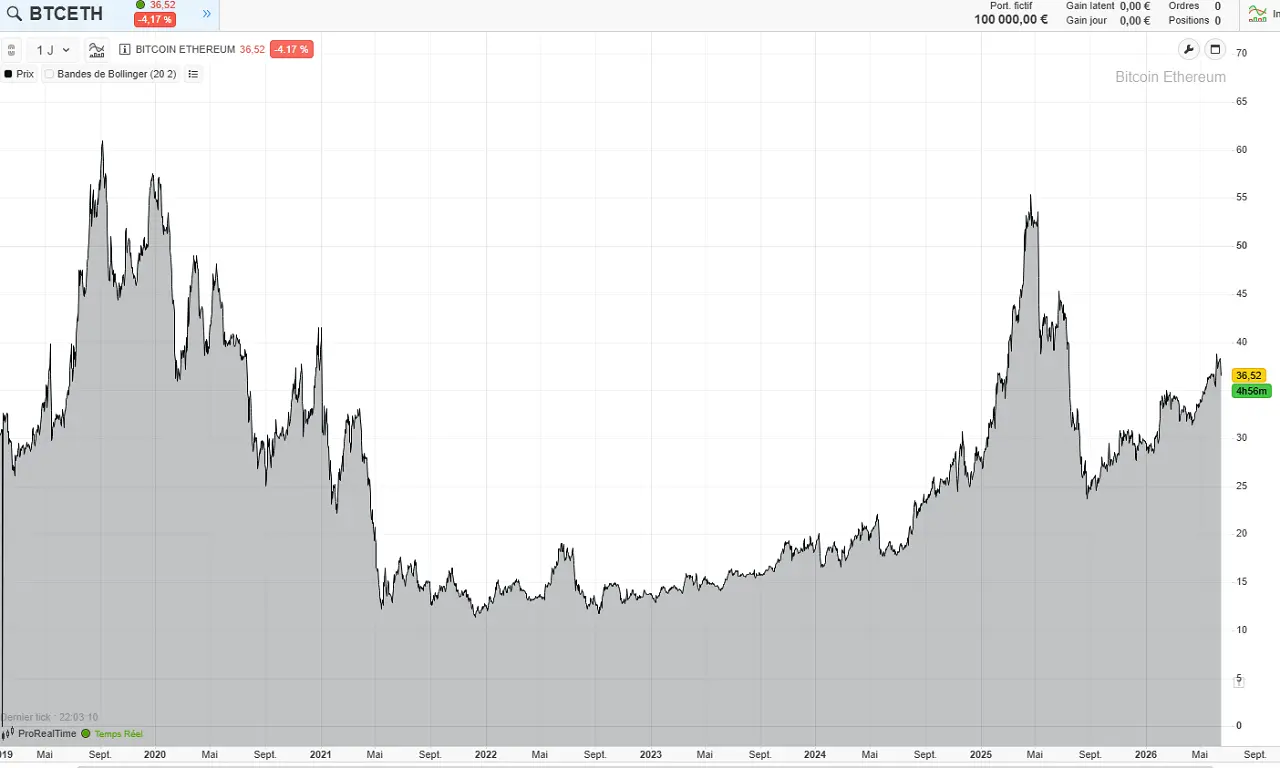
Today, with a ratio hovering around 36, the market is in an intermediate situation. Bitcoin retains a significant advantage, but Ethereum has regained part of its appeal thanks to the rise of Ethereum ETFs, staking, and the continued development of its ecosystem.
In general:
- High BTC/ETH ratio: Bitcoin domination, more cautious investors, seeking relative safety
- Low BTC/ETH ratio: Ethereum outperforms, return of risk appetite and ecosystem innovations
- Rising ratio: Bitcoin outperforms Ethereum
- Falling ratio: Ethereum gains ground on Bitcoin
Analyzing this ratio helps better understand capital rotations within the cryptocurrency market and the periods during which investors favor either Bitcoin’s relative safety or the growth potential offered by Ethereum.
Ethereum: what technological evolutions?

Since its launch in 2015, Ethereum has undergone numerous evolutions aimed at improving its performance, security, and capacity to host an increasing number of users. Unlike some blockchains that evolve little over time, Ethereum regularly undergoes major updates.
The most significant technological evolutions are bolded in the table below:
| Date | Upgrade | Key evolution |
| July 2015 | Frontier | Official launch of the Ethereum network |
| March 2016 | Homestead | First version deemed stable enough for broader use |
| October 2017 | Byzantium | Improved security, privacy, and preparation for future network evolutions |
| February 2019 | Constantinople | Performance optimizations and reduced calculation costs on the network |
| December 2019 | Istanbul | Improved compatibility with other blockchains and optimization of transaction fees |
| August 2021 | London (EIP-1559) | Introduction of burning part of transaction fees, permanently altering ETH economics |
| December 2021 | Arrow Glacier | Delay of the “difficulty bomb” to prepare the transition to Proof of Stake |
| September 2022 | The Merge | Historic event: abandoning Proof of Work (mining) in favor of Proof of Stake
More than 99% reduction in the network’s energy consumption |
| April 2023 | Shapella (Shanghai + Capella) | Allowing withdrawals of ETH staked |
| March 2024 | Dencun | Introduction of proto-danksharding aimed at reducing Layer 2 costs for Arbitrum, Optimism, or Base |
| 2025 | Pectra (gradual rollout) | Improved user experience, optimized staking, and preparation for future scalability evolutions |
The importance of Ethereum for smart contracts
If Bitcoin demonstrated that value could be transferred without going through a bank, Ethereum took a further step by enabling automatic execution of contracts through smart contracts. For many observers, this is where the true blockchain revolution lies.
A smart contract can be likened to a traditional contract whose execution is entirely automated. Take the example of travel insurance. Today, when a flight is canceled, the passenger typically fills out a claim, provides supporting documents, and waits for the insurer to process the request. With a smart contract, compensation could be triggered automatically as soon as an official database confirms the cancellation. No advisor, no manual validation, and no administrative delay would be required.
Another example: when selling real estate, several intermediaries typically verify documents, secure funds, and validate the transfer of ownership. In the long run, part of these operations could be automated by smart contracts executed on a blockchain like Ethereum.
This ability to automatically execute predefined rules opens the door to a multitude of applications in finance, insurance, real estate, logistics, or asset management. It is thanks to this innovation that decentralized finance (DeFi), NFTs, stablecoins, and the first real-world asset tokenization projects emerged.
More than just a cryptocurrency, Ethereum has thus become an infrastructure for creating a new generation of digital services that operate without intermediaries.
The role of Ethereum in DeFi
For decades, we have relied on intermediaries to manage our money. To save, borrow, exchange currencies, or make a payment, you usually go through a bank, broker, or another financial institution. Decentralized finance, commonly known as DeFi, offers a different approach.
Imagine you want to lend money and earn interest. In the traditional financial system, you deposit your money in a bank, which then lends it to other customers. With DeFi, this intermediary role largely disappears. The rules are directly managed by computer programs running on the Ethereum blockchain. Lenders and borrowers can interact directly with each other, according to predefined rules accessible to all.
Another example: when you exchange euros for dollars, you usually go through a bank or currency exchange. In DeFi, there are platforms that enable direct peer-to-peer exchange of digital assets without a central organization validating the operation.
Of course, DeFi is not without risks and remains a complex space for beginners. But its potential is considerable. Just as the Internet allowed anyone to access information without going through traditional media, DeFi aims to make certain financial services accessible to everyone, anywhere, at any time.
Ethereum occupies a central place in this revolution. It is on this blockchain that most early decentralized finance services were developed.
Today, a large portion of applications for borrowing, lending, trading, or investing in digital assets still rely on the Ethereum ecosystem. For this reason, many investors consider Ethereum to be much more than a cryptocurrency: it is one of the major infrastructures of tomorrow’s digital finance.
What can you buy with Ethereum?

In practice, it is possible to buy many things with Ethereum: some merchants accept ETH as payment, there are bank cards enabling automatic spending of cryptocurrencies, and certain specialized platforms even offer to purchase travel, services, or gift cards with digital assets. Technically, if a seller accepts ETH, you can use it as a method of payment.
But that is not really why Ethereum was created.
Unlike Bitcoin, which was designed from the outset as an independent digital currency for banks and governments, Ethereum was conceived to meet a different need. Its creator, Vitalik Buterin, primarily wanted to build an infrastructure capable of hosting decentralized applications and smart contracts.
To understand the difference, one could draw an analogy with the traditional economy. Bitcoin resembles more of a form of digital gold: an asset held mainly to store value or to transfer funds. Ethereum, on the other hand, is more like a kind of digital oil. You do not necessarily buy it to spend every day, but because it is essential to the operation of an entire ecosystem.
Every time a user performs an operation on Ethereum, exchanges assets on a DeFi platform, creates an NFT, or uses an application built on this blockchain, they must pay fees in ETH. The more Ethereum’s ecosystem is used, the higher the demand for Ether can rise.
This is one of the main differences between Bitcoin and Ethereum. While Bitcoin’s value largely rests on its role as a store of value, Ether’s value is closely linked to the economic activity developing on its network.
How far can Ethereum go in 2026? Our view and technical analysis

With cryptocurrencies, it is often harder to determine a theoretical value than for a stock traded on a stock market. There are indeed indicators to assess the health of a network like Ethereum, but they do not always reach consensus among investors. For this reason, we will primarily rely on technical analysis to identify the main levels to watch and the possible scenarios for Ethereum’s price in 2026.
Long-term Ethereum price analysis
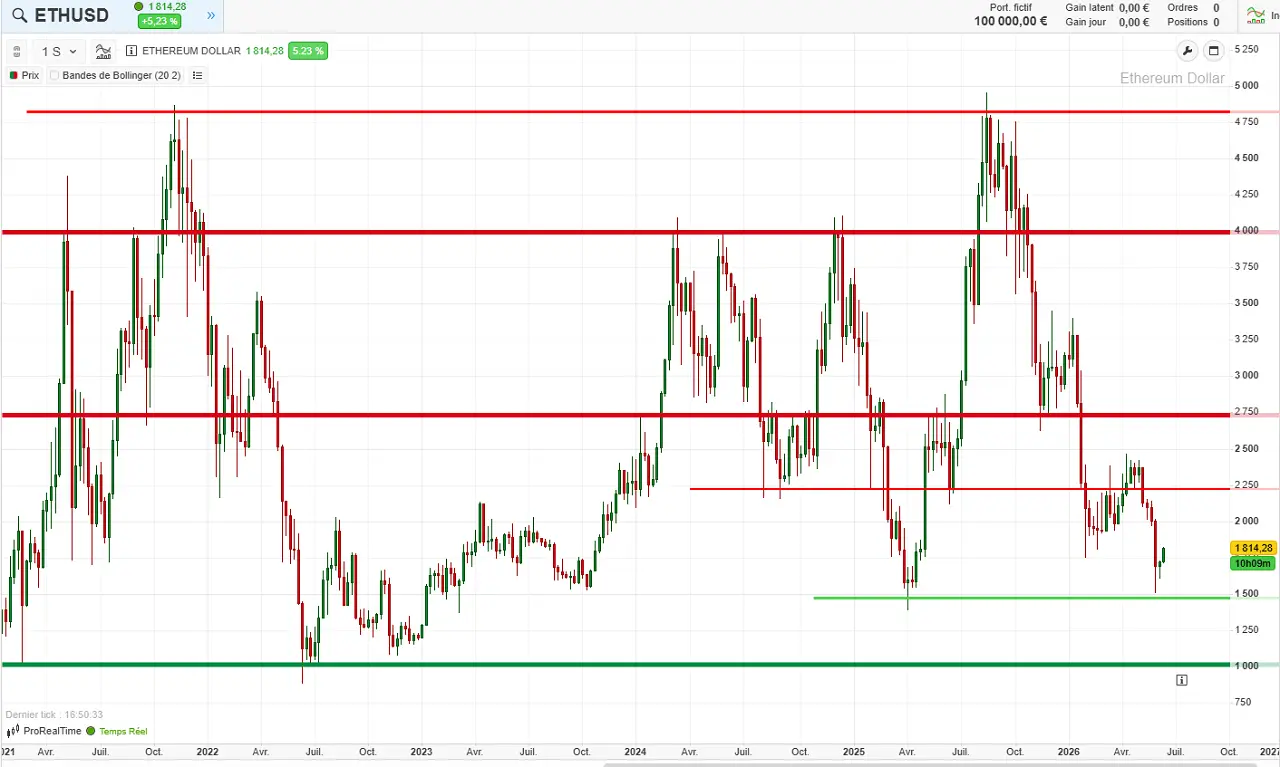
From a chart perspective, Ethereum has evolved for several years in a sequence of clearly identifiable upward and downward phases. Notably, there was a first major uptrend between March 2021 and November 2021, followed by a second between May 2025 and October 2025. Conversely, two significant correction periods can be observed between December 2021 and July 2022, and between September 2025 and June 2026.
One of the most interesting chart elements remains the presence of a major support around $1,500. This level dates back to February 2021 and was tested several times during 2022. It also appeared in October 2023, before playing a decisive role during the sharp correction of April 2025. More recently, this support again halted the decline in June 2026, triggering a price rebound. The more a support is tested over time without breaking, the more it tends to gain importance in the eyes of technical analysts.
If the rebound continues, an initial resistance can be identified around $2,200, which constitutes the first technical objective to watch. Above that, investors will contend with a second resistance located around $2,750. Then, the entire zone between $3,800 and $4,000 could impede price progression. This zone corresponds to several turning points observed in recent years and is likely the main resistance on the chart. Finally, the last major level visible at this stage is the Ethereum’s previous all-time high, at $4,833.
Currently, ETH is moving in the lower part of its long-term range observed over the past five years. Chart-wise, the trend will only be considered sustainably bullish if there is a successive breakout through these various resistances. As long as these levels are not surpassed, the market remains technically in a reconstruction phase after the correction started in late 2025.
Long-term Ethereum technical analysis
Short-term Ethereum price analysis
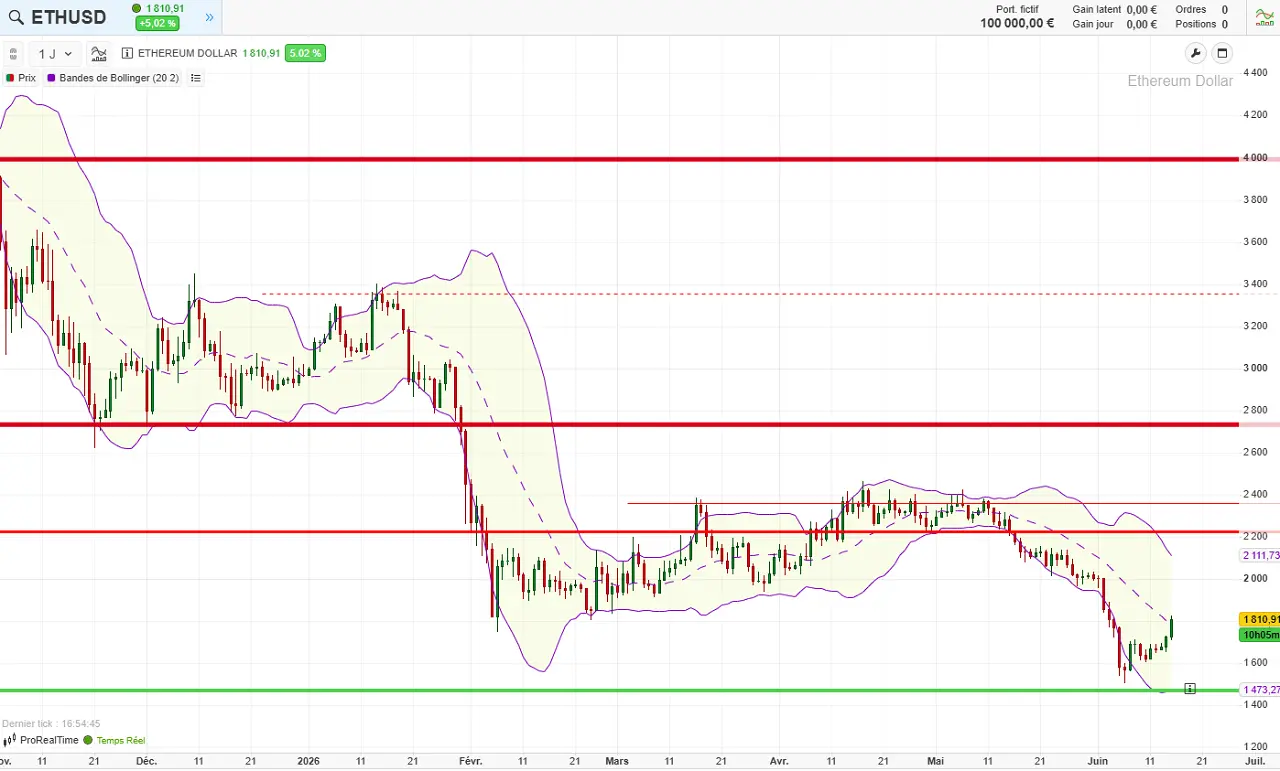
On a daily chart, several previously mentioned levels continue to hold significance. The $2,750 resistance and the $3,800–$4,000 zone remain the main obstacles to a sustainable rebound in the uptrend. However, the shorter-term analysis allows identifying intermediate levels that could serve as targets before these major price levels.
Thus, an initial intermediate resistance appears around $3,350, marked on the chart by a dotted zone. Closer to current prices, two other resistances also deserve attention: $2,230 and $2,365. These levels could constitute the first objectives if the rebound started from the $1,500 support continues.
The analysis of Bollinger bands also provides interesting insights into current market behavior. After a period of very high volatility observed in February 2026, characterized by a wide band spread, Ethereum’s price entered a long consolidation phase from March to late May. During this period, Bollinger bands gradually narrowed, signaling a return to calm and a significant drop in volatility.
Since the beginning of June, the situation has evolved. The bands have started to widen again, signaling a return of volatility to the market. At this stage, the price is trading near the middle band, represented by the central moving average. This setup is particularly interesting because it shows the market is not currently in overbought territory near the upper band nor oversold near the lower band.
From a chart perspective, this relatively neutral position still leaves ample room for future directional moves. In other words, prices remain distant from the Bollinger bands’ extremes, which leaves the door open for new acceleration phases, both upward and downward, in the coming weeks.
Short-term Ethereum technical analysis
Summary table of important technical levels on Ethereum
| Type | Level | Commentary |
| Major support | $1,500 | Historical support tested since February 2021 It has contained declines in 2022, October 2023, April 2025, and again in June 2026 |
| Short-term resistance | $2,230 | First bullish objective to watch if the current rebound continues |
| Short-term resistance | $2,365 | Second technical short-term objective visible on the daily chart |
| Medium-term resistance | $2,750 | Resistance level observed on medium- and long-term charts |
| Medium-term resistance | $3,350 | Technical intermediate level identified on the daily chart |
| Major resistance zone | $3,800 to $4,000 | Key zone that has repeatedly acted as support and resistance over the last five years |
| Historical resistance | $4,833 | Ethereum’s all-time high (ATH) – final graphical obstacle before a potential price discovery phase |
Does Ethereum move in cycles?
Even though Ethereum does not have a halving event like Bitcoin, its price has historically evolved through major bullish and bearish cycles. These movements are generally linked to the overall evolution of the cryptocurrency market, as well as innovations within the Ethereum ecosystem.
Since its 2015 launch, several euphoric phases have succeeded one another. The first appeared in 2017 with the ICO (Initial Coin Offering) wave, these fundraising events conducted directly on the Ethereum blockchain. Between 2020 and 2021, a new bullish cycle was driven by the DeFi and NFT boom.
More recently, the development of Ethereum ETFs, asset tokenization, and Layer 2 networks fuels a new adoption cycle.
Like most financial assets, Ethereum typically cycles through four major phases:
- an accumulation phase, during which the most convinced investors strengthen their positions after a sharp decline;
- a rising phase, marked by the gradual entry of new investors;
- a euphoria phase, where optimism sometimes becomes excessive and valuations soar;
- a correction phase, during which the market purges the excesses of the previous cycle.
Unlike Bitcoin, whose cycles are often linked to halvings, Ethereum’s cycles are more influenced by the adoption of its technologies and the development of new uses.
This is also what makes it unique: ETH’s value depends less on a programmed scarcity mechanism than on the economic activity developing on its network. The more Ethereum attracts developers, users, and capital, the higher the potential demand for ETH can rise. This close relationship between innovation and valuation explains why Ethereum’s cycles are often more pronounced, yet also more volatile than cycles observed in many traditional assets.
How to invest and trade Ethereum in practice?
There are several options to buy Ethereum directly or indirectly. First, many stock brokers offer access to derivative products. This includes stock brokers such as IG, XTB, Saxo Bank, Interactive Brokers, etc. Be aware that derivative products allow short-term trading of virtual currencies and require a deep understanding of financial markets.
ETPs (exchange-traded products, similar to ETFs) on Bitcoin and Ethereum are also now available on the Paris Bourse. Since early June 2021, VanEck, 21Shares, CoinShares, and WisdomTree offer ETPs with the two largest cryptocurrencies as underlyings: BTC and ETH.
Next, there are stock brokers that also offer direct crypto purchases, such as eToro or Trade Republic, as well as crypto exchanges specializing in cryptocurrencies such as Binance, Coinbase, Coinhouse, Bitpanda, etc. These are generally the preferred means to invest in cryptocurrencies over the medium to long term. These brokers and crypto platforms allow you to buy or sell a wide range of cryptocurrencies, including Ethereum. Transaction fees vary considerably (see our guide and comparison of crypto brokers and exchanges). Also note that some platforms charge capital withdrawal fees.

FAQ: everything you need to know about Ethereum
Ethereum (ETH) is a decentralized exchange protocol that, through a Turing-complete language, enables users to set up smart contracts. It is also the network behind the Ether cryptocurrency, this digital asset that challenges Bitcoin and is based, like it, on blockchain technology.
To invest in Ethereum, you can either buy tokens or go long or short on Ether via derivative products. Online brokers like eToro, IG, or XTB allow you to trade cryptos, and specialized platforms like Coinbase or Binance allow you to purchase digital currencies.
Investing in Ethereum is a must if you want to invest in cryptocurrencies. Investing in Ethereum allows you to diversify by positioning yourself on one of the most important digital currencies, which closely tracks Bitcoin’s movements while exhibiting higher volatility.
All our information is, by nature, generic. It does not take into account your personal situation and does not constitute personalized recommendations for executing transactions, nor can it be regarded as financial investment advice or an invitation to buy or sell financial instruments. The reader is solely responsible for using the information provided, and Cafedelabourse.com cannot be held liable. The publisher cannot be held responsible for errors, omissions, or ill-timed investments.
