
A few years ago, Solana was often described as a mere “Ethereum killer.” Since then, the project has far surpassed that status.
Despite the turbulence that the crypto market has known and the collapse of some major players in the sector, the Solana blockchain has remained in the leading pack of the most valuable cryptos. Its speed of execution, its very low transaction costs and the growing activity of its ecosystem have allowed it to maintain a premium place with investors.
However, investing in Solana is not just about betting on a fast blockchain. What are the real strengths of the project? What risks should be considered before buying SOL? And above all, does Solana still have growth potential after its spectacular development in recent years?
In this article, we propose to revisit how the network works, its advantages, its limits, the different ways to invest in SOL and the prospects for this cryptocurrency.
What is Solana?
Before examining in more detail how Solana works and its potential, here are the main information to know about this cryptocurrency.
This technical sheet provides at a glance the essential characteristics of the project, of its SOL token and of its operation.
| Category | Information |
| Name | Solana |
| Ticker | SOL |
| Launch year | 2020 |
| Asset type | Native cryptocurrency of a Layer 1 blockchain |
| Market capitalization | About $41 billion |
| Market cap rank | Top 10 global cryptocurrencies |
| Circulating supply | 579,941,378 SOL |
| Total supply | 628,433,398 SOL |
| Max supply | Unlimited (see explanations under the table) |
| Consensus mechanism | Proof of Stake (PoS) and Proof of History (PoH) |
| Average validation time | A few seconds |
| Transaction fees | Generally less than $0.01 |
| Main competing blockchain | Ethereum |
| Primary uses | DeFi, NFT, payments, decentralized applications (dApps), memecoins |
Explanation about the unlimited number of SOL tokens:
Unlike Bitcoin, whose supply is capped at 21 million units, Solana does not have a hard cap embedded in its protocol. A theoretical supply is implied by the current monetary mechanism, but the network rules could be changed in the future by the protocol governance. In practice, there is therefore no maximum cap comparable to Bitcoin.
Solana: how does it work?
To understand how the Solana Network operates, we must first examine the components that make up this protocol. Among these components, we can highlight the following.
The Solana consensus protocol “Proof of History” (PoH)
Proof of History (PoH) is Solana’s consensus protocol; it is the cornerstone of Solana, since this protocol enables processing at high speed and with security.
PoH is one of Solana’s main innovations. Contrary to a common belief, it is not the network’s consensus mechanism per se, but a cryptographic timestamping system that works alongside Proof of Stake (PoS). Its role is to allow validators to verify the order of transactions more quickly by using time as a common reference.
The Verifiable Delay Function validation process of Solana
For a PoH validator to operate on the network, it must perform a certain staking that gives it the power to vote within the network; the validation process uses Verifiable Delay Functions as an extra security measure beyond the simple lottery typically seen in most PoS algorithms.
In this sense, Solana’s PoH Verifiable Delay Function works in two ways:
- it allows you to order network transactions chronologically so they are followed exactly in that order;
- it creates a cryptographic system inherently tied to the time in which the transactions are made, taken and verified by the network. This is possible because Verifiable Delay Functions use the transient parameters of transmissions (Tx) to execute a unique cryptographic function to guarantee their validity.
The practical operation of Solana
Concretely, imagine thousands of users sending transactions on the Solana network in the same second. On some blockchains, part of the work involves first determining precisely the order in which these operations arrived before they can be validated. Solana simplifies this step thanks to its built-in timestamping system. The network already has a common temporal reference that allows it to quickly know which transaction arrived first.
It is like a counter at a counter where each document would automatically receive a number and an arrival time as soon as it is deposited. It becomes much easier to process cases in the correct order, without wasting time checking which arrived first. This organization is what enables Solana to process a large number of transactions quickly while maintaining a high level of security and generally very low fees.
Solana price today
How much is Solana? Discover the SOL price in dollars in our quotes table.
https://api.stockdio.com/visualization/financial/charts/v1/HistoricalPrices?app-key=FF10210C6A444EA49F4A968EDECA2159&stockExchange=CRYPTO&symbol=SOL%2FUSD&displayPrices=Candlestick÷nds=true&splits=true&culture=French-France&palette=Financial-Light&width=100%25" width="100%" height="420" frameborder="0" scrolling="no
Solana’s technological advantages
The main issue with most current blockchains is that they support very few transactions per second (TPS).
For example, Bitcoin handles between 3 and 7 transactions per second and Ethereum between 15 and 30. Once these figures are surpassed, the network has no choice but to become congested.
What does that mean? That transaction fees rise so that these transactions are validated ahead of others.
According to its developers, Solana can exceed 65,000 transactions per second, which would make it the fastest network in existence. In practice, Solana processes between 1,000 and 4,000 transactions per second.
Gulf Stream: a system that moves failing or unconfirmed transactions to the edge of the network
Moreover, Solana includes Gulf Stream, which eliminates the mempool used in certain cryptocurrencies such as Bitcoin and Ethereum, so that Solana distributes transactions among validators even before they have finished validating the previous batch of transactions. This enables reaching maximum speed and as many transactions as possible simultaneously.
Turbine: a protocol that enables rapid and easy propagation of information among nodes
Furthermore, Solana also has the Turbine protocol, which propagates blocks so that information delivery to nodes is facilitated, because the Solana protocol only takes about 0.5 seconds per block. Turbine splits block data into small sections sent by the network and tells nodes the content to construct the block.
If, by coincidence, a node does not have the necessary information to create a block, it can request it from the rest of the network in parallel, thereby reducing bandwidth.
Solana trading volume
The expansive Solana ecosystem
The success of a blockchain does not depend solely on its technology. It also requires developers, companies and users to want to build on it. In this regard, Solana has succeeded in its bet.
Over the years, thousands of projects have appeared in domains as varied as decentralized finance (DeFi), NFTs, blockchain games, payments or asset tokenization.
Among the best-known applications in the ecosystem are Jupiter, Raydium, Kamino, Jito, Drift, Helium, and Pyth Network. This sustained activity partly explains why Solana has remained one of the most used blockchains despite the turbulence the crypto market has experienced in recent years.
Every day, billions of dollars flow through the various applications built on the network, demonstrating adoption that goes beyond sole speculation on SOL’s price.
Solana’s technological drawbacks
Solana: a blockchain still under development
Although Solana has progressed significantly since its launch, the network continues to evolve rapidly. New updates are regularly deployed to improve performance, stability and security of the infrastructure.
Like most major blockchains, Solana remains a project in permanent development.
The high requirements for validators
Solana pays a price for its speed: validator requirements are very high (validators are computers that help operate the Solana network).
While in theory anyone can run a Solana validation node, the cost of building, running and maintaining such a machine will drive many users away. In theory, this makes the network less decentralized, as more power concentrates in the hands of fewer users.
This could cause other problems. For example, validation nodes that are not sufficiently powerful to handle network activity can cause slowdowns or instability, which occasionally occurs in Solana.
Solana: a network younger than Ethereum
Despite its strong growth, Solana remains younger than Ethereum and has a more limited track record. The network has notably experienced several outages or slowdowns during its development, even if its stability has significantly improved in recent years.
As with any blockchain, the risk of technical failures or vulnerabilities cannot be entirely ruled out.
How far can Solana go in 2026? Our view and technical analysis

Solana’s price has been going through a difficult period since September 2025. After several months of decline, the market began showing signs of stabilization from February 2026. Between February and May, prices moved within a relatively tight trading range, reflecting a kind of hesitation between buyers and sellers. This consolidation phase was eventually broken in June. The breakout happened to the downside, but buyers quickly regained control around a support zone near $62.
Since this rebound, SOL has risen above $71 and is now attempting to approach $78.70, a level that had previously served as support and now acts as resistance. If prices manage to re-enter the former range, that would already be a fairly positive signal for the future. The next step would then target around $97, a significant technical level located just below $100.
Beyond that, the next resistances appear between $119 and $125, then around $145 and $176. Further out, a move back toward the $250–$262 zone would allow it to reach levels seen during previous market euphorias.
Solana technical analysis
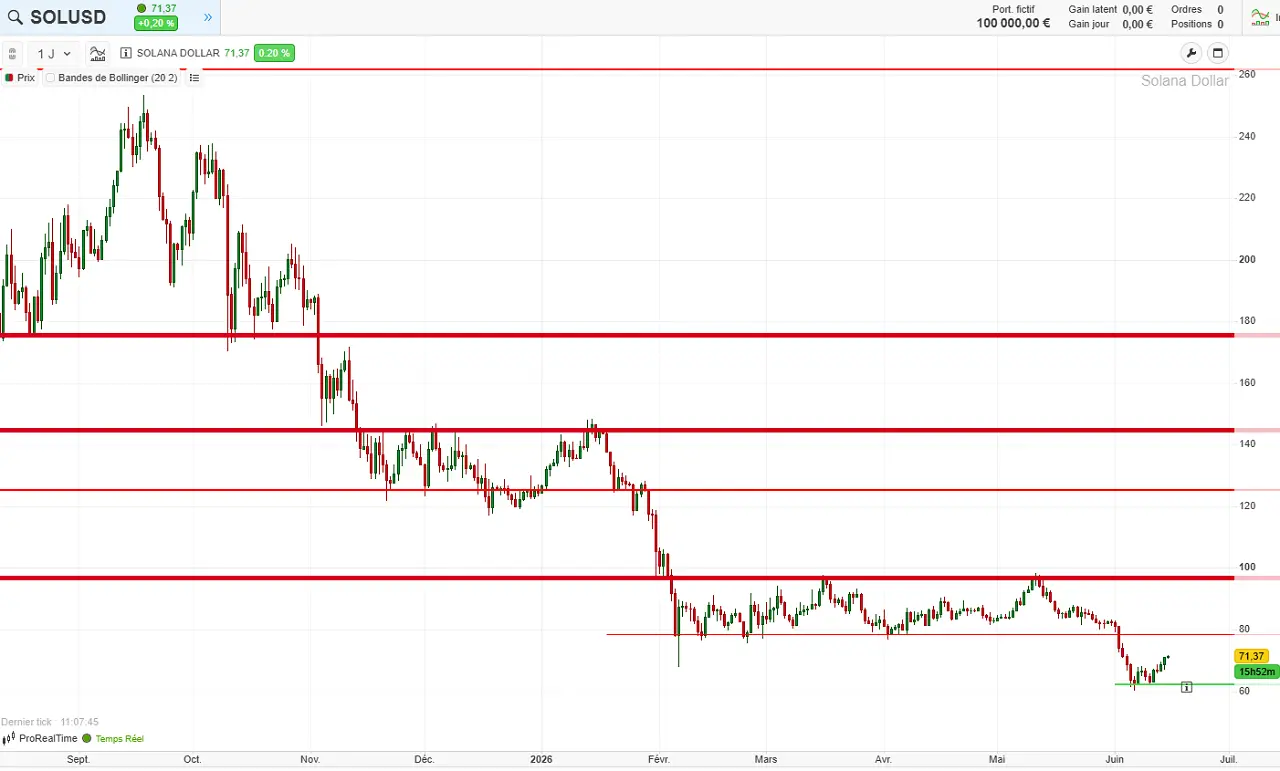
Table of the main technical levels on Solana
| Type | Level | Comment |
| Major support | 62 $ | Zone where buyers have recently regained control after the downside breakout from the trading range |
| Intermediate resistance | 78,70 $ | Former support turned into resistance, first hurdle to clear to improve the technical setup |
| Near-term major resistance | 97 $ | Important technical level observed on the chart |
| Psychological resistance | 100 $ | Symbolic threshold likely to attract investor attention |
| Resistance zone | 119 – 125 $ | First objective area if the rebound continues |
| Intermediate resistance | 145 $ | Level likely to trigger profit-taking |
| Major resistance | 176 $ | Last major resistance before a return to cycle highs |
| Psychological resistance | 250 $ | Round-number zone likely to slow progress |
| Historical resistance | 262 $ | Last resistance before the all-time highs |
How to invest in Solana?
Today there are several ways to gain exposure to Solana, depending on your investor profile and goals. Some will prefer direct purchase of SOL tokens to hold long term, while others will prefer trading or staking to try to generate supplementary income. Here are the main solutions to invest in Solana.
How to buy and trade Solana?
To invest in Solana, the simplest approach is usually to buy SOL tokens directly on a cryptocurrency exchange. This operation is carried out on the spot market, which means you actually purchase the tokens and become the owner.
French investors today have a wide choice of platforms to buy Solana. Coinbase, eToro, Bitpanda, Trade Republic, Bitvavo, Finst or Binance all provide easy access to SOL. Some favor a simple approach aimed at long-term investors, while others also offer more advanced features such as futures, perpetual futures, or leverage for trading.
Once the tokens are purchased, they can be kept directly on the platform or transferred to a personal crypto wallet. Some investors favor cold storage, which consists of storing crypto assets offline on a hardware wallet to bolster security.
Before opening an account, it is advisable to compare fees, deposit methods, staking possibilities, custody solutions and available trading tools. Differences can be significant depending on whether you simply want to buy and hold Solana or engaging in more active trading.
Investing in Solana with exchange-traded products
Direct purchase of SOL tokens is not the only way to gain exposure to Solana.
Over the past years, the offer of crypto-backed financial products has significantly expanded. Investors can notably use ETPs (Exchange Traded Products), which track Solana’s price without requiring opening an account on a crypto exchange or managing a digital wallet. Firms such as 21Shares, CoinShares, VanEck, Wisdomtree or Bitwise offer several ETPs allowing exposure to the main cryptocurrencies.
More active investors can also use other financial instruments such as certificates, options or futures. These products enable both bullish and bearish bets, sometimes with leverage. They are suited for sophisticated investors, as gains and losses can be amplified versus a straightforward spot investment.
How to stake Solana
Beyond buying and holding SOL tokens, it is also possible to generate supplementary income through staking. This practice involves locking up your crypto to participate in securing the Solana network and, in return, receiving rewards in the form of additional tokens.
While it used to require relatively technical solutions, staking has become much more accessible today. Many platforms, such as Bitpanda, Bitvavo, Finst or Binance, now offer staking solutions for Solana directly from their interface in a few clicks.
It is even possible today to combine exposure to Solana’s price with staking income via certain specialized ETPs. This is notably the case with the 21Shares Solana Staking ETP (Ticker: ASOL, ISIN: CH1114873776), a Solana-backed financial product that tracks SOL while reinvesting the staking rewards into the product’s value.
What forecast for Solana?
Forecasts for Solana vary significantly from one analyst to another, but several recognized market players remain optimistic about the blockchain’s long-term potential. Here are some recent estimates published by market professionals.
Geoffrey Kendrick, head of research on digital assets at Standard Chartered:
“We target a price level of $250 for Solana by the end of 2026 and $2,000 by 2030.”
Matthew Sigel, head of research on digital assets at VanEck:
“In our most optimistic scenario, Solana’s valuation could exceed $3,000 by 2030 if network adoption continues to grow strongly.”
Anthony Scaramucci, founder of SkyBridge Capital:
“I think [sooner or later] Solana will surpass Ethereum in market capitalization.
These forecasts are of course not certainties. Like all cryptocurrencies, Solana remains a particularly volatile asset whose evolution will depend on the adoption of its blockchain as well as the global economic, regulatory and financial environment.
All our information is, by nature, generic. It does not take into account your personal situation and does not constitute personalized investment advice, nor any encouragement to buy or sell financial instruments. The reader is solely responsible for the use of the information provided, and Cafedelabourse.com cannot be held liable for any error, omission or inappropriate investment.
