
What is a family office? Who is this type of structure for? What are its missions and how does it support great fortunes in managing, protecting and transmitting their wealth? Which investments do family offices favor in 2026?
For a long time reserved for the largest industrial dynasties, the family office gradually opened up to entrepreneurs who had sold their business and to individuals with substantial financial wealth. A true conductor of wealth management, it coordinates investments, taxation, transmission, family governance, and philanthropy, drawing on a network of independent experts.
In 2026, Family Offices continue to play a major role in financing the real economy. According to the 11th AFFO/EY Barometer, they particularly favor private equity, innovative companies and profitable growth strategies, in a context marked by geopolitical and fiscal uncertainties.
Operation, services offered, fees, eligible profiles, preferred investments and major 2026 trends: Café de la Bourse explains everything you need to know about family offices.
Family office: what to remember in 30 seconds
- A family office supports large fortunes in the overall management of their wealth.
- It can be a single family office (one family) or a multifamily office (several families).
- Its services cover notably investments, taxation, transmission, family governance and philanthropy.
- It is generally aimed at assets above €10 million;
- In 2026, private equity remains the leading asset class for Family Offices.
Quels sont les différents types de family office ?
A family office is a private structure dedicated to preserving and developing the family wealth of the very wealthy. There are several types of family offices that we will detail.
Qu’est-ce qu’un single family office ?
Family offices emerged at the end of the 19th century in the United States, at the initiative of large industrial families such as the Rockefellers who needed to have an internal team of professionals to preserve and develop their family wealth as well as to manage their daily and administrative affairs. This type of structure is called a single family office or mono family office. Their role is to be the unique interlocutor for all the family’s concerns—from the legal to the fiscal, including luxury concierge services “art of living.”
Qu’est-ce qu’un multifamily office ?
Over the years, multifamily offices have developed. These structures external to the family operate on behalf of several wealthy clients. Usually composed of about a dozen people at most, multifamily offices are small structures whose main mission is to structure the wealth and manage their clients’ assets. European multi-family offices serve around thirty families on average.
We interviewed several multifamily offices which exhibit some similarities. Their leaders are often former executives of private banks or investment banks. Multifamily offices have offices in several cities: London, Geneva, Hong Kong and Singapore, among others. Their clientele is highly international, comprising Europeans, Americans, Russians, Chinese and Emiratis. Nowadays, more than a third of their clients are industrialists who have sold their companies. This entrepreneurial clientele, labeled “new money” as opposed to the “old money” clients of the grandes familles, is currently the most dynamic, say the family officers surveyed.
Qu’est-ce qu’un family office de banque privée ?
Private banks like Edmond de Rothschild also offer, within their structure, a family office for their wealthiest clients. Switzerland’s second private bank, Lombard Odier, also launched a family office-type structure: Cité Gestion.
The 2008 crisis appears to have triggered a transformation of wealth management. Thus, private banks have reclaimed the strengths of the family office to regain client trust and intensify personalization and proximity between the financial advisor and the client.
Comparatif des différents types de family offices
| Type | Clients | Wealth | Particularity |
| Single Family Office | One family | Very large | Dedicated team |
| Multi Family Office | Several families | >€10M | Cost sharing |
| Family Office de banque privée | Private bank clients | Variable | Integrated service |
Quels sont les plus grands family offices européens ? TOP 10 family offices 2026
- Square Capital (Multi Family Office)
- Baltisse (Single Family Office)
- 1875 Finance (Multi Family Office)
- Julen Group (Single Family Office)
- HQ Trust (Multi Family Office)
- Stanhope Capital (Multi Family Office)
- Korys (Single Family Office)
- Canica (Single Family Office)
- La Financière Saint James (Single Family Office)
- Occident Group AG (Single Family Office)
Que propose un family office ?
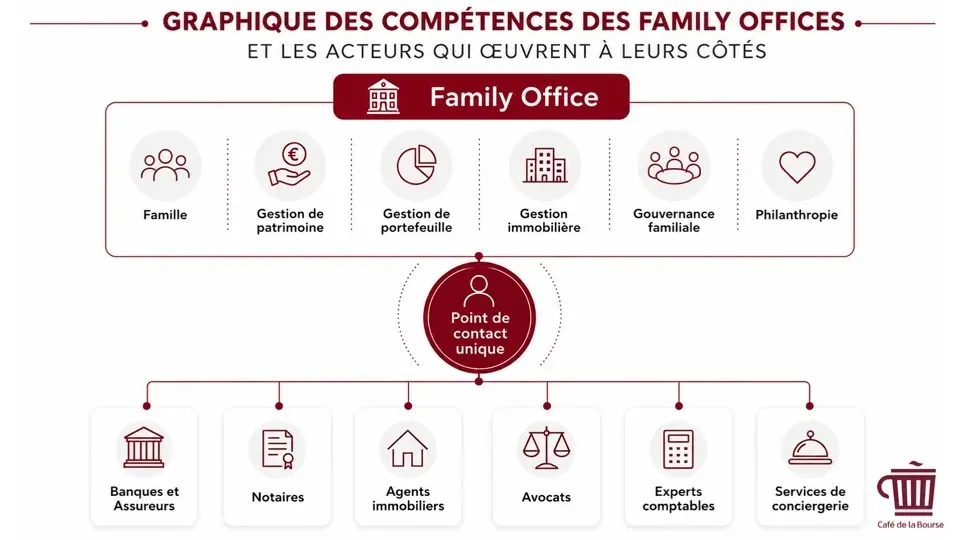
A family office supports its clients by providing its expertise in:
- wealth management (financial engineering, tax optimization, wealth transmission),
- portfolio management (all financial assets are covered, including private equity);
- real estate management;
- family governance;
- and philanthropy as well.
Clémence’s view:
Contrary to a common misconception, the role of a family office is not limited to selecting financial investments. Its real added value lies in coordinating all wealth-related, legal, tax and family issues across multiple generations.
Quels sont les acteurs travaillant avec les family officers ?
To deliver its advice and support its clients, the family officer works with several banks as well as notaries, lawyers, real estate agents, accountants—numerous interlocutors engaged by the professional to obtain the best advice according to the situations encountered.
Graphique des compétences des Family offices et les acteurs qui œuvrent à leurs côtés
Pourquoi recourir aux services d’un family office ?
The role of family offices is not limited to investment advice. The family officer is truly a partner for reflection and dialogue with the family as well as with the various stakeholders orbiting around it.
According to Jean-Marie Paluel-Marmont, former president of AFFO (French Association of the Family Office) “a family business, over its lifetime, inevitably needs the expertise of a family office, in one form or another. This profession is polymorphic and evolves in the same way as the needs of families.” For Frederick Crot, former president of AFFO as well, the family officer plays “an essential role […] in wealth preservation and also in family cohesion.”
The independence of family officers is a real advantage since they are remunerated in the form of fees and not through retro-commissions on products subscribed by their clients. To better defend the client’s interests, family offices typically offer three custodian banks. Some go as far as working with seven custodian banks to pit them against each other to propose the best solution to their clients.
Quel est le tarif d’un family office en 2026 ? À qui s’adresse un family office ?

A family office is remunerated in several ways, notably annual management fees on assets under management, varying with the complexity of the management, but generally around 0.5% to 2%. In addition, commissions are charged for specific services, involving precise experts (tax lawyers, accountants, etc.).
The early 2000s saw the emergence of this profession, which is no longer limited to large industrial families. Now, the family office is accessible to many entrepreneurs who have chosen to sell their business. Wealthy individuals today are interested in the services of a family office to manage their finances.
According to the French Association of Family Offices, their services are generally offered to clients with financial wealth above €10 million. The entry threshold to access a family office remains very high, so those with more “modest” wealth can turn to independent wealth managers to benefit from some advantages of the family office. Some multifamily offices allow external clients to subscribe to their in-house funds.
Clémence’s view:
Below €10 million in wealth, an independent wealth management advisor is often a more relevant and more economical solution than a family office.
Phoenix Finance
Quels sont les investissements privilégiés par un family office en 2026 ?
Quelles sont les thématiques de prédilection des family offices en 2026 ?
Parmi les demandes les plus fréquentes des familles à leur family officers, on retrouve ces dernières années les thématiques suivantes.
The transmission of the family business at the heart of family offices
The transmission of the family business relates to both human and political considerations within the company, but it also has complex legal and tax implications. This topic, particularly salient right now, is the subject of an AFFO white paper, Education and Training, which concerns the beneficiary of the transmission, to prepare the younger generations for their responsibilities and to develop training tools specific to each family. Benjamin Cavalli, Head of Strategic Clients at UBS Global Wealth Management, recalls in the UBS Global Family Office Report 2025 that “family offices around the world prioritize above all a stable, long-term approach, focusing on wealth preservation for the coming generations.” According to AFFO’s 11th Barometer in partnership with EY, published on June 24, 2026, intergenerational transmission remains the primary concern of families (72%).
Private assets, the cornerstone of investment for family offices prioritizing investment in the real economy
Private assets are a booming asset class. Notably the enthusiasm around private equity remains the main investment vehicle in the real economy and the first asset class in family portfolios. Development capital is the most represented strategy (71%), ahead of growth strategies (58%). This distribution reflects a desire to balance value creation potential with a manageable risk level. Investors thus favor already-established companies with significant growth prospects, rather than seed-stage firms whose visibility is judged more limited in the current environment.
The 11th AFFO Barometer in partnership with EY, published on June 24, 2026, emphasizes the commitment of family offices to the real economy and “their structuring role in financing and supporting the real economy,” as Benoît Losfeld, Partner Lawyer – EY Société d’Avocats, notes.
Technology, health and industry: Family Offices bet on profitable growth
For 2026, technology asserts itself as the leading investment sector for Family Offices (73%), ahead of health and life sciences (48%). Innovation is seen as a strategic growth engine by 86% of respondents. Industry, financial services, real estate and energy also figure among the favored sectors, showing a search for balance between innovation and more traditional assets. Family Offices also place growing importance on growth-focused strategies and yield-oriented approaches. Conversely, sustainable investment and strategies for international expansion lose some ground. This evolution reflects a priority given to value creation, visibility of companies, and better risk management.
Sustainable investment remains a strong topic for families
Wealthy families increasingly factor this parameter into their investments and want to clearly understand the issues of environmental transition
Many AFFO thematic commissions also inform us about the topics of interest to family offices. We thus find a white paper published by the Risk Management Commission for families, another published by the Real Estate Commission for Families, another by the Assets, Rights and Taxation of Family Wealth Commission, and another by the Philanthropy Commission.
It is clear here both the central subjects of client requests to family offices and the diversity of topics handled by family officers, who accompany families in managing the entirety of their wealth. The energy transition and climate regulations (taxonomy, CSRD, SFDR, etc.) continue to have a significant impact in 2025 on investment choices.
Quelles sont les classes d’actifs et les secteurs privilégiés par les family offices en 2026 ?
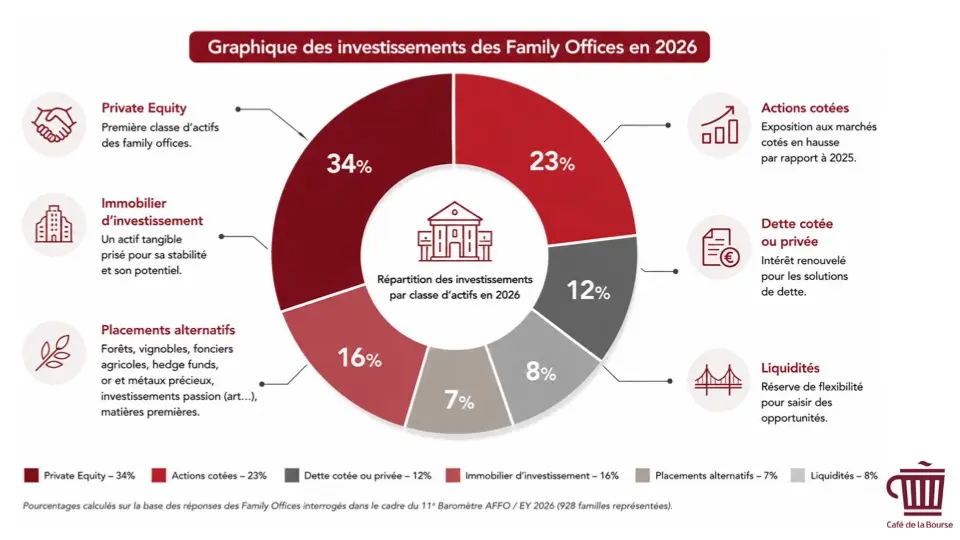
According to AFFO’s 11th Barometer in partnership with EY based on a survey conducted from March 5, 2026 to May 5, 2026 among family offices, multi-family offices and family-related professionals (lawyers, notaries, private bankers) and AFFO non-member partners representing 928 families, Family Offices continued in 2025 to adapt their asset allocations to better face economic, geopolitical and tax uncertainties. Investments remained supported, but selection criteria became more demanding and portfolios more diversified.
Graph of investments of Family offices in 2026
Analyse et avis sur les investissements de Family offices en 2026
Private equity remains the leading asset class for Family Offices, representing 34% of allocations. Although slightly down from the previous year, it still holds a central place in wealth strategies. This shift comes with a major change: investments made via funds rise strongly, while direct investments decline. This trend indicates a desire to strengthen diversification and rely more on the expertise of management companies.
Family Offices also continue to prioritize supporting SMEs (45%) and mid-caps (ETIs) (36%), confirming their role in financing the real economy over the long term.
Listed equities are also regaining interest and now represent 23% of allocations, mainly thanks to the growth of investments made via funds. The prospects remain favorable as more than 80% of respondents expect stability or an increase in their exposure to equity markets in 2026.
Investment real estate continues its recovery and now accounts for 16% of portfolios, confirming the rebound after the sharp rise in interest rates.
Bonds continue to gain ground with 12% of allocations, while cash represents 8% of portfolios and alternative asset classes 7%
Quels sont les plus grands risques identifiés par les family offices en 2026 ?
The 11th AFFO/EY Barometer confirms that Family Office investment decisions are now strongly influenced by a more uncertain environment.
The main factors considered in investment strategies are:
- macroeconomic factors (88%);
- geopolitical tensions (73%);
- political and fiscal uncertainties (71%).
If 65% of respondents still see 2026 as a year offering investment opportunities, the rise in geopolitical tensions and the lack of visibility on fiscal developments push Family Offices to strengthen their selectivity and favor the strongest business models.
Family concerns are also evolving. Intergenerational transmission remains the priority (72%), ahead of changes in tax policies (58%), geopolitical issues (43%), governance issues (38%) and digital transformation (33%). These priorities illustrate families’ desire to securely preserve their wealth over the long term while anticipating economic, regulatory and technological changes.
To protect their portfolios, Family Offices continue diversification strategies and favor a better balance between performance, value creation and risk management, while maintaining a long-term wealth perspective.
Charles-Henri Bujard, President of AFFO:
« In the face of a more complex economic, geopolitical and tax environment, Family Offices once again demonstrate their resilience. Rather than disengaging, they continue to invest and support companies in a value-creation and long-term transmission logic. More selective and more demanding, they are now seeking a new balance between performance, diversification and risk management. This long-term vision remains more than ever their hallmark. »

FAQ Family Office: answers to the most frequently asked questions
The services of a family office generally target individuals with financial wealth above €10 million. At this wealth level, issues of transmission, taxation, governance, and diversification of investments justify comprehensive support. Below this threshold, an independent wealth management advisor or a private bank can often meet the investor’s needs at a lower cost.
A private bank mainly markets its own investment solutions and financial services. A family office takes a much more global and independent approach. It coordinates all wealth-related concerns of the family (investments, taxation, transmission, real estate, governance, philanthropy…) and can work with multiple banks, notaries, lawyers or accountants to select the solutions best suited to its clients’ interests.
The remuneration of a family office most often relies on fees and annual management charges, typically between 0.5% and 2% of assets under management, depending on the complexity of the mission. Additional fees may also be charged for specific services, such as a transmission operation, a wealth restructuring or the involvement of external experts (lawyers, tax specialists, notaries, etc.).
Yes. According to the 11th AFFO/EY Barometer 2026, private equity remains the leading asset class for Family Offices and represents 34% of allocations. Investments mostly favor development capital and already mature companies, still offering strong growth potential. Family Offices remain highly diversified and also invest in listed equities, real estate, bonds, cash and alternatives to balance return, diversification and risk management.
All our information is, by nature, generic. It does not take into account your personal situation and does not constitute personalized investment recommendations, nor any invitation to buy or sell financial instruments. The reader is solely responsible for the use of the information provided, and Cafedelabourse.com cannot be held liable. The publisher’s liability can in no way be engaged in case of error, omission or inappropriate investment.
