
The numismatic market has been bubbling in recent days with the arrival of the new one-dollar coin bearing the portrait of President Donald Trump.
Officially released by the United States on September 2 as part of the commemorative series for the country’s 250th anniversary of independence, the piece began circulating in an unusual way: a few days before the official launch, it had already appeared at the World’s Fair of Money, one of the world’s largest numismatic events, held in Pittsburgh from August 25 to 29.
Ccuriously, the coins were not for sale.
As is often the case at these events, they were distributed via a change machine installed at the U.S. Mint’s booth. All that was needed was to insert a $1 or $5 bill to receive new, uncirculated coins, at exactly the same value.
A coin that became an object of desire
On the first day, the machine went almost unnoticed.
On the second day, however, all it took was a few collectors posting photos on social media for the line to grow rapidly. On the third day, the coins ran out. The machine ended up being removed from the booth — something quite unusual for this type of equipment.
As if the initial shortage weren’t enough, another detail fed the collectors’ rush: the discovery of a privy mark.
The term refers to a small symbol or discreet detail minted on a coin to indicate information about its production or to commemorate a special event.
In the case of the 250-year anniversary coins, some units, mixed with the total production, received a special mark with the inscription “July 4,” a reference to the date of American independence.
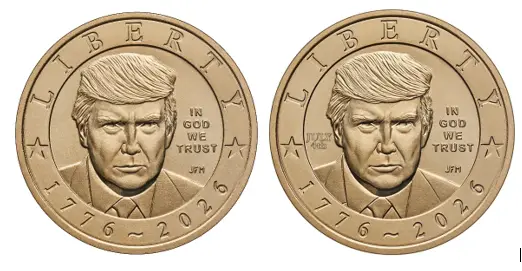
Besides the pursuit of the version with the special mark, the choice of Trump as the portrait on the coin has made the issue a matter far beyond numismatics. It is the first circulating American coin to bear the portrait of a living president in a century.
The last time this happened was in 1926, exactly 100 years ago.
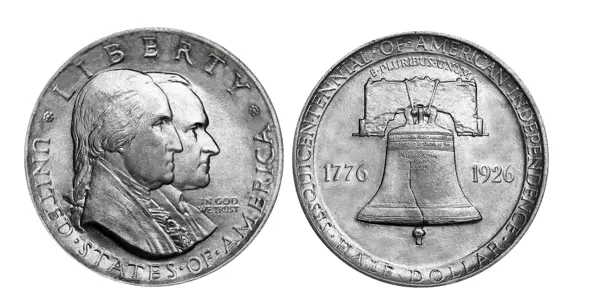
The president was Calvin Coolidge, who appeared on the commemorative half-dollar issued to celebrate the 150th anniversary of the United States Declaration of Independence.
In the piece, Coolidge’s bust appears beside that of George Washington.
But why don’t living presidents appear on American coins?
The tradition dates back to the early years of the Republic, when the United States sought to differentiate itself from European monarchies, where it was common to depict living rulers on coins.
The idea was to prevent money from becoming an instrument of personal exaltation. This principle was incorporated into law in 1866, establishing that living people could not be depicted on American coins and banknotes.
That is precisely why the Trump coin is so significant. For the 250th anniversary commemorative series, Congress approved a specific law with a loophole allowing the sitting president to be depicted on the coin, breaking a centuries-old tradition.
See also: New Pope, New Coins: the Vatican Presents the First Official Series with Leo XIV
The historical coincidence draws even more attention: in 1926, Calvin Coolidge appeared on a commemorative coin during the 150th anniversary celebrations of independence. Exactly 100 years later, Trump appears on a coin created to mark the country’s 250th anniversary.
Remember that this is not a political text. It is a portrait of how the numismatic market reacts when history, novelty, scarcity, and a good narrative come together.
How much does the Trump coin cost
And the numbers help explain the enthusiasm. On September 2, at the U.S. Mint website, a tube containing 25 one-dollar coins featuring Trump’s face was sold for US$ 61, or US$ 2.44 per coin.
A bag with 100 units cost US$ 154.50, equivalent to US$ 1.54 per piece.
On the same day, both options already appeared as unavailable for sale, indicating that the stock produced up to that point had run out.
But the story doesn’t end there. The coins are also expected to appear in change and enter common circulation. This means that, from now on, a new phase of the hunt begins: Americans may encounter these pieces at face value in a simple purchase and, who knows, discover in their own change one of the versions most sought after by collectors.
See also: No coin for the World Cup: why the football-loving country was left out of the numismatic party?
It is precisely this kind of phenomenon that makes numismatics so fascinating. A coin can leave the Mint worth only US$ 1, but carry a story, a minting peculiarity, or a variant that makes collectors willing to pay much more for it.
In the case of the Trump coin, it is still early to know which versions will truly become rare and valuable. But one thing has already become evident: even before it reached the hands of the public, a coin worth only US$ 1 managed to provoke queues, deplete stocks and start a real hunt among collectors.
And if you want to know a little more about this universe, the Brazilian Numismatic Society is promoting, on September 11 and 12, from 9 a.m. to 6 p.m., the next special collectors’ meeting, which will take place at Leques Brasil Hotel, in Liberdade, São Paulo. Admission is free and open to the public.
