
Nike, Lululemon, JD Sports… Several major names in sport are going through a particularly difficult period on the stock market. After having long benefited from the fever for sportswear and sneakers, these stocks have undergone significant corrections, sometimes despite strong brands and a global market that remains supportive in the long term.
Behind these declines lie, however, different realities: a slowdown in consumption, competition from new brands, difficulties in certain strategic markets, or high investors’ expectations for growth.
So, is the sports equipment sector simply going through a rough patch or are we witnessing a deeper market shift? And more importantly, does the drop in Nike’s stock, Lululemon’s stock and JD Sports’ stock present an opportunity for investors by the end of 2026? Should one invest in these names in the stock market in H2 2026? Discover our opinion and detailed analysis.
Pourquoi les valeurs du secteur des équipements sportifs chutent-elles ?
The sporting goods sector is evolving in a less favorable environment. A slowdown in discretionary consumption, consumers more attentive to their spending, intensified competition among brands, and cost pressures weigh on growth prospects and margins, all factors that push investors to be more cautious about sector stocks.
Action Nike : un redressement qui prend du temps
Nike has been in a multi-quarter transition phase aimed at reigniting its growth, but investors are still waiting for more convincing signs of a recovery. In fiscal year 2026, revenue remained flat on reported data but declined by 2% at constant currency. The group remains penalized by its difficulties in China and by weak direct-to-consumer sales, while competition has intensified in several key segments.
Here are a few key factors weighing on Nike’s stock:
- sales that are struggling to rebound : Nike’s revenue declined 1% at constant currency in FY2026;
- persistent difficulties in China and Europe, which weighed on the brand’s performance;
- a ‘Nike Direct’ channel in clear decline : -8% at constant currency for the year, with a 12% decline in digital;
- stronger competition, notably in running, as Nike seeks to put innovation and performance products at the core of its strategy;
- a turnaround still to be confirmed : management themselves acknowledge that the group is still navigating a period of turbulence despite early improvements.
Action Lululemon : un spectaculaire coup de frein en Amérique du Nord
For Lululemon stock, the market punishment mainly reflects the break with the strong growth outlook investors had become used to. In the second quarter of 2026, revenue fell 4% and comparable-store sales declined 9%. The situation is especially challenging in its historic U.S. market, as the brand must also contend with changing consumer tastes, increased competition, and the effects of new U.S. trade policies.
Here are a few key factors weighing on Lululemon stock:
- a pronounced slowdown on the American continent : revenue down 8% and comparable sales down 12% in Q2;
- less foot traffic and lower conversion, coupled with a drop in average basket size on the American continent;
- a demand and brand perception evolving, with Lululemon acknowledging the impact of changing demand and consumer sentiment toward the brand;
- tariffs complicating the equation, although the group benefited in 2026 from exceptional refunds of some previously paid duties;
- international growth no longer fully offsetting U.S. difficulties.
Action JD Sports : consommation sous pression et marché des sneakers moins dynamique
JD Sports presents a different case since it is primarily a distributor. The group is directly affected by consumer caution, but also by difficulties faced by some major brands it distributes. In the second quarter of its 2026/2027 fiscal year, comparable sales fell 3.1%, driving JD Sports to cut its annual earnings guidance. Weakness is particularly pronounced in North America.
Here are a few key factors weighing on JD Sports stock:
- a more cautious consumer, notably due to higher cost of living;
- a less buoyant sneaker market, with persistent weakness in certain lines nearing the end of their cycle;
- fewer highly sought-after sneaker products, notably in North America, reducing one of the traditional footfall drivers for stores;
- a highly promotional environment, forcing JD Sports to adjust prices to stay competitive;
- comparable sales down 6.8% in North America in Q2, even though apparel, accessories and running show more resilience;
- lowered guidance, JD Sports now aiming for profit before tax and exceptional items between 700 and 800 million pounds for the year, versus 750–850 million previously.
Le marché des équipements sportifs peut-il renouer avec la croissance fin 2026 ?
Despite the current difficulties faced by several major players, the fundamentals of the sporting goods market remain fairly solid. In the United States, sector wholesale sales rose 3.7% in 2025 to nearly $130 billion, supported in particular by sustained high participation in sports activities.
Looking further ahead, the prospects remain positive as well: according to estimates cited by McKinsey, the global sportswear market could grow by about 6% per year between 2024 and 2029, versus 7% between 2021 and 2024. It is therefore more a slowdown in growth than a market in decline.
The real challenge lies in the redistribution of this growth. Consumers remain interested in sport, running, fitness, and the sportwear fashion, but become more price-conscious and less loyal to the big brands.
At the same time, specialized and newer players are gaining market share thanks to highly differentiated products and a more innovative image. In the short term, consumer prudence, tariffs and cost pressures remain significant headwinds. The sporting goods market thus still has substantial growth potential, but the return of sector growth does not guarantee growth for all its players : Nike, Lululemon or JD Sports will mainly have to demonstrate their ability to regain innovation, attractiveness and market share.
Faut-il profiter de la chute de l’action Nike, l’action Lululemon et l’action JD Sports pour investir en Bourse ? Avis Café de la Bourse
The sharp decline in Nike, Lululemon, and JD Sports shares may present attractive entry points, but a stock that has fallen is not necessarily a cheap one. Each of these companies has different fundamentals, valuations and prospects. It is therefore essential to analyze them individually before considering an investment.
Faut-il acheter l’action Nike en 2026 ?
Fundamentally, Nike stock remains a case of a turnaround rather than a growth stock. FY2026 ended with revenue of $46.4 billion, flat on a reported basis but down 2% at constant currency, while net income fell another 3%.
Encouraging point: wholesale sales are up 6%, a sign that the reconstruction of the distribution network is starting to bear fruit. By contrast, Nike Direct remains in trouble (-6%) and the Chinese market remains fragile. The rebound potential therefore exists thanks to the brand’s power and the ongoing turnaround, but it now depends on a genuine return of organic growth.
Analyse technique de l’action Nike
Nike stock is currently trading around $36.80, still within a downtrend channel. The first major resistance sits at $38.60, a level that also corresponds to the channel’s median: breaking through it is essential to envision a more durable rebound. The next resistance is near $41.30, close to the upper bound of the channel. It would only be a durable breakout above $42 that would allow for a genuine short-term bullish reversal, with $46.55 as the first objective.
Faut-il acheter l’action Lululemon en 2026 ?
The Lululemon stock represents a more delicate investment to evaluate. The sharp price correction has significantly reduced the expectations priced in, but fundamentals continue to deteriorate: in Q2 2026, revenue fell 4%, comparable sales down 9%, and operating income down 13%.
Moreover, Lululemon now guides for a 5% to 7% decline in revenue for all of 2026. The company nevertheless retains a powerful brand, $1.4 billion in cash, and a high gross margin. The stock could thus regain potential, but it still seems premature to assume that the operational bottom has been reached.
Analyse technique de l’action Lululemon
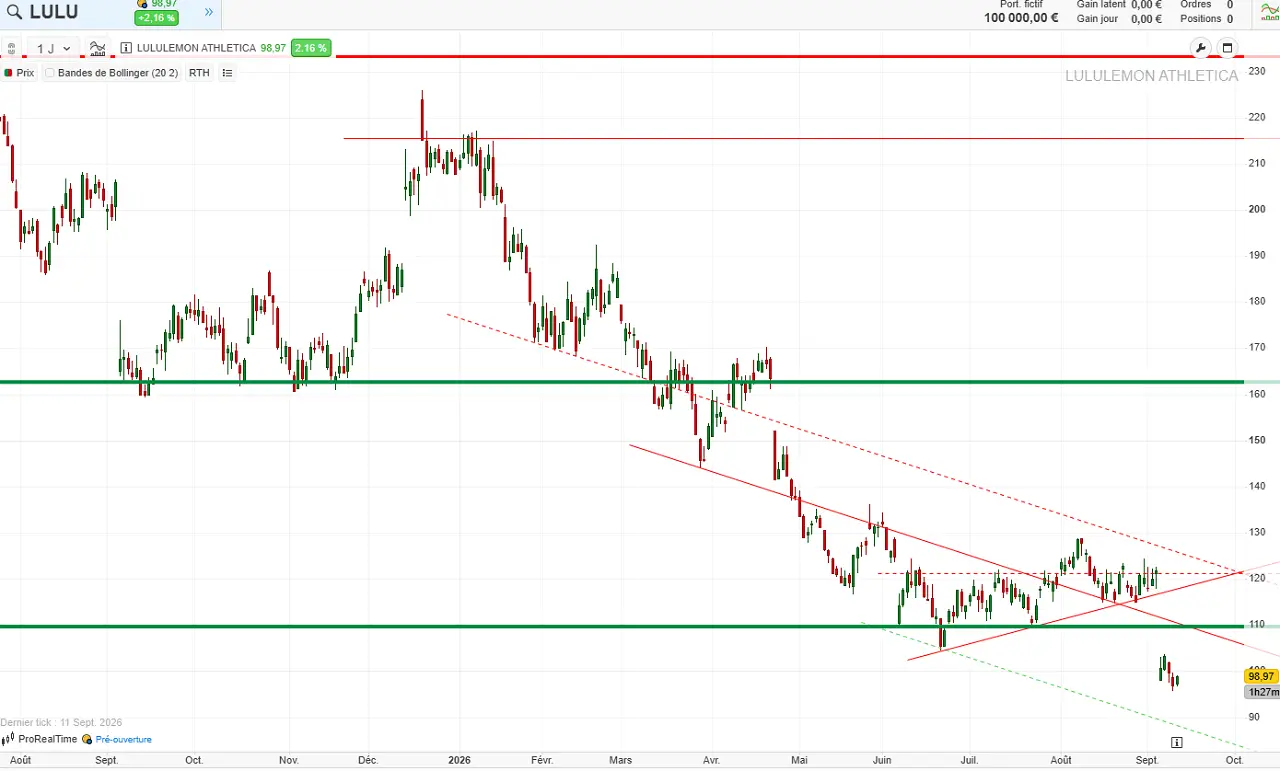
The technical setup for Lululemon stock looks very similar to Nike’s, with the price still moving within a downtrend channel. From current levels near $99, the first major obstacle sits at $109, around the channel median, then at $121, near the upper bound. A durable breakout around $130 would be needed to confirm an exit from the channel and to envisage a bullish reversal. The first objective would then be around $163, then, in extension, at $215 and $231, levels that are still quite distant.
Faut-il acheter l’action JD Sports en 2026 ?
The JD Sports stock presents a different bet: the company must not only execute its strategy well, it also depends on the dynamism of the brands it distributes and discretionary consumer demand. The current weakness of the sneaker market and consumer caution weigh directly on its prospects. The decline in the share price can make the valuation more attractive, but this should be weighed against the risk of further earnings revisions if sales stay under pressure. For an investor, JD Sports stock thus appears more like a bet on a normalization of consumption and the sports footwear market than a defensive growth stock.
Analyse technique de l’action JD Sports
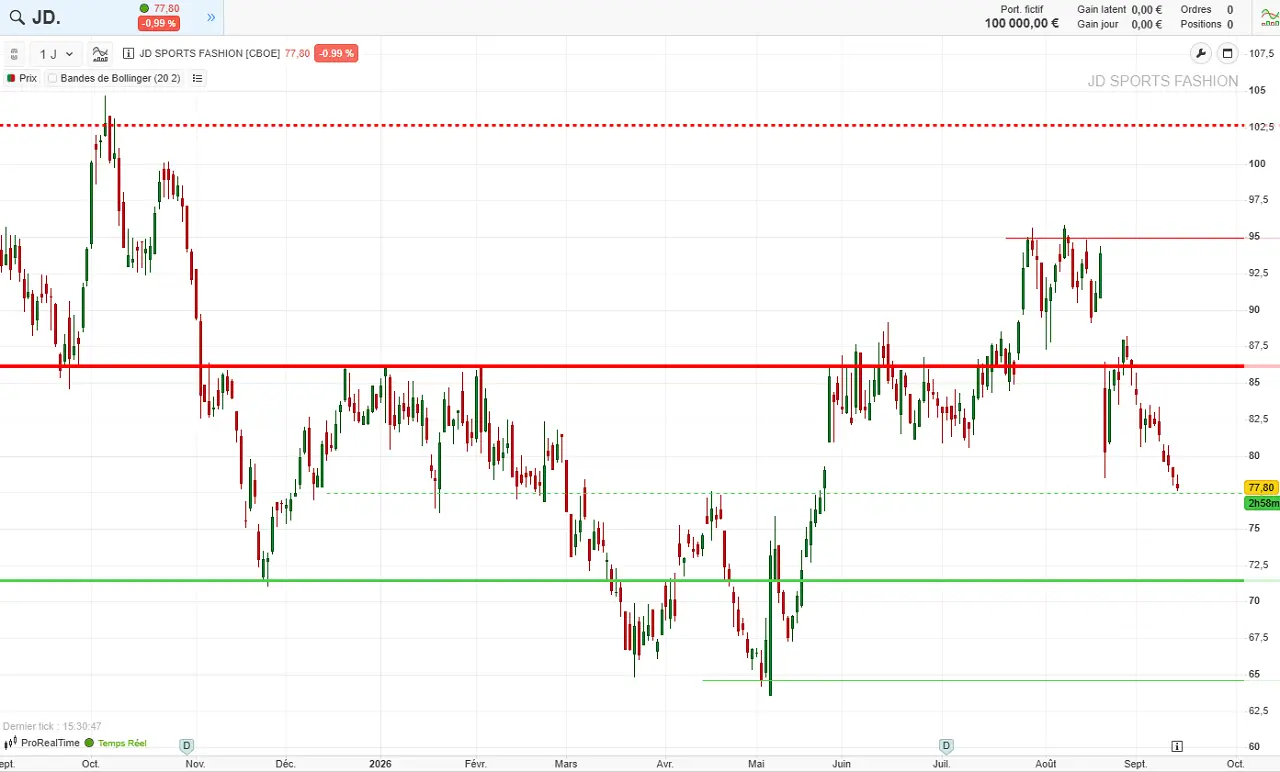
The technical setup for JD Sports stock differs from Nike and Lululemon’s, as there is no clearly established downward channel. The price is currently testing the support at 77.50 pence, a level to watch closely. If broken, the next major supports are at 71.50 and 64.50 pence. On the upside, breaking above the resistance at 86.10 pence would constitute an encouraging first signal, with 95 pence as the initial objective, then the major resistance at 102.60 pence in extension.
Comment investir en Bourse dans Nike, Lululemon ou JD Sports en pratique ?
To invest in Nike, Lululemon, or JD Sports stock, you can buy these shares directly through ordinary share accounts (CTO) with traditional brokers such as BoursoBank, Bourse Direct, or Fortuneo, for example. Investors can also turn to online neo-brokers such as eToro, XTB, or Trade Republic, which offer, among other things, fractional investing on certain stocks and notably competitive pricing, sometimes even zero-commission trading under certain conditions.
To diversify further, online brokers offering a wide range of ETFs such as Saxo Bank, Interactive Brokers or Freedom24 can also be interesting.
However, to our knowledge, there is not yet a readily accessible UCITS ETF dedicated specifically to sporting goods manufacturers. Investors must therefore, for the moment, turn to broader ETFs, particularly those focused on discretionary consumer, while awaiting the possible arrival of sport-focused ETFs.
Past performance is not indicative of future results. Stock investing involves the risk of capital loss.
All of our information is, by its nature, generic. It does not take into account your personal situation and does not constitute personalized recommendations for making transactions and cannot be considered as financial investment advice, nor as an encouragement to buy or sell any financial instruments. The reader is solely responsible for the use of the information provided, and no recourse against Cafedelabourse.com’s publisher is possible. The publisher Cafedelabourse.com cannot be held liable for any error, omission or ill-timed investment.
