
In the second quarter of 2026, the real GDP of the United States rose at an annualized rate of 1.5%, after a 2.1% increase in the first quarter. The American economy therefore continues to grow, but at a slower pace. In parallel, inflation remains a major topic for investors: in August 2026, the consumer price index (CPI) rose by 3.4% year over year, versus 2.4% for core inflation excluding food and energy.
In September 2026, the major U.S. indices generally remained well oriented despite an environment marked by geopolitical tensions, fluctuations in the price of oil, and questions surrounding the Fed’s monetary policy. As of September 21, 2026, the S&P 500 had gained 13.4% from the start of the year, compared to 8.2% for the Dow Jones and 16.7% for the Nasdaq Composite. However, high valuations of certain large technology and AI-related names remain a point of vigilance for investors.
Before diving in and investing in the U.S. stock market with one of the best securities accounts (or one of the best PEA with eligible ETFs), it seems important to revisit the composition of the American market, the main stock indices, and the different ways for a retail investor to invest in a U.S. stock or to gain exposure to the American markets.
What are the characteristics of the American stock market? Which markets and indices are representative of the U.S. stock market? How to invest in the U.S. equity market when you are a French retail investor? What are the different ways to invest in a U.S. stock? What fees apply to transactions on the U.S. stock market? What tax rules apply to your investments on the U.S. markets?
Find in this article everything you need to know about the American stock market and discover its advantages and disadvantages, the 5 ways to invest in U.S. stocks, and our guide to investing in the U.S. in video.
What is Wall Street? The emblem of the American Stock Market
Wall Street is a street south of Manhattan where the New York Stock Exchange is located. Its name comes from the palisade built in the 17th century by Dutch settlers at the northern edge of New Amsterdam, notably to protect the colony in a context of tensions with the English.
The term Wall Street is also often used to designate the New York Stock Exchange: the NYSE, which we will come back to in this article, and even the world of finance in general. It must be said that Wall Street is also the historical home to many brokerage firms but also to the largest investment banks in the United States. As a result, “Wall Street” has quickly become a way to refer to the U.S. financial community, which includes the Exchanges, the big banks and brokers, investment firms, and, by extension, major companies. The interests of these large “Wall Street” firms are sometimes contrasted with those of small and mid-sized businesses on “Main Street”.
Finally, Wall Street, in the collective imagination, remains the symbol of the 1929 crash but also of the vitality of the American economy and far beyond the financial power, including its excesses. It is also the title of Oliver Stone’s famous film depicting the exploits of the fictional financial genius Gordon Gekko.
U.S. Stock Market: What are the American Exchanges?
The U.S. equity market is a vast and mature market that brings together a large number of companies, industries, and investment styles, with iconic growth names, notably in Tech with the famous GAFAM, but also dividend aristocrats like AT&T, ExxonMobil, or Coca-Cola, as well as many value stocks in the real estate sector, among others.
The New York Stock Exchange: The NYSE
The New York Stock Exchange or NYSE refers to the stock exchange of New York where the shares of the largest U.S. companies (Coca-Cola, Boeing) are listed. It is the premier American market and the NYSE Composite is one of the world’s leading stock indices. Until 2005, the NYSE was a non-profit association. It then became a public company: the NYSE Group. In 2006, the NYSE Group and Euronext merged to form NYSE-Euronext. NYSE Euronext was acquired by ICE in 2013, which spun Euronext off by listing it in June 2014.
When paired with two of the largest U.S. indices—the Dow Jones Industrial Average (often called Dow Jones 30) and the Standard & Poor’s 500 (S&P 500)—the true NYSE index is the NYSE Composite, which covers all ordinary shares listed on the New York Stock Exchange, including American depository receipts, real estate investment trusts, tracking stocks, and foreign listings.
The Nasdaq, the Other Exchange in New York
The Nasdaq, acronym for the National Association of Securities Dealers Automated Quotations, is an electronic stock exchange opened in 1971. The Nasdaq is the second largest stock market in the United States by traded volume, after the NYSE. It is the world’s largest electronic stock market. Located in Times Square in New York, the Nasdaq marketplace belongs to the transatlantic Nasdaq Group. It gave its name to the technology-focused stock index, the Nasdaq 100.
The Chicago Exchange
Finally, one cannot discuss the American stock market without mentioning the Chicago Exchange, located in the Loop. The Chicago Board of Trade (CBOT) is a marketplace where agricultural and financial contracts are traded.
In its early days, it traded only commodities such as wheat, corn, or soy. Specializing in futures contracts on agricultural commodities, the Chicago Exchange gradually diversified into all types of derivatives. Today, the CBOT offers options and futures contracts on a wide range of products including gold and silver, U.S. Treasury bonds, energy, as well as indices and interest rates.
In July 2007, the CBOT merged with the Chicago Mercantile Exchange (CME) to form the CME Group.
U.S. Stock Market: What Are the Indices of the American Stock Market?

Comparison Table of American Stock Indices
| U.S. Index | Number of Companies | Weighting Method | Dominant Profile | Annualized 10-Year Return* |
|---|---|---|---|---|
| Dow Jones | 30 | Price-weighted | Large U.S. companies | 10.90% |
| S&P 500 | Approximately 500 | Floating market cap | Broad US large-caps, diversified | 13.50% |
| Nasdaq-100 | 100 | Modified capitalization | Large non-financial tech-heavy names | 20.20% |
*Annualized returns as of September 23, 2026, excluding dividends. Past performance is not indicative of future results.
The Dow Jones 30, Benchmark Index of the NYSE, a Must-Have for Investing in U.S. Stocks
The Dow Jones Industrial Average is composed of 30 major U.S. companies selected to represent several sectors of the American economy. Unlike the S&P 500, its components are not weighted by market capitalization but by the price of their shares.
This stock index is one of the most well-known and oldest still followed today. Its first publication dates back to 1896, which makes it a way to study the evolution of the economy over nearly 130 years. It is still published today even though the Dow Jones 30 corresponds to a price-weighted calculation rather than a market-capitalization-weighted index. This rather limited calculation method and its small 30-company composition have led it to be gradually superseded by the S&P 500 as a representative index of U.S. economic performance.
Top 10 Dow Jones 30 Stocks in September 2026
| Company | Ticker | Sector | Weight |
|---|---|---|---|
| Goldman Sachs | GS | Financial Services | 10.83% |
| Caterpillar | CAT | Industrials | 9.30% |
| Microsoft | MSFT | Information Technology | 5.68% |
| Amgen | AMGN | Healthcare | 4.44% |
| UnitedHealth Group | UNH | Healthcare | 4.33% |
| Travelers | TRV | Insurance | 4.31% |
| Visa | V | Financial Services | 4.24% |
| JPMorgan Chase | JPM | Financial Services | 4.02% |
| Alphabet | GOOGL | Communication | 4.02% |
| Apple | AAPL | Information Technology | 3.87% |
Although the Dow Jones 30 is composed of stocks from different sectors, it is often associated with industrials.
Over the long term, the Dow Jones has generated very different performance depending on the starting point chosen. For example, from the end of 1977 to the end of November 2023, the index posted an annualized return excluding dividends of about 8.93%, very close to that of the S&P 500 over the same period. Past performance does not guarantee future results.
Here are the average annual performances of the Dow Jones 30 over different periods:
- Over the last 10 years: about +10.9% per year (excluding dividends)*
- Over the last 15 years: about +11.0% per year (excluding dividends)*
- Over the last 20 years: about +7.8% per year (excluding dividends)*
Graph of the Dow Jones index price today
The S&P 500, the Benchmark Index for U.S. Stocks to Invest in the U.S. Market
The S&P 500, created on March 4, 1957, is an index based on 500 large companies listed on U.S. exchanges. Its name comes from the Standard & Poor’s rating agency that manages it.
Representative of the U.S. equity market, the S&P 500 gradually displaced the Dow Jones as the benchmark index for the U.S. stock market. Over the decades, it has established itself as one of the main barometers of U.S. stock markets. To be eligible for the S&P 500, a company must be American and meet several criteria related to market capitalization, liquidity, float, and profitability.
As a result, the S&P 500 is the index most closely followed by fund managers and finance professionals.
Note: the S&P 500 includes companies listed on NYSE and NASDAQ.
Among the major stocks that constitute the S&P 500 in September 2026, Nvidia, Apple, Microsoft, Amazon, Alphabet, Meta Platforms, Broadcom, Tesla, Netflix, and Berkshire Hathaway stand out.
Top 10 stocks of the S&P 500 index in September 2026
| Company | Ticker | Weight | Sector |
|---|---|---|---|
| NVIDIA | NVDA | 7.76% | Information Technology |
| Apple | AAPL | 7.01% | Information Technology |
| Microsoft | MSFT | 5.30% | Information Technology |
| Amazon | AMZN | 3.83% | Consumer Discretionary |
| Alphabet (Class A and C) | GOOGL / GOOG | 5.86% (3.03% + 2.83%) | Communication |
| Meta Platforms | META | 2.70% | Communication |
| Broadcom | AVGO | 2.41% | Technology |
| Tesla | TSLA | 2.14% | Consumer Discretionary |
| Micron Technology | MU | 1.72% | Technology |
| Berkshire Hathaway | BRK.B | 1.55% | Finance |
Since its launch in its current form in 1957, the S&P 500 has historically delivered a long-term annualized performance close to 10% when including reinvested dividends. This average hides significant variations depending on the periods studied and obviously does not guarantee future results.
Here are the average annual performances of the S&P 500 over different periods:
- over the last 10 years: about +13.5% per year (excluding dividends)*
- over the last 15 years: about +13.6% per year (excluding dividends)*
- over the last 20 years: about +9.2% per year (excluding dividends)*
Graph of the S&P 500 index price today
The Nasdaq, the World’s Largest Electronic Stock Market Index for Investing in U.S. Tech Stocks
The NASDAQ, primarily composed of technology, internet, and telecom companies, is often considered the technology stock index.
However, the Nasdaq is not limited to just this sector, as it also includes companies from the industry, banking, transportation, and even the biopharmaceutical sectors, for example. It should be noted that these are almost always growth companies with high growth potential.
The Nasdaq has kept in its composition most of the nascent technology firms it welcomed in the 1980s and 1990s. Notably, there is the Nasdaq Composite, which gathers more than 3,200 listed Nasdaq stocks, and the Nasdaq-100, which includes 100 of the largest non-financial Nasdaq-listed companies meeting eligibility criteria for the index.
Among its main components in September 2026 are Nvidia, Apple, Microsoft, Amazon, Alphabet, SpaceX, Meta Platforms (formerly Facebook), Broadcom, Tesla, and Micron Technology.
Top 10 stocks of the Nasdaq 100 index in September 2026
| Company | Ticker | Weight | Sector |
|---|---|---|---|
| NVIDIA | NVDA | 12.71% | Technology |
| Apple | AAPL | 11.48% | Technology |
| Alphabet (Class A and C) | GOOGL / GOOG | 9.61% (4.97% + 4.64%) | Communication |
| Microsoft | MSFT | 8.68% | Technology |
| Amazon | AMZN | 6.28% | Consumer Discretionary |
| SpaceX | SPCX | 4.56% | Industry / Aerospace |
| Meta Platforms | META | 4.42% | Communication |
| Broadcom | AVGO | 3.96% | Technology |
| Tesla | TSLA | 3.50% | Consumer Discretionary |
| Micron Technology | MU | 2.83% | Technology |
Here are the average annual performances of the Nasdaq 100 over different periods:
- over the last 10 years: about +20.2% per year (excluding dividends)*
- over the last 15 years: about +19.1% per year (excluding dividends)*
- over the last 20 years: about +15.8% per year (excluding dividends)*
How to Invest in the U.S. Stock Market? Step-by-Step Guide in Video
5 Ways to Invest in the USA, Briefly
There are 5 main ways to invest in the U.S. stock market:
- buy U.S. stocks directly through a securities account
- invest in ETFs that replicate, among others, the S&P 500, Nasdaq-100, or Dow Jones
- invest via actively managed UCITS funds
- buy fractional shares to invest smaller amounts
- use derivative products, a more complex solution intended for experienced investors
1. How to Invest in U.S. Stocks Directly?
First, it is possible to invest in U.S.-listed companies directly via live shares with brokers such as Bourse Direct or Freedom24. This involves buying shares of American companies. You can then perform stock picking yourself and select the shares of companies you are interested in and hold them directly within your stock portfolio. The choice will be very broad. However, check what exactly is available with such a broker before choosing one to invest in U.S. stocks. It is better to open a trading account with a broker that gives you access to all the stocks you plan to trade if you want to invest in a very specific U.S. stock.
The simplest approach when you want to invest in U.S. stocks directly is to hold the stock in a standard securities account (CTA), an envelope you can easily open with any online broker if you do not already have one. Some insurers also offer a few U.S. live shares from unit-linked supports of their life insurance contracts. However, the choice will be much more limited. But it may be sufficient if you target only a few well-known U.S. names such as Tesla, Apple, or Amazon, for example. Note that live U.S. stock holdings cannot be held in a PEA with favorable taxation, which is eligible only for stocks with headquarters located in the EU.
Finally, choosing to invest in U.S. stocks via direct live shares requires a significant amount of capital. Indeed, given the sometimes extremely high valuations of U.S. stocks, building a U.S. stock portfolio that meets basic diversification rules requires a substantial starting capital. For example, as of September 23, 2026, a share of Apple traded around $337, Microsoft around $501, and Meta Platforms around $744.
A solution to this problem could be to use a stock broker that allows you to buy fractional shares of U.S. stocks, such as Interactive Brokers, eToro, Scalable Capital, or Trade Republic. We will discuss this in more detail below.
Note also that most major U.S. stocks on the NYSE are also listed in Europe on Euronext or the Frankfurt Stock Exchange.
U.S. Regulations for Listed Companies
Just like European companies, U.S.-listed companies are required to provide investors with the latest information about their activities and revenues. As with European companies, the best way to access this information is to consult the company’s website in the “Investor Relations” section. Reports can be quarterly or annual.
As the AMF does in France, the SEC closely monitors U.S. companies and does not hesitate to impose heavy penalties for insider trading. The U.S. regulator is known for its severity in fines, which can reach several hundreds of millions of dollars.
2. How to Invest in U.S. Stocks via an ETF?
It is also possible to invest in the American market via an ETF or trackers, these passively managed funds that replicate the performance of an index. In this case, it will most often be an American stock index (S&P 500, Nasdaq 100, Dow Jones, etc.), though it could also be a thematic ETF offering exposure to the U.S. This type of investment will provide you with a diversified portfolio (at least in cash), at a lower cost. Not only is the price of an ETF on a stock index much cheaper than buying all the stocks that compose it, but you will also have only one stock order to place (and thus one set of trading fees).
Moreover, some ETFs, including those on U.S. indices, can be held in a PEA. They can even be the best way to invest outside Europe while benefiting from the favorable tax treatment of the PEA, which, after 5 years of holding the plan, allows the holder to be exempt from capital gains tax (social contributions still apply).
Investing in the U.S. market via ETFs however does not allow you to perform your own stock picking and target only the stocks you deem particularly interesting.
You can invest in the U.S. market via ETFs with brokers such as XTB or Degiro.
3. How to Invest in U.S. Stocks with UCITS Funds?
Investing in the U.S. market can also be done through means other than live shares and ETFs. It will indeed be possible for the French retail investor to invest in U.S. stocks via actively managed UCITS funds if they do not wish to pick their own holdings and want to rely on the expertise of a fund manager. However, with this type of product, it is important to evaluate the fund’s performance against its benchmark index over recent years, as well as its volatility, especially the max drawdown, always comparing to the benchmark, and the fees charged.
While, in theory, delegating your investment in the U.S. stock market to experts via actively managed UCITS funds may seem like a good idea, remember that in practice very few fund managers consistently outperform their benchmark over the long term. And the fund’s performance is also eroded by higher fees, often higher than those charged by ETFs, for example.
4. How to Invest in Fractional Shares of U.S. Stocks?
Fractional shares, which consist of buying only a fraction of a share, represent a particularly advantageous way to invest in the U.S. market for investors who want to perform their own stock picking but do not have enough capital to build a diversified portfolio. With fractional shares, the investor is exposed to the stock, but with a lower entry ticket. For example, with Alphabet (Class A) trading around $338 as of September 23, 2026, an investor who can buy fractional shares could theoretically gain exposure to 1/10 of the stock for about $34 or 1/100 for about $3.40, excluding possible fees. Note that if the company pays dividends, the investor will receive the portion of the dividend corresponding to the portion of the share held. Thus, if you own 1/10 (or 1/100) of a share, you will receive 1/10 (or 1/100) of the dividend. Generally, the minimum amount for a fractional share is about 1 euro.
Fractional investing is now offered by several brokers accessible to French investors. The terms may vary depending on the financial intermediary: it is important to verify the legal nature of the product held, the available securities, the minimum investment amount, and the applicable fees.
Fees related to fractional shares depend greatly on the broker’s pricing model. Some intermediaries charge per order, while others offer programmed investment plans with reduced or even zero execution commissions. It is therefore important to compare pricing and brokerage fees before regularly investing small amounts.
So, is fractional investing a bad idea? In fact, the newer generation of stock brokers offering it are not expensive, with some offering 0% commission. Among the brokers that offer fractional investing, one can cite Trade Republic, eToro, Scalable Capital, or Interactive Brokers.
5. How to Invest in U.S. Stocks with Derivative Products?
To position oneself on the U.S. market, it is also possible to opt for derivative products, especially when one wants to engage in trading and implement sophisticated investment strategies. It will thus be possible to anticipate an increase or decrease in prices as well as to benefit from leverage, using, for example, trading products like turbo certificates, warrants, or certificates, and also via derivatives such as options. Caution, these products are intended for experienced traders as they can lead to rapid capital loss, sometimes exceeding the initial investment.
You can invest in the U.S. market via derivative products with brokers such as Saxo Bank or IG.
U.S. Stock Market: How to Invest in U.S. Stocks in Practice?

Open a Brokerage Account and Buy Financial Products
Like any investment in an asset, to position yourself in the U.S. market, you will need to open a brokerage account with a stockbroker or a bank. You can hold your securities in a securities account or, for certain assets, in a PEA. The securities account will allow you to invest in all the possible solutions for investing in the U.S. market: live shares and fractional shares, ETFs, actively managed UCITS funds, or even derivative products.
The PEA, which has restrictions in terms of eligible securities, will allow you to position yourself on the U.S. market only through certain ETFs or UCITS funds.
In any case, the selection of securities, order placement, and portfolio monitoring will be the same as what you are used to for your investments in the French or European market.
Comparison of the Best Stockbrokers to Invest in the U.S. Stock Market in 2026
Discover the current offers from online brokers.
| Top Stockbrokers | Current Offers | See Offers |
|---|---|---|
| 0% commission up to €100,000 invested per month. Capital at risk* | ||
| Get up to $500 of free assets. Capital at risk* | ||
 |
Open your Regular Investment Plan in stocks and ETFs with no fees and receive up to 20 shares free with promo code WELCOME 50. Capital at risk. | |
 |
3% interest on your cash + invest from €1 in stocks, ETFs, regular investment plans, cryptos and stock products. Capital at risk* | |
 |
Invest with the online stock market expert. Securities account, PEA, Regular investment plan, corporate securities account. All asset classes and markets available. Capital at risk* | |
 |
Official U.S. stocks starting from $1 + support with an expert on the platform. Capital at risk* | |
| Invest with €0 commissions and 5% interest on your invested cash. Capital at risk* | ||
 |
From €0.99 per stock order + transfer fees reimbursed and free training. Capital at risk* | |
 |
€100 brokerage fees reimbursed for new clients under conditions + €1 commission on French, U.S., and ETF stocks. Investing carries a risk of loss* | |
 |
Transfer fees 2x reimbursed + from €0 per order with Boursomarkets. Investing carries a risk of loss* |
*See conditions on the site.
Wall Street Opening Hours
There is, however, a particular point to be aware of: the opening hours of the U.S. stock market, which are, of course, different from those of European exchanges. The main NYSE session runs Monday to Friday from 9:30 a.m. to 4:00 p.m., New York time, which is generally 3:30 p.m. to 10:00 p.m. in Paris. During the brief periods of time changes due to daylight saving time, which do not occur on the same dates in the United States and Europe, hours may temporarily correspond to 2:30 p.m. to 9:00 p.m. in Paris time.
Note that the most popular U.S. stocks are also generally listed on European exchanges such as Tesla on the Frankfurt Stock Exchange (Xetra), or Apple and NIO on Euronext Italy (Milan). There are indeed partnerships between certain U.S. and European exchanges to enable this type of arrangement.
It is also possible to trade in euros several hundreds of U.S. and European stocks via Euronext GEm (Global Equity Market), the Euronext trading platform aimed notably at retail investors.
U.S. Stock Market: Which Sites to Use to Track U.S. Stocks?

If you decide to invest in U.S. stocks, it can be interesting to seek information on specialized sites. Café de la Bourse already offers a large amount of information in French, including our analyses of current U.S. stocks and our Top U.S. values articles. But to go further, here are a few comprehensive English-language sites (Google Translate can help).
Café de la Bourse Invest
Café de la Bourse Invest is the stock-picking assistance platform developed by Café de la Bourse. It allows you to analyze 918 stocks including many U.S. stocks, based on more than 30 fundamental criteria and customizable and savable filters. Each stock also benefits from the Café de la Bourse Score, a rating from 0 to 10 based on four main dimensions: valuation, dividend, financial strength, and growth. Investors can also access 8 thematic portfolios including U.S. stock portfolios, build their watchlist, and benefit from data updated twice daily. The objective: save time in the search for opportunities and facilitate stock selection thanks to Café de la Bourse’s methodology and expertise.
Seeking Alpha
Seeking Alpha is a reference site for American investors with 22 million visitors per month, offering numerous analyses from more than 18,000 contributors and individual analysts. Sections dedicated to dividends and ETFs provide very specific investment ideas. You’ll find more than 5,000 analyses each month.
MarketWatch
MarketWatch is an indispensable site for U.S. market news, a subsidiary of Dow Jones, providing access to market data on U.S. stocks as well as numerous tools such as stock screeners, an IPO calendar, an earnings calendar, etc.
MarketWatch also runs stock market games with virtual money featuring a community aspect, known as the Virtual Stock Exchange.
CNBC
Equivalently to BFM Business in France, CNBC is not only a financial news TV channel but also a well-known information site that provides the latest news on the U.S. economy.
Other Sites and Sources
Beyond the reference sites above, investors have a multitude of other information sources on financial markets. Among the most consulted are Yahoo Finance, Bloomberg, Barron’s, The Wall Street Journal, or Morningstar, which offer analyses, news, and market data. In addition, specialized portals such as Investing.com, Zacks Investment Research, or Motley Fool provide additional insights to track the evolution of U.S. stocks, ETFs, and indices.
U.S. Stock Market: What Fees for My Investments in 2026?
Before investing in the U.S. stock market, several categories of fees must be checked:
- Brokerage fees charged on orders on U.S. markets
- EUR/USD exchange fees possibly charged by the broker
- Management fees for ETFs and UCITS funds
- Spreads and financing costs for certain derivative products
- Possible fees related to fractional shares, depending on the pricing model of the stock broker
Therefore, it is important to keep in mind the differences in fees that may exist between investing in the European market and investing in the U.S. market. Indeed, trades on live U.S. stocks are often more expensive than trades on Euronext Paris. But it all depends on the broker’s offers. If you plan to invest regularly in the U.S. market, perhaps this is a factor to consider when choosing your broker.
It is also relevant, if your broker charges substantial fees for U.S. market transactions, to check whether the American stocks you want to invest in are also cross-listed on a European exchange.
As for fractional shares, most online brokers will not charge more for U.S. stocks than for European stocks. Some players like Trade Republic or Scalable Capital offer fractional shares with a programmed investment plan that lets you invest every month a defined amount in ETFs or stocks with no or low commissions.
ETF fees are typically the same whether you are investing in a European or a U.S. index. Remember that if you invest in the U.S. market via ETFs eligible for the PEA, regardless of your broker, PEA fees will be capped at 0.50% per order online.
Finally, for derivative products, fees can include spreads that vary and may not be easy to assess.
How to Take into Account Currency Risk for Investments in the U.S. Stock Market in 2026?
Another potential cost to consider when investing in the U.S. stock market: currency risk.
The currency risk refers to the risk of loss associated with fluctuations in exchange rates (for example: EUR/USD).
EUR/USD Rate from 1980 to 2026 (synthetic before 2002)
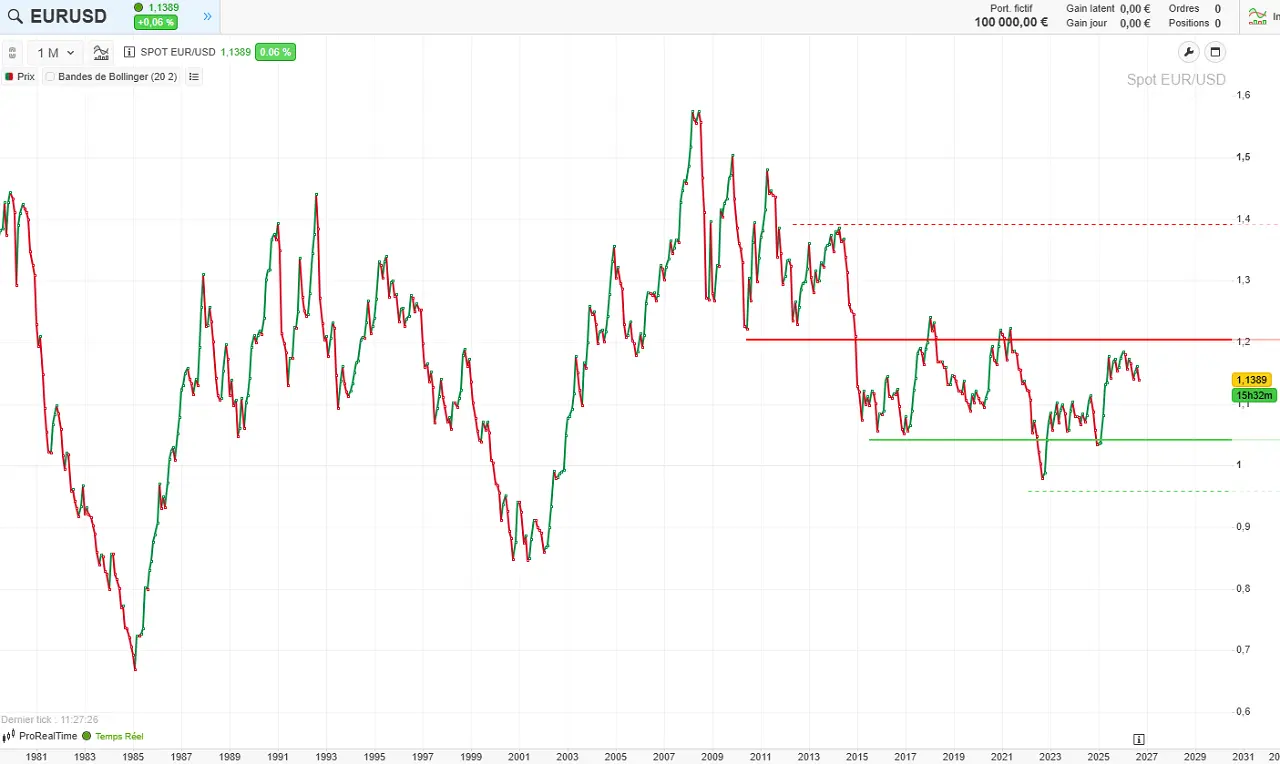
The loss can manifest as a decline in the stock’s performance if the share price rises, or an increase in loss if the stock falls. We speak of currency risk rather than a currency cost, because this risk factor can equally lead to gains as to losses.
The evolution of the EUR/USD pair can significantly modify the performance achieved by a French investor on U.S. stocks. When the dollar appreciates against the euro, it can amplify the euro-denominated performance of a dollar-denominated investment; conversely, an appreciation of the euro against the dollar can reduce, or even erase, part of the rise recorded by the U.S. asset. The impact of currency risk must therefore be taken into account when comparing the performance of a U.S. index in dollars with the actual performance obtained by a euro-area investor.
In the same vein, to a greater extent, investors who bought U.S. stocks before 2003 suffered significant currency-related losses through 2008 (-60%).
Buying U.S. stocks indirectly means buying U.S. dollars.
Professional fund managers use currency-hedging instruments such as options or turbo certificates to hedge currency risk and try to neutralize it as best as possible.
In conclusion, there are ETFs offering exposure to the U.S. markets with currency risk hedged. For example:
- Amundi Nasdaq 100 UCITS ETF Daily Hedged EUR
- BNP Paribas Easy S&P 500 UCITS ETF EUR Hedged
U.S. Stocks: What Taxation in 2026 for Investments in the U.S. Market?
Regarding capital gains, they are taxed like other movable capital gains realized in a securities account. Since January 1, 2026, the flat tax (PFU) stands at 31.4%, composed of 12.8% income tax and 18.6% social contributions. It remains possible to opt for taxation at the progressive income tax rate.
As for dividends from U.S. stocks, a 15% withholding tax is generally applied to French taxable residents benefiting from the Franco-American tax treaty. In France, dividends are then subject by default to the PFU of 31.4% in 2026, with the tax credit mechanism provided by the tax treaty. It is also possible to opt globally for the progressive income tax rates; eligible dividends then particularly benefit from the 40% allowance.
Note also that the tax treaty between France and the United States provides for a tax credit mechanism to avoid double taxation of dividends.
* Annualized performances calculated as of September 23, 2026, excluding dividends. Past performance is not indicative of future results.
All of our information is, by nature, generic. It does not take into account your personal situation and does not constitute personalized investment advice or a recommendation to buy or sell any financial instrument. The reader is solely responsible for the use of the information provided. No liability can be engaged against the publishing company Cafedelabourse.com for any error, omission, or inappropriate investment.
