
This Wednesday (the 30th) marks the final date for the complete withdrawal of the United States military presence from Iraq, one of the terms of a transition agreement signed in 2024. Although Americans have been in the Arab country since 2023, there have been no combatants there since 2021 – only a contingent of 2,500 soldiers carrying out logistical and training missions.
The fulfillment of the agreement will therefore end 23 years of U.S. military activity in the country, a process that began as one of the responses to the September 11, 2001 terrorist attacks in New York and Washington and that cost about 315,000 direct deaths and $1.79 trillion to the American coffers (combined spending in Iraq and Syria).
Read more: U.S. lifts sanctions on Iraqi companies tied to Iran’s Revolutionary Guard
About 4,500 U.S. service members have died in combat or from insurgent attacks in the Arab country since 2003.
The InfoMoney prepared a synthesis of the events that led the United States to invade and remain in Iraq for more than two decades:
1990s – War and Prohibited Weapons
The Iraqi invasion of Kuwait in 1990 ended with Iraq’s defeat by a U.S.-led coalition in the Persian Gulf War (1990-1991). The Iraqi branch of the Ba’ath Party, led by Saddam Hussein, remained in power and began suppressing revolts by the Kurdish minority and the Shiite Arab majority. The Allies created a northern air exclusion zone in Iraq to prevent attacks on refugees, and the UN began implementing economic sanctions against the country to hinder the progress of its nuclear, biological, and chemical weapons programs. But Iraq maintained the programs, which led to in 1998 the bombing by the U.S. of several Iraqi military installations (Operation Desert Fox), during Bill Clinton’s presidency. Iraq became increasingly resistant to international inspectors.
2001/2002 – Terrorism Claims
After the attacks on the U.S. on September 11, 2001, the global fight against terrorism strategy implemented during George W. Bush’s presidency included Saddam Hussein’s Iraq as a potential target. The U.S. argued that Iraq had been manufacturing weapons of mass destruction for years (the assumption was later disproved) and that Iraqi support for terrorist groups, such as al-Qaeda, posed risks to the country. On March 17, 2003, Bush declared the end of diplomacy and issued an ultimatum to Saddam, giving the Iraqi president 48 hours to leave Iraq. Leaders of France, Germany, Russia and other countries opposed this escalation toward war.
2003 – War
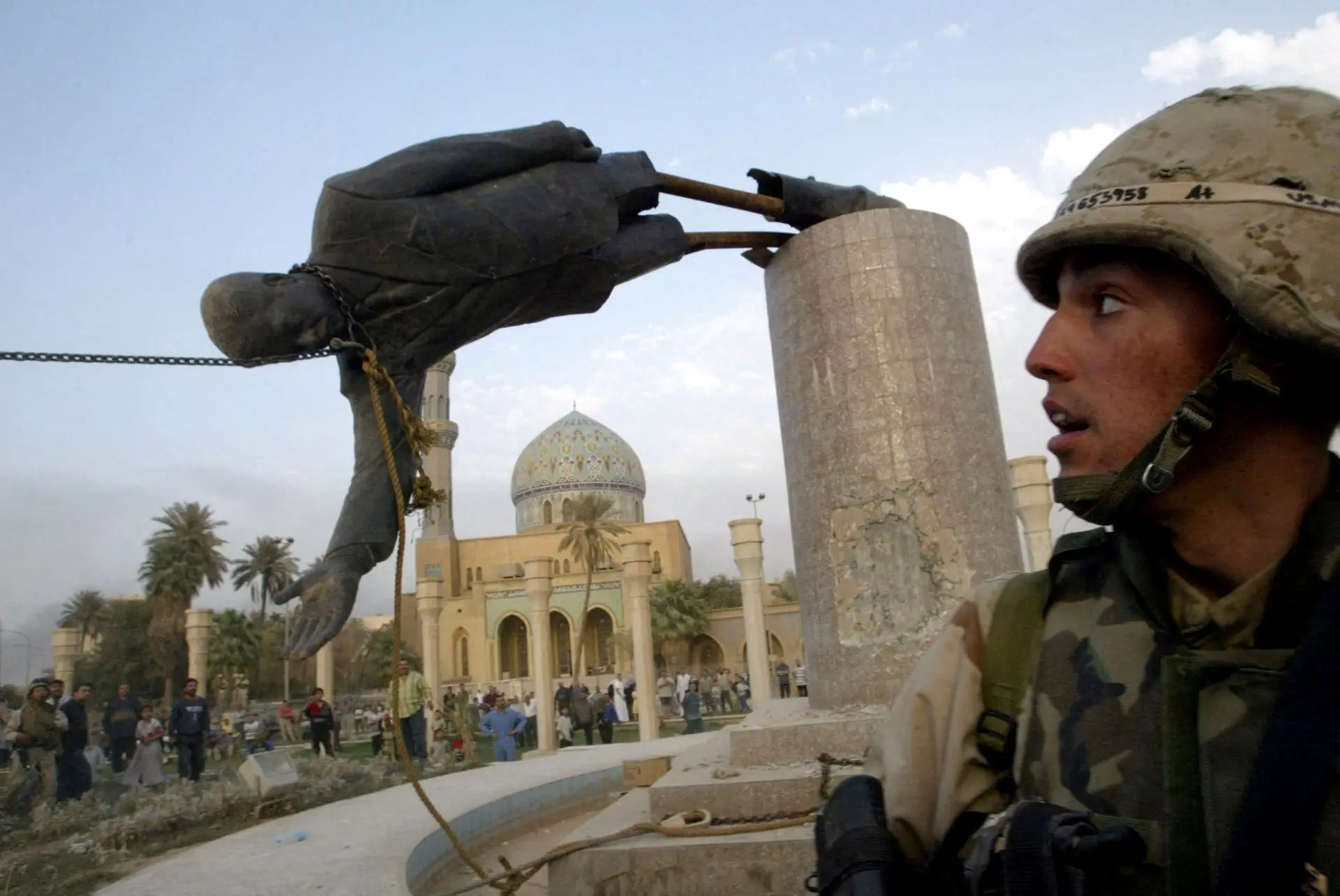
Saddam refused to leave Iraq and U.S. and allied forces launched an attack on the morning of March 20, 2003. First, they launched several precision bombs on a bunker complex where the Iraqi president was believed to be meeting with his high-level coterie. Then, a series of airstrikes against government and military installations followed. A few days later, U.S. forces invaded Iraq from Kuwait. Part of Iraqi forces chose not to resist the advance of the coalition forces. Saddam’s government was defended in the south by irregular Ba’ath Party supporters, known as Saddam’s Fedayeen. In the center of the country, including the capital Baghdad, defenses were the responsibility of the Republican Guard — a heavily armed paramilitary group. The U.S. Marine Corps advanced northwest through the Tigris-Euphrates river valley and bypassed many populated areas where Fedayeen resistance was strongest. On April 4, the Americans took control of Baghdad International Airport, and on the 9th, the capital’s defense collapsed — the British took Basra on the same day. Saddam’s hometown, Tikrit, stood as the regime’s last major stronghold, but fell with little resistance on April 13. Saddam Hussein was captured on December 13, 2003. He was convicted of crimes against humanity and executed on December 30, 2006.
Occupation
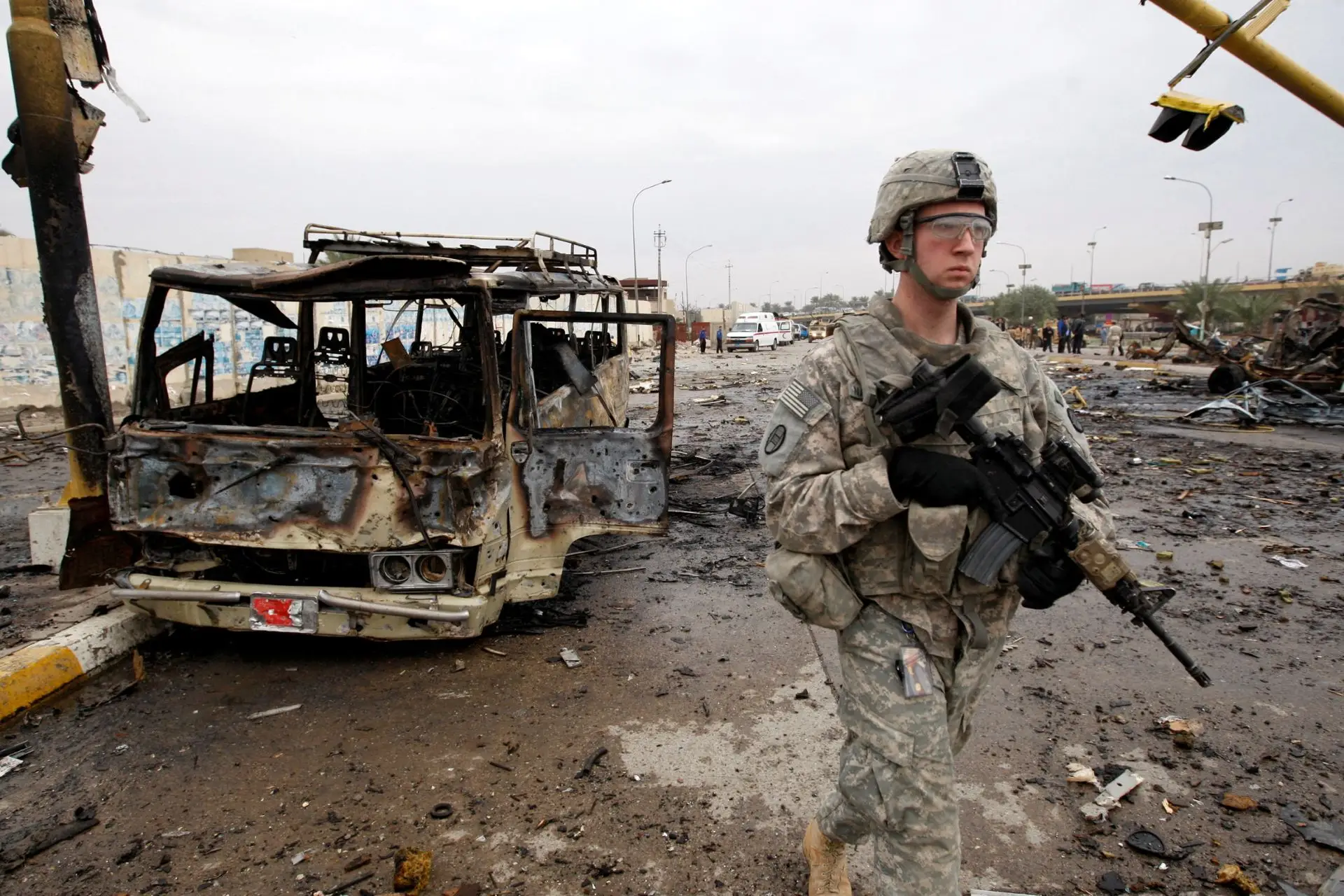
With the fall of the Baathist regime, the U.S. began to support the Shiites, but sectarian violence in Iraq left the country in a condition of civil war, with waves of looting of government buildings and other public institutions, as well as outbreaks of violence in retaliation against the old ruling elite. American and allied troops began conducting operations to restore internal order and, as a result, became constant targets of guerrilla attacks. War casualties, which were a little over 100 combatants in the early phase of the conflict, rose to thousands: about 1,000 by the time of the American presidential election in November 2004, but surpassed 3,000 in early 2007. In that period, the First and Second Battles of Fallujah were especially intense. The number of Iraqi military and civilian deaths during the conflict is uncertain — figures range from 40,000 to about 315,000.
Troop Buildup
Although internal debates in the U.S. over the need for the military to remain in Iraq intensified, President Bush announced in January 2007 a plan to temporarily increase the number of U.S. troops in the country by more than 20,000, an effort that came to be known as the “surge.” It is believed that, at the height of the occupation, in 2007, the U.S. had 505 bases and about 170,000 soldiers in Iraq. While the number of American casualties peaked, the Iraqi Awakening movement emerged, a coalition of Sunni tribes that had previously fought against U.S. troops eventually began helping to fight other insurgents, especially those linked to al-Qaeda. At the end of the Bush administration, an agreement was signed for U.S. troops to withdraw from the country by December 31, 2011. The newly elected U.S. president, Barack Obama, accelerated the timetable and in August 2010 the last combat brigade withdrew from Iraq. However, around 50,000 American soldiers remained in Iraq to act as a transition force.
Fighting the Islamic State
In 2014, the Islamic State advanced into Iraq from Syria and took parts of the Anbar province, expanding north across the country and capturing Mosul in June 2014. That year, then-President Barack Obama authorized targeted airstrikes against Islamic State militants in Iraq and Syria, and U.S. forces returned to Iraq to use the country as a base to strike the Islamist group in Syria, as part of an international coalition of nearly eighty countries to combat the terrorist group. Regional forces — including about thirty thousand Iranian soldiers — joined the Iraqi army, local tribes, and the Kurdish Peshmerga in operations to retake IS territory. They recaptured Tikrit in April 2015, Ramadi in December 2015, Fallujah in June 2016, and Mosul in July 2017. The Iraqi government declared victory over the group in December of that year, and foreign troops began to withdraw again. Since 2018, the U.S. has maintained about 2,500 soldiers in the country, as part of a mission to train, advise and assist the Iraqi army in the fight against domestic terrorism.
What is the local situation today?
The remaining American soldiers in Iraq have been targets of persistent attacks on their bases, such as Al-Asad Air Base in western Iraq. Under the withdrawal agreement for all U.S. troops, Iraq promised to place Iran-backed Iraqi militias under state authority. But the more radical armed groups so far have not indicated that they are willing to lay down their weapons and join the country’s armed forces. And Iraq faces a complex security and economic environment, balancing competing expectations from Washington and Tehran, while continuing to confront the ISIS insurgency and manage thousands of detainees affiliated with the Islamic State.
(Sources: Global Conflict Tracker, Atlantic Council, Reuters, AP)
