
The S&P 500 ETFs are trackers that allow replicating in the stock market the performance of the S&P 500 index, thus enabling an investment in the flagship American index at low cost and with remarkable ease, providing diversified exposure to the major American companies.
In this article, we will dive into the world of S&P 500 ETFs, exploring all their characteristics and selecting the best S&P 500 trackers available in 2026.
You can invest in an S&P 500 ETF from one of the best stock accounts, but also from one of the best PEA accounts if its replication method makes it eligible for this more tax-advantaged wrapper.
What is an S&P 500 ETF?
An S&P 500 ETF, or S&P 500 tracker, is a type of exchange-traded investment fund that tracks the Standard & Poor’s 500 stock index, which is often used as a barometer of stock market performance and the US economy. The S&P 500 index is composed of about 500 large American companies, representative of various economic sectors, thus reflecting the overall health of the US stock markets.
It is interesting to know that the very first ETF to be created in 1993 was the “SPDR S&P 500 ETF Trust,” better known by the mnemonic code “SPY.” The launch of this S&P 500 ETF marked the beginning of the ETF industry, which has since experienced exponential growth worldwide.
The operation of the S&P 500 ETF is fairly simple since when the S&P 500 index rises or falls, the ETF’s value follows this trend. S&P 500 ETFs are popular because they offer exposure to a wide range of American companies, and they have almost always (or almost always) lower management fees than actively managed funds.
A S&P 500 ETF aims to replicate the S&P 500 index, which is weighted by the market capitalization of the companies that compose it. This means that companies with a larger market value have a greater influence on the index’s performance. Indeed, market-cap weighting means that price movements of the largest companies have a more significant impact on the ETF’s value.
The 10 largest companies comprising the S&P 500 index at the end of 2026:
As of October 13, 2026, the 10 largest U.S. stocks in the S&P 500 by index weight are:
- Nvidia Corp (NVDA) – 8.34%
- Apple Inc. (AAPL) – 7.43%
- Microsoft Corp (MSFT) – 5.80%
- Amazon.com Inc (AMZN) – 3.73%
- Alphabet Inc. Class A (GOOGL) – 3.06%
- Broadcom Inc. (AVGO) – 2.56%
- Alphabet Inc. Class C (GOOG) – 2.45%
- Meta Platforms, Inc. Class A (META) – 2.38%
- Micron Technology (MU) – 1.75%
- Tesla (TSLA) – 1.58%
Note : Alphabet (Google) Class A and Class C shares are counted separately in this ranking. Adding their respective weights would place Alphabet at 5.51% of the S&P 500, which would rank the group fourth, behind Nvidia, Apple, and Microsoft, but ahead of Amazon.
Why invest in an S&P 500 ETF?
Investing in an S&P 500 ETF is primarily a simple way to position yourself in the major American companies without having to select the stocks yourself. Rather than buying Nvidia, Apple, Microsoft, or Amazon shares individually, you can invest in all of these companies, and hundreds of others, by purchasing a single ETF.
Another benefit is diversification. Your money is spread across different sectors, even if the largest market capitalizations occupy a much larger share of the index than the others. However, be aware that an S&P 500 ETF remains an investment concentrated in U.S. equities, with a strong presence of tech giants.
Finally, unlike some traditional investment funds, S&P 500 ETFs are listed on an exchange throughout the trading day. You can buy or sell them during trading hours, just like a stock.
What makes S&P 500 ETFs successful?
Here is what helps explain why S&P 500 ETFs are so appreciated by investors:
- Investing in about 500 companies in a single operation: no need to pick stocks one by one; the ETF lets you track the entire index.
- Very low fees: some S&P 500 trackers charge as little as 0.03% in management fees per year.
- An accessible solution: you don’t need a large capital to start. The minimum amount mainly depends on the ETF’s share price and your broker’s terms.
- ETFs easy to buy and sell: the main S&P 500 trackers generally offer good liquidity, facilitating trading on the stock market.
- The possibility to invest from a PEA: some S&P 500 ETFs are eligible for the PEA, allowing you to benefit from the tax advantages of this wrapper, especially after five years of holding.
How to choose the S&P 500 ETF to invest in? Café de la Bourse tips
All S&P 500 ETFs track the same index, but they do not all operate in the same way. Some reinvest dividends, others distribute them, and fees can also vary from tracker to tracker. Before choosing your S&P 500 ETF, it is therefore important to compare several criteria, including replication method, management fees, fund size, liquidity, and eligibility for the PEA.
Comparative table of criteria to properly choose a S&P 500 ETF
| Criteria | What you should know | Café de la Bourse tips |
|---|---|---|
| Replication method | An ETF may hold the index stocks directly (physical replication), only select some (sampling), or use derivatives (synthetic replication). | Physical replication is easy to understand. Synthetic replication can be particularly interesting for investing in the S&P 500 from a PEA. |
| Management fees | Annual fees vary by ETF. Some S&P 500 trackers show fees as low as 0.03% per year. | With comparable characteristics, opt for the lowest fees, not forgetting brokerage costs. |
| Dividends | A accumulating ETF reinvests dividends automatically, whereas a distributing ETF pays them out to investors. | For long-term investing without seeking regular income, an accumulating ETF is often more practical. |
| Fund size (AUM) | Assets under management give an indication of the fund’s size and commercial longevity, even if a newer ETF can also be of quality. | An ETF with several hundred million euros in AUM generally makes a good starting point. |
| Liquidity | Liquidity depends notably on traded volumes, market makers, and the liquidity of the underlying securities. | Check especially the spread between bid and ask price, particularly for less-traded ETFs. |
| PWA eligibility | Some S&P 500 ETFs with synthetic replication are eligible for your PEA, unlike most ETFs invested directly in U.S. stocks. | If you want to invest via a PEA, be sure to check the ETF’s eligibility before placing your order. |
How to buy an S&P 500 ETF in practice?
S&P 500 ETFs can be bought and sold like ordinary stocks on an exchange. After selecting the S&P 500 tracker that fits your needs, you will be able to place a buy order through one of the best stock brokers such as Freedom24 or eToro or through your traditional bank or an online bank like Boursorama or Fortuneo, or even by using the services of a neobroker like XTB or Trade Republic.
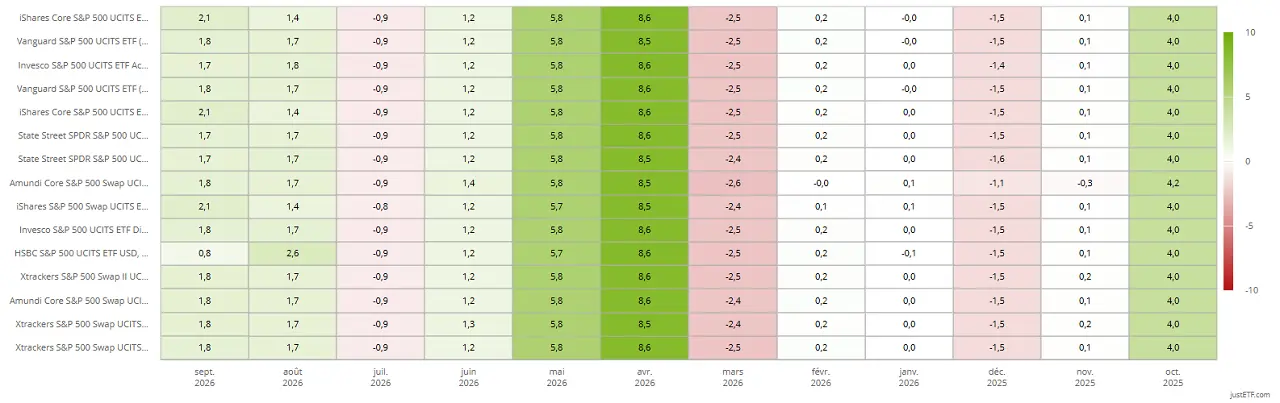
To help your decision, you can consult the comparative table of the different S&P 500 ETFs available below, taking into account the fund size and associated fees, and consult our below three best ETFs of 2026.
Heat Map Comparison Table of the 15 Largest S&P 500 ETFs in Europe
What are the advantages and drawbacks of S&P 500 trackers? Café de la Bourse view

Investing in an S&P 500 ETF offers several advantages, notably in terms of diversification and costs. But these trackers also carry some limitations that are worth knowing before investing.
What are the advantages of S&P 500 ETFs?
- Good diversification: with a single ETF, you invest in several hundred major American companies across different sectors.
- Very low management fees: S&P 500 ETFs are among the cheapest trackers on the market, with annual fees that can drop to 0.03%.
- High liquidity typically: the main S&P 500 ETFs are widely traded on the Exchange. It is therefore generally easy to buy or sell your shares, with bid-ask spreads often narrow.
Also discover our Top 7 Guide to the best placements and investments for 2026
What are the drawbacks of S&P 500 ETFs?
- Currency risk: most S&P 500 ETFs are not hedged against dollar movements against the euro. A fall in the dollar can penalize your performance, even if the US index rises.
- More limited choice in the PEA: not all S&P 500 ETFs are eligible for the PEA. There are some trackers that allow investing in this index via this tax wrapper, but the selection is more limited than on a standard stock account.
- Heavy concentration on large US stocks: even if the index includes about 500 companies, a large portion of its performance depends on a few giants, particularly in technology. An S&P 500 ETF thus does not allow global diversification of a portfolio.
What are the best S&P 500 ETFs? Our Top 3 S&P 500 trackers for late 2026
As part of this article, we conducted a rigorous selection of S&P 500 ETFs, favoring exclusively those that use a dividend capitalization method (accumulating).
We further refined our choice by opting for S&P 500 ETFs with the lowest management fees to maximize returns. Finally, we considered the amount of assets under management as an indicator of stability and trust, selecting funds with more than EUR 2.5 billion in AUM.
For the 3rd ETF, we chose an S&P 500 ETF eligible for the PEA while meeting the 2.5 billion AUM criterion and the lowest possible fees.
1. State Street SPDR S&P 500 UCITS ETF
ISIN : IE000XZSV718
Ticker code : SPYL
Fees : 0.03% per year
Trading venue : Euronext Amsterdam, Xetra-Frankfurt, Borsa Italiana, SIX Swiss Exchange, London Stock Exchange
Assets under management (AUM) : 17.6 billion EUR
Created on : October 31, 2023
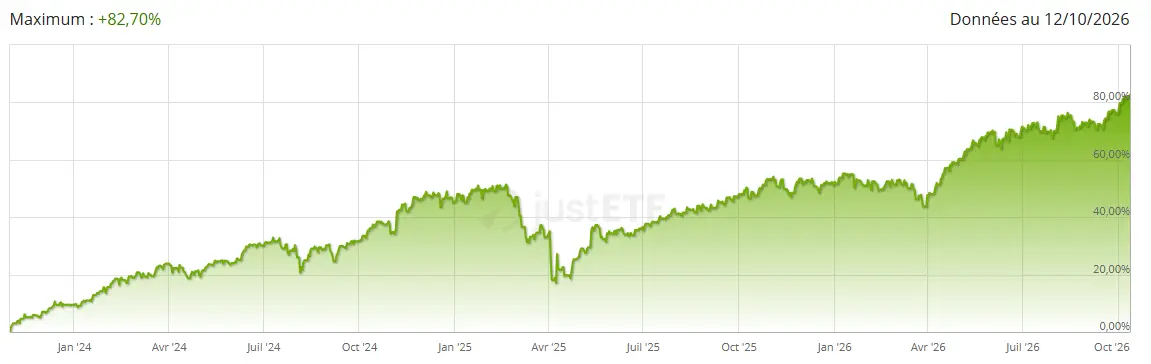
Performance of the SPDR S&P 500 UCITS USD ETF
2. ETF Xtrackers S&P 500 UCITS ETF
ISIN : IE000Z9SJA06
Ticker code : XDPU
Fees : 0.03% per year
Trading venue : Xetra-Frankfurt, Borsa Italiana, SIX Swiss Exchange, London Stock Exchange, Gettex
Assets under management (AUM) : 2.6 billion EUR
Created on : June 8, 2022
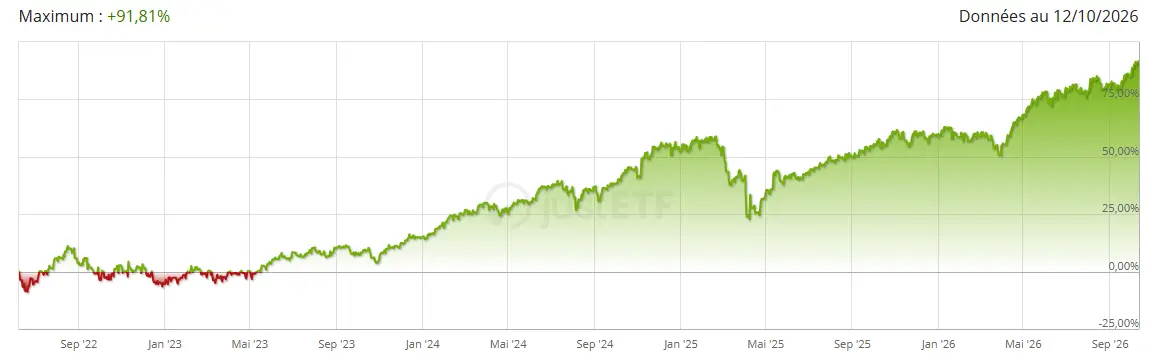
Performance of the Xtrackers S&P 500 UCITS ETF
3. BNP Paribas Easy S&P 500 UCITS ETF
ISIN : FR0011550185
Ticker code : ESE
Fees : 0.14% per year
Trading venue : Euronext Paris, Xetra-Frankfurt, Borsa Italiana, SIX Swiss Exchange, London Stock Exchange
Assets under management (AUM) : 3.65 billion EUR
Created on : September 16, 2013
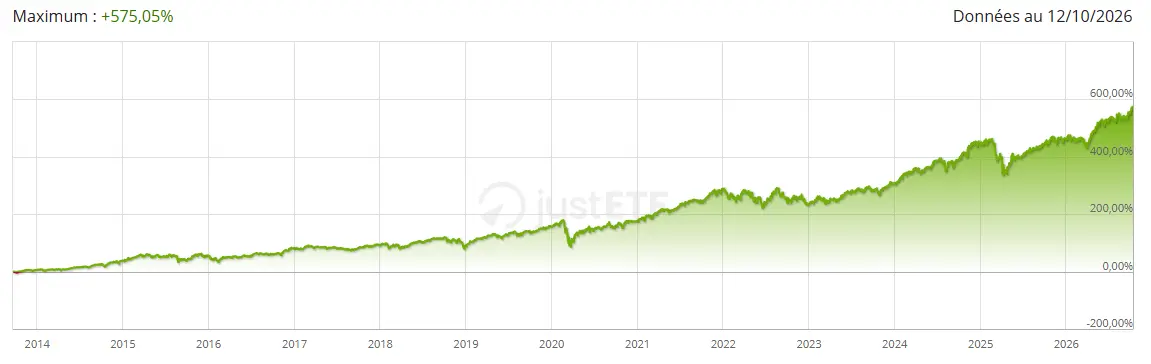
Performance of the BNP Paribas Easy S&P 500 UCITS ETF
All information is, by its nature, generic. It does not take into account your personal situation and in no way constitutes personalized investment recommendations for executing transactions and cannot be equated with investment advice or any encouragement to buy or sell financial instruments. The reader is solely responsible for using the information provided, and no recourse against the publisher Cafedelabourse.com is possible. The publisher Cafedelabourse.com’s liability can in no case be engaged in the event of an error, omission, or ill-timed investment.
