
Regularly investing in the stock market, for example each month with a fixed amount, is a strategy often recommended for medium- to long-term investing. This method, called DCA (Dollar Cost Averaging), allows you to spread your purchases of shares or ETFs over time, rather than investing all your capital at once.
But what results can one realistically obtain with DCA? And can this strategy be improved by adjusting contributions to market fluctuations? In this article, we analyze the performance of a monthly investment over ten years, before presenting dynamic DCA, an approach that involves investing more when prices fall and reducing contributions when they rise. We will outline two concrete methods to put it into practice, as well as their advantages and limitations. You will also find our video dedicated to this strategy.
You can invest in the stock market through the best securities accounts, as well as the best PEA accounts. Investment plans are offered by leading brokers such as Trade Republic, XTB, Scalable Capital or eToro, but also the best crypto platforms to gradually enter the markets.
What is a DCA strategy?
Let’s start with a quick reminder about the principle of the DCA (Dollar Cost Averaging) strategy, which is the English term corresponding to what we could call, in French, an investment plan.
The principle is simple: it involves spreading over time the buy orders for shares or ETFs that will compose your stock portfolio.
Rather than buying for an amount of €2,000 worth of Danone shares on the same day, the DCA strategy would consist of buying €80 worth each month for 2 years.
Since no one can predict the future, this method helps reduce the risk of a purchase at the wrong moment (such as right before a stock market crash). The strategy also smooths prices and minimizes market volatility to achieve a more regular performance.
The arrival of online brokers offering fractional share purchases provides great flexibility in implementing this type of investment strategy.
DCA: invest now or wait for the next dip? In video
Investing €150 per month in DCA: what results after 10 years? Practical case
What would your money have become if you had invested €150 every month in the stock market using DCA over the past ten years?
To find out, we conducted a simulation for the period from October 2016 to September 2026, with a monthly contribution of €150, i.e., €18,000 invested in total.
We selected four major stock indices, the CAC 40, the MSCI World, the S&P 500 and the Nasdaq 100, to which we added the Livret A in order to have a comparison with traditional savings. And as you will see, the results are very different from one investment to another!
Example of a €150 per month investment in DCA excluding taxes
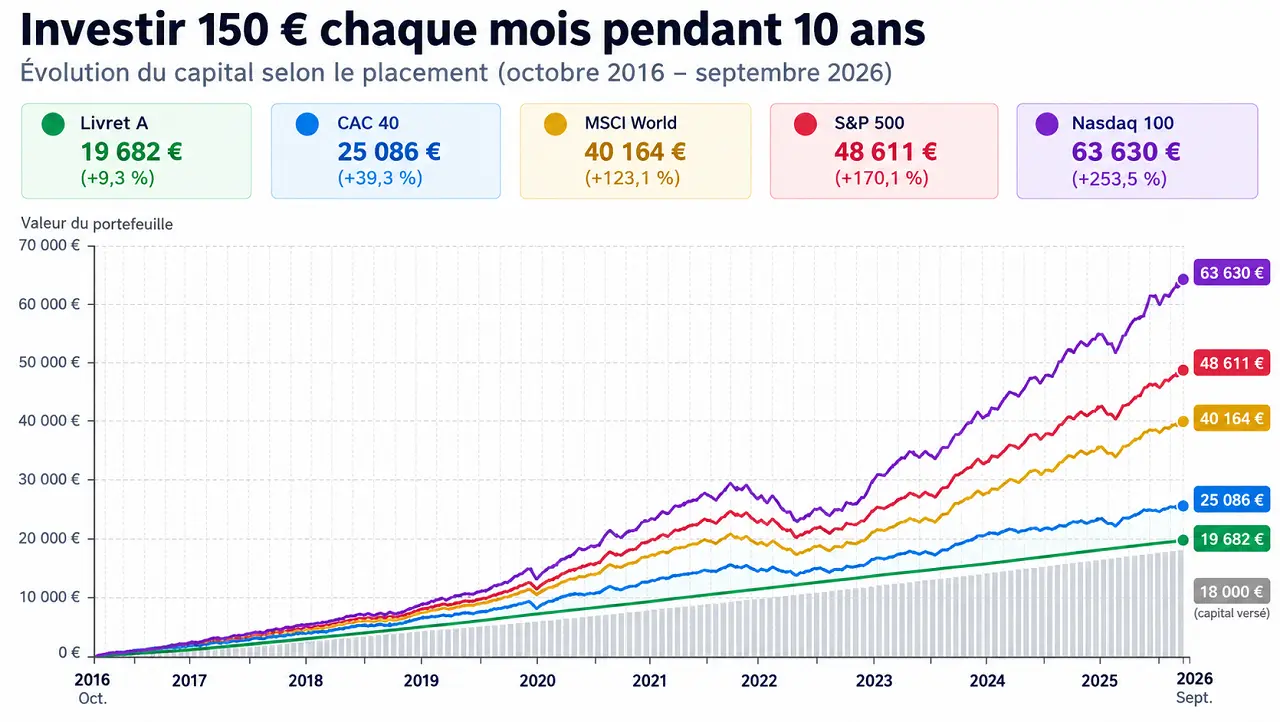
The results are particularly revealing, because with €18,000 invested over 10 years, the capital reaches €19,682 on the Livret A, versus:
- €25,086 for the CAC 40;
- €40,164 for the MSCI World;
- €48,611 for the S&P 500;
- up to €63,630 for the Nasdaq 100.
The Nasdaq 100 thus shows a gain of 253.5% relative to the amounts deposited, compared with only 9.3% for the Livret A. These gaps illustrate the potential of regular (DCA) investing in the stock market over the long term.
However, it should be noted that past performance does not predict future results and that stock market investments carry the risk of capital loss, unlike the Livret A.

What is the impact of taxation on the performance of Dollar Cost Averaging?
While raw performance helps measure the potential of a DCA strategy, it does not necessarily reflect the gains actually kept by the investor.
Indeed, when selling the securities, the realized capital gains may be subject to tax.
To go further in our simulation, we therefore incorporated the tax impact on the different stock placements, assuming a flat tax on gains (PFU) of 31.4% within a standard securities account.
The Livret A, for its part, benefits from exemption from tax on interest and social contributions.
Example of a €150 per month investment in DCA including taxes
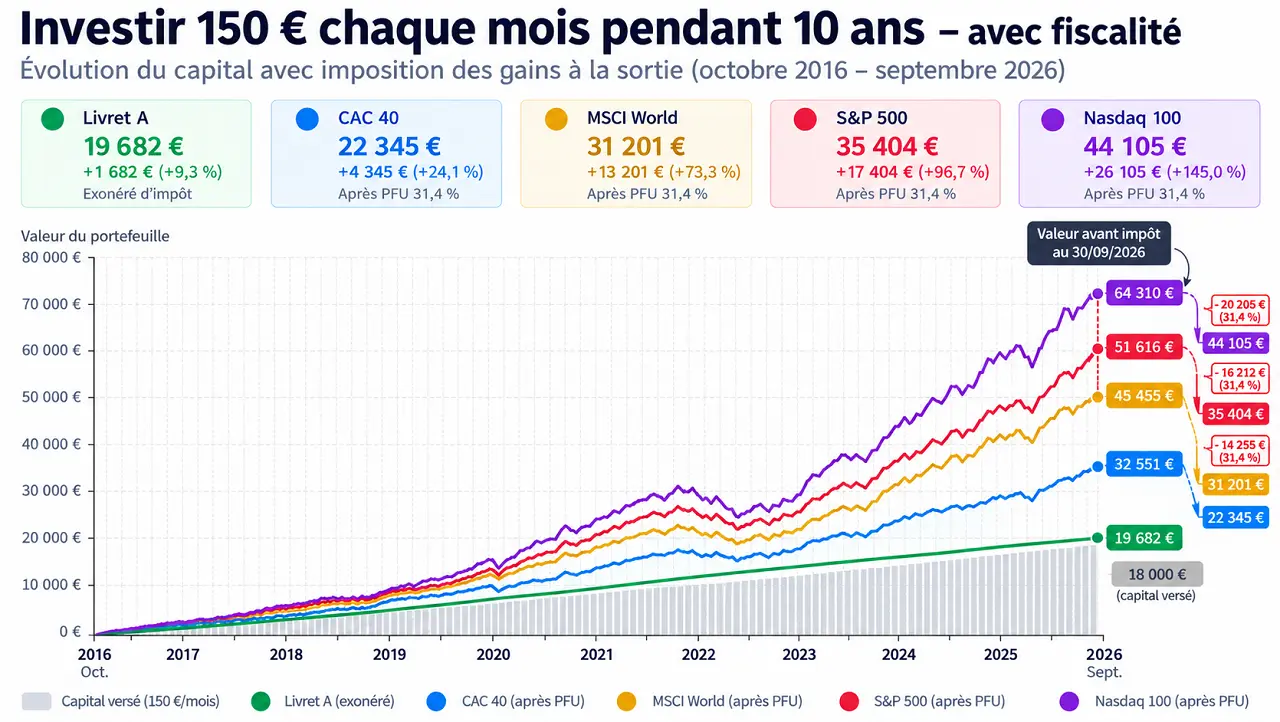
Taxation significantly reduces gains, but it does not change the ranking of investments in our simulation.
With €150 invested each month in DCA for ten years, the Nasdaq 100 still comes out on top with €44,105 after tax, followed by the S&P 500 (€35,404) and the MSCI World (€31,201). Even the CAC 40, at €22,345, outperforms the Livret A and its €19,682. Again, past performance is no guarantee of future results and stock market investing carries the risk of capital loss.
However, note that these calculations assume holding investments in a standard securities account. With a PEA for over five years, the taxation would be different since gains are exempt from income tax but remain subject to social contributions, a factor not to be overlooked when considering regular DCA in the stock market over many years.
Why is time an ally of DCA investing? A concrete example
With Dollar Cost Averaging you invest regularly, but each amount contributed does not have the same amount of time ahead of it. The €150 placed today could remain invested for ten years, while those paid toward the end of the program will only have a few weeks to grow.
Let’s take a closer look.
DCA: time as a determining factor
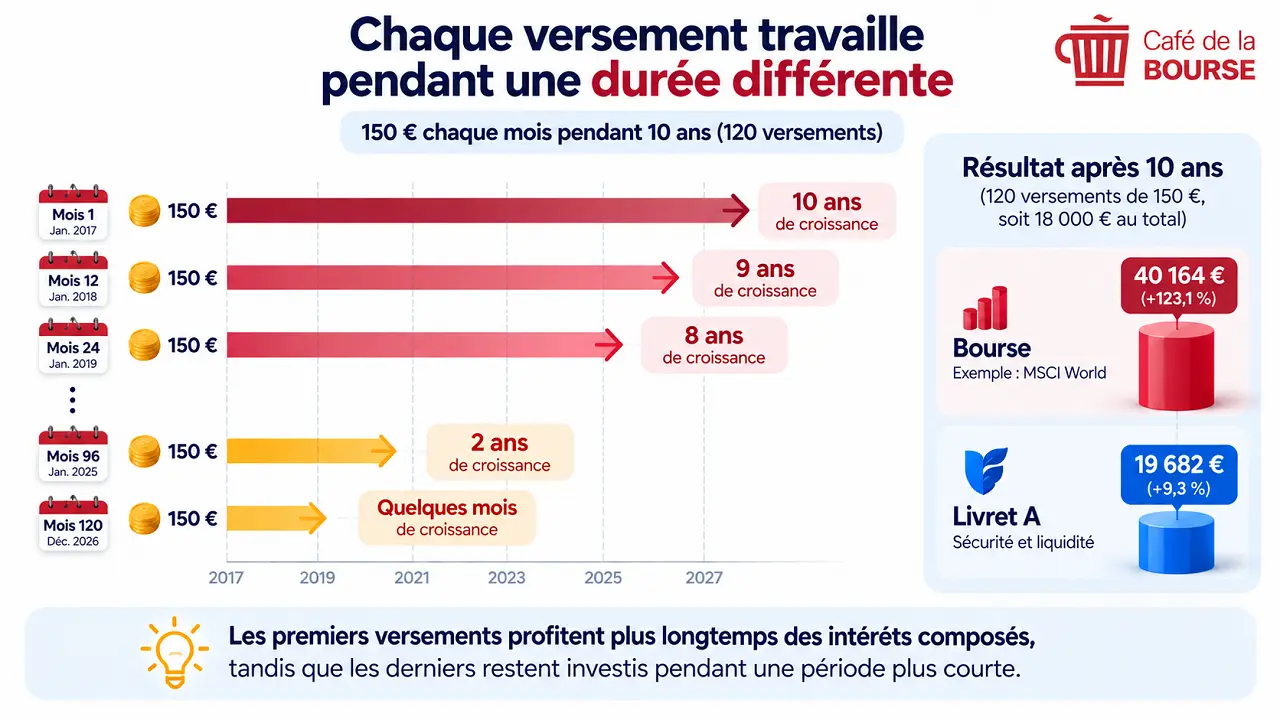
That is why it can be interesting not to wait too long before starting to invest. Even with €50 or €100 per month, starting a few years earlier can significantly change the capital obtained in the end. The early contributions will have more time to benefit from potential market upswings, but also to weather downturns.
This does not mean that an investment over ten or fifteen years will necessarily be winning. Simply, the more time you have, the less risk you run of having to sell your investments at an inopportune moment to fund a project or a need.
DCA in the stock market or Livret A: what are the yield differences according to duration?
Over 1 year, 3 years, or 10 years, the results of an investment can vary greatly. We therefore compared what monthly investments of €150 would have become on the Livret A and on the MSCI World, depending on the investment duration.
Example of a €150 per month investment in DCA: Livret A Vs Stock Market
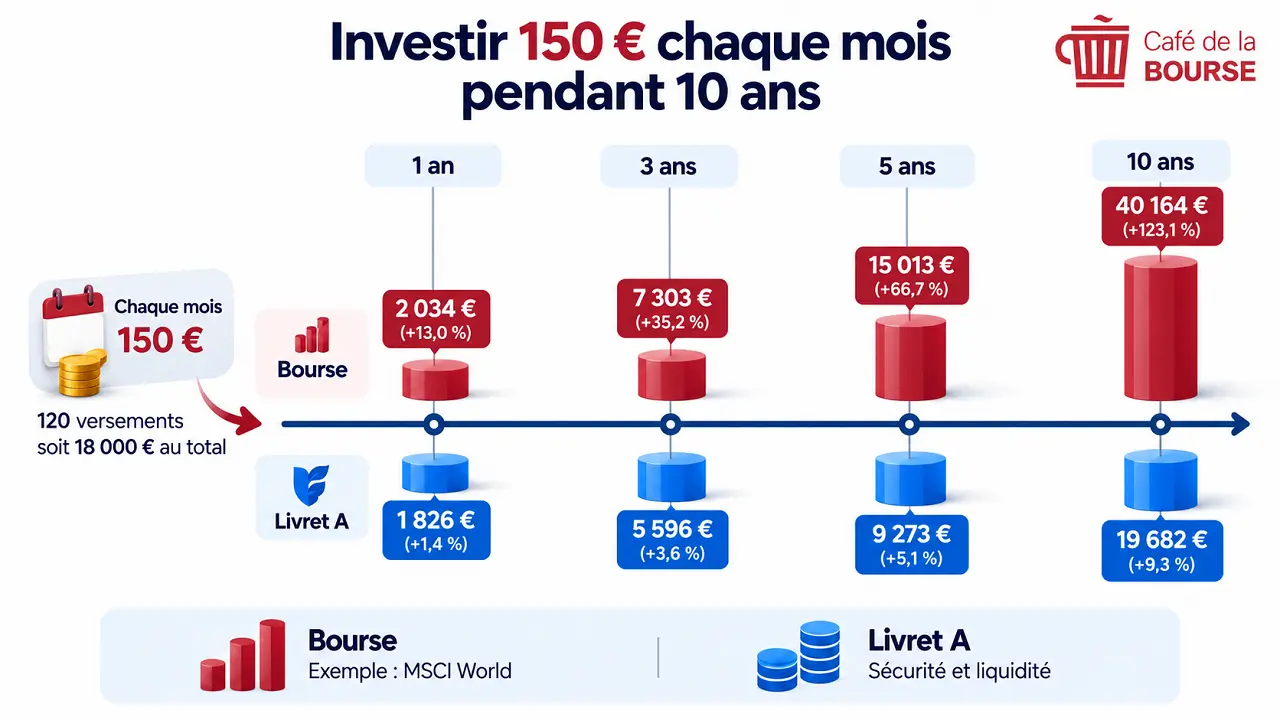
With exactly the same €18,000 deposited over 10 years, the gap is striking:
- €40,164 for the MSCI World
- versus €19,682 for the Livret A
Should one abandon their Livret A to invest everything in the stock market? Certainly not! These two placements do not serve the same needs.
The Livret A allows savings to be kept available at any time, without risk of capital loss. The MSCI World offers higher return potential, but it can also undergo sharp declines.
For a short-term project, safety must remain a priority.
How do compound interest effects reinforce Dollar Cost Averaging?
There is another phenomenon worth highlighting: compound interest.
Over the years, gains can themselves generate new gains, provided they are left invested. And the more time passes, the more this effect can amplify with DCA, as our latest simulation shows.
DCA: the magic of compound interest explained
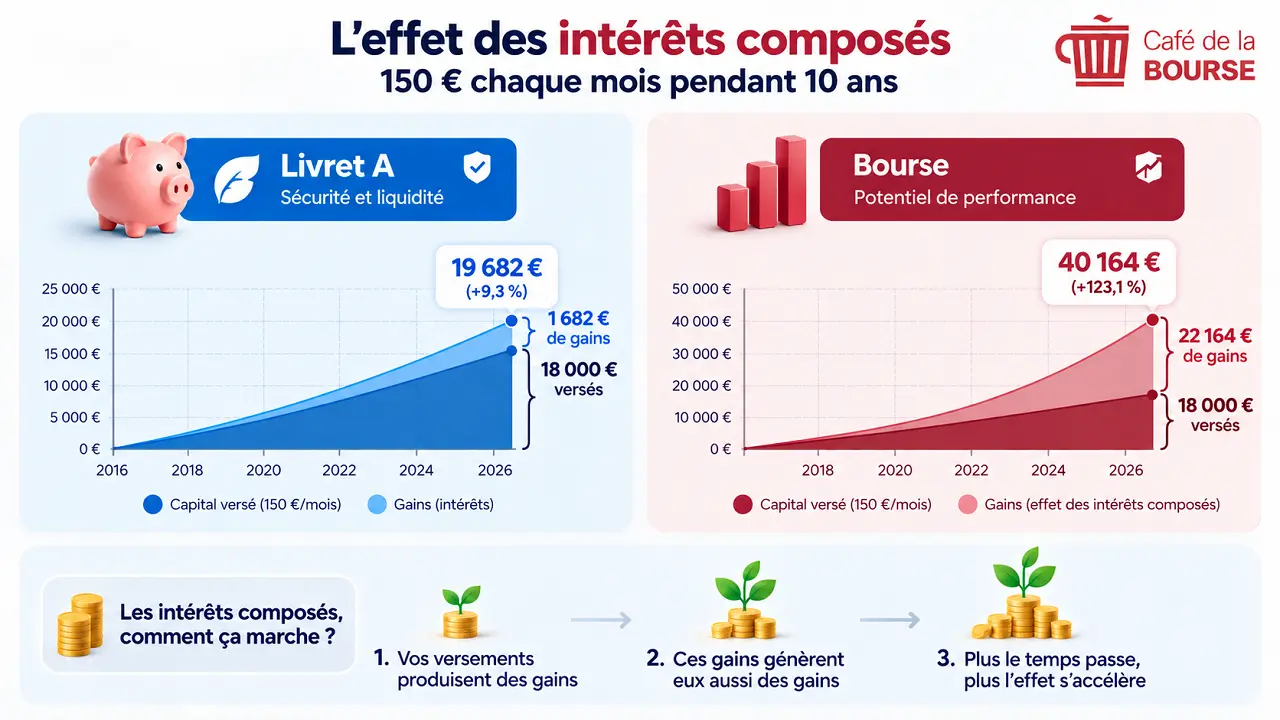
Our simulation clearly illustrates the power of this compound interest mechanism within a DCA. With €150 invested each month for 10 years, the MSCI World reaches €40,164, of which €22,164 are gains, against only €1,682 in interest for the Livret A. The difference is substantial, although it also reflects the very different performances of the two placements.
To fully benefit from compound interest, you should mainly keep the gains invested, notably by reinvesting dividends when investing in stocks.
And above all, be patient: results may take several years to become truly meaningful.
What is the dynamic approach to a DCA strategy?
The dynamic approach to Dollar Cost Averaging aims to adapt the amounts invested to market conditions. It can improve results in certain configurations, but it does not guarantee better performance than a classic DCA strategy.
The basic DCA investment strategy takes only one parameter into account, time! With the dynamic approach, we keep the time factor but also add an additional parameter. A parameter that professional managers consider essential to investment decision-making: the market itself.
We will therefore monitor market prices and movements to adjust the amount of staggered purchases.
The goal of dynamic DCA is to adjust exposure to the markets according to predefined criteria. The investor can thus reduce contributions when prices seem high and increase them after certain downturns, without being able to forecast future market moves with certainty.
Investing in DCA: why use the dynamic approach?
The effectiveness of the DCA investing strategy has proven itself and remains the best solution for those who do not have a lot of time to devote to managing their stock portfolio.
Investors who have a bit more time to manage their portfolio will quickly understand the value of the dynamic approach to the Dollar Cost Averaging strategy.
Below is a chart illustrating the difference in results between:
- an investment without a DCA strategy to invest;
- an investment following a simple DCA investment strategy;
- and the dynamic approach to the DCA investment strategy.
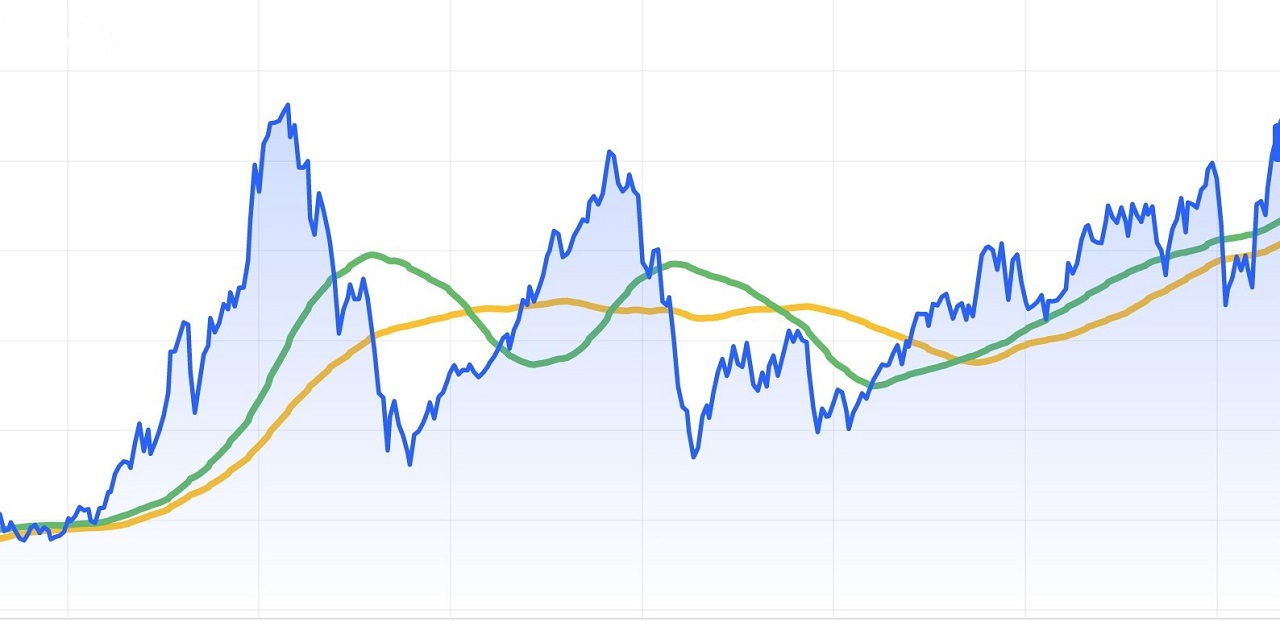
- The blue curve represents the evolution over several years of a stock portfolio whose manager did not use a DCA investing strategy.
- The green curve represents the evolution over several years of a stock portfolio whose manager used a DCA strategy for his investments (basic strategy).
- The orange curve represents the evolution over several years of a stock portfolio whose manager implemented the dynamic Dollar Cost Averaging approach.
A quick glance shows that the dynamic approach helps smooth out large market swings.
Note: this is an illustration representing a fictional scenario.
How to apply dynamic Dollar Cost Averaging? Method 1

The first method we will learn consists of taking the historical price levels of the stock index to which you are most exposed.
We will take here the CAC 40 index.
The first step is to draw two zones that will determine, on the one hand, the high-price zone and, on the other hand, the low-price zone.
Here is the result you could obtain:
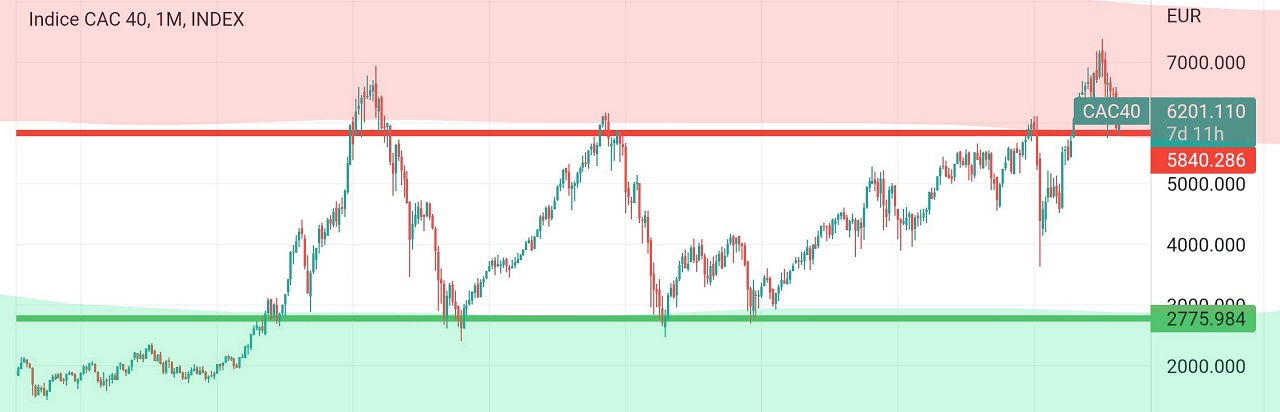
Note that there is not necessarily a right or wrong way to draw the reference lines and zones. It all depends on the investor.
Some will prefer to bring the zones closer together, while others will choose to space them further apart. The most important thing is to be comfortable with the methodology you will implement.
The hard part is done. You must now determine three amounts. If you intended to invest €100 each month, we could determine the following amounts:
- 150€
- 100€
- 50€
The strategy is simple. You only invest 50 € when the CAC 40 price is in the high zone, 100 € when the CAC 40 price is in the middle zone, and 150 € when the CAC 40 price is in the low zone.
By applying this dynamic strategy, you will therefore reduce the amount of your contribution (monthly or quarterly depending on your investment plan) to lower your risk during periods signaling a higher probability of market declines.
Conversely, you will increase your contribution amount to raise your profit potential when the probability of market gains is higher.
How to apply dynamic DCA? Method 2
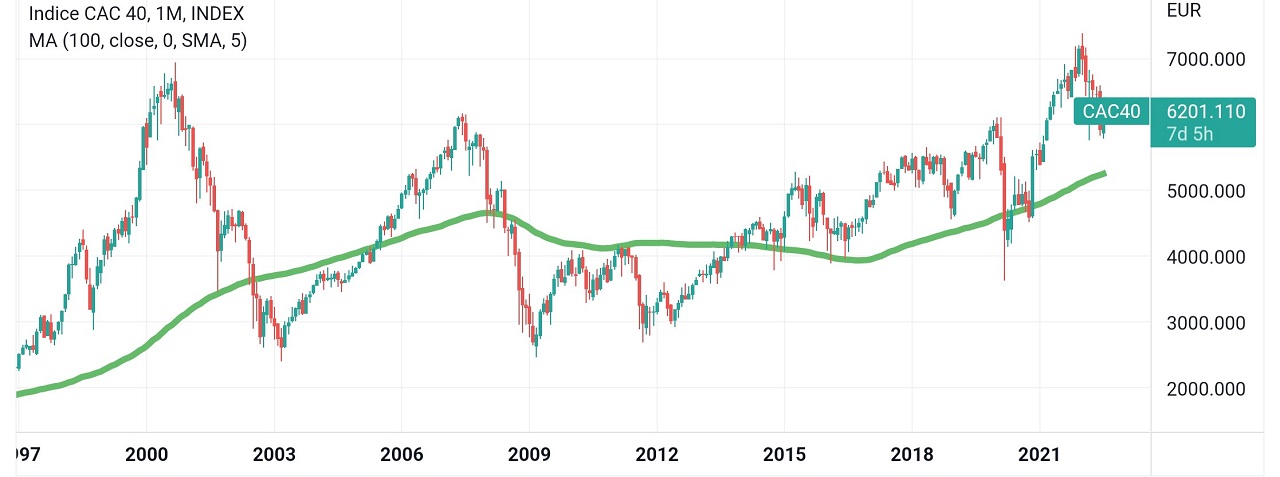
The second method we will analyze in this article is quite close to the previous one. The difference is that the investor does not arbitrarily draw zones on the price history, but relies on moving averages. The principle remains similar, but the method here rests on two situations: when the market price is above its moving average and when it is below.
When the market price is above its moving average, you should reduce the amount of the contribution. Conversely, when the market price is below its moving average, you should increase the contribution amount.
To apply this strategy correctly, it is advisable to use simple moving averages over 100 periods on a daily chart.
Here is an example of what you could obtain:
Programmed DCA investing: what are the advantages and drawbacks of the dynamic approach?

We will conclude this article by listing the advantages and disadvantages of this type of investment strategy.
What are the advantages of the dynamic DCA approach?
Dynamic DCA can present several benefits for investors who want to adjust their purchases to the evolution of financial markets:
- Better manage market volatility: rather than investing the same amount every month, the investor adjusts contributions based on market movements. This can help avoid committing large sums when prices seem particularly high.
- Limit exposure before certain market crashes: by reducing purchases during market phases deemed risky, the investor can sometimes mitigate the consequences of a sharp correction. It remains essential to identify the right signals, which is far from obvious!
- Buy more when prices fall: this is arguably one of the most interesting aspects of this method. When stocks or ETFs become cheaper, increasing contributions allows acquiring more shares with the same budget.
- Hope to improve long-term performance: by buying less when markets are expensive and more when they fall back, dynamic DCA can help achieve a better average purchase price. That does not guarantee it will always outperform a classic DCA.
What are the drawbacks of the dynamic DCA approach?
While dynamic DCA offers some advantages, one must also be aware of the constraints it entails before getting started:
- Time to devote to your investments: unlike classic DCA, where contributions can be automated, this method requires keeping an eye on the markets. No need to become an active trader and monitor prices all day! A check once or twice a week can suffice, depending on the chosen strategy.
- Sometimes difficult decisions to make: should you increase purchases after a 10% drop or wait for a larger correction? This kind of question regularly arises with dynamic DCA. You must therefore set your own rules and, above all, manage to follow them.
- The risk of missing some upside: by reducing contributions when markets look too expensive, you may miss part of their upward movement. And since no one knows exactly when prices will resume rising or falling, adjustments do not always hit the right moment.
- Performance not necessarily better: spending more time on your portfolio does not automatically mean more money. In some market conditions, a classic DCA can even yield better results without requiring as much monitoring.
Marc’s comment:
In the stock market, there is no magic solution offering guaranteed results. Keep in mind that on financial markets, the past is rarely an exact reflection of the future. This is why there can be scenarios where a dynamic DCA approach will not deliver the expected positive results.
Replay of the videoconference on the programmed dynamic DCA strategy to take advantage of market fluctuations
All of our information is, by nature, generic. It does not take into account your personal situation and does not constitute personalized recommendations for the execution of transactions and cannot be construed as financial investment advice, nor as any encouragement to buy or sell financial instruments. The reader is solely responsible for using the information provided, and no recourse against the publisher Cafedelabourse.com is possible. The publisher Cafedelabourse.com’s liability cannot be engaged in case of error, omission, or ill-advised investment.
