
Although Microsoft stock has largely underperformed the U.S. S&P 500 index this year, the release of its latest results and the acceleration of growth in its Cloud division could change the game and support its share price.
Should you trade or invest in Microsoft stock via one of the best brokerage accounts by the end of 2026 after the results? What are the prospects for Microsoft in artificial intelligence? The stockbroker ActivTrades offers you an analysis of Microsoft stock at the end of 2026.
Microsoft reports Q1 2027 results powered by Azure and the acceleration of AI profitability
During its first fiscal quarter 2027, Microsoft posted results well above expectations, driven by strong cloud momentum and ongoing integration of artificial intelligence:
- Revenue: $92.28 billion (+19% year over year)
- Net income: $36.63 billion ($4.92 per share, vs $3.72 a year earlier, up 32%)
- Free cash flow: $18.6 billion
The performance of the Azure Cloud division drew particular attention from the markets. With 48% growth in the quarter and expected growth between 49% and 50% for the next quarter, the Azure division’s momentum dispels much of the suspicion that weighed on tech giants.
While Wall Street feared an overvaluation of AI infrastructure needs or late returns on investment, Microsoft provides concrete evidence that its investment outlays translate directly into contracts and recurring revenues.
This achievement reassures investors on two fronts. First, it demonstrates that AI solutions enrich and extend Microsoft’s software empire rather than cannibalizing it. Second, it confirms, to some extent, that the group maintains a degree of independent technological control, reducing concerns about dependence on external partners such as OpenAI.
To sustain this colossal pace of investment in data centers while preserving margins, Microsoft maintains strict budgeting discipline. It has extended a voluntary separation plan that could affect up to 60,000 employees, from a total workforce of 223,000 (as of end June).
This solid ability to self-finance its transformation through cash reserves clearly distinguishes Microsoft from some competitors, who are forced to rely more on debt to fund the AI race.
The colossal AI spending weighed on the cash reserves of hyperscalers
Microsoft maintains the financial edge against liquidity-stretched rivals
What is the price of Microsoft stock today?
How is Microsoft benefiting from artificial intelligence?
Artificial intelligence has now become a strategic growth engine for Microsoft. The group does not merely develop AI models or add new features to its software: it seeks to monetize this technology at multiple levels, from renting cloud computing power to selling intelligent assistants to businesses and individuals. This strategy allows it to build on already well-established activities, such as Microsoft 365, Azure, Windows and GitHub, to disseminate AI to an existing client base while developing new revenue streams.
Azure: the infrastructure powering AI development at Microsoft
The primary monetization lever for AI at Microsoft is its cloud computing activity, led by Microsoft Azure. Developing AI models requires substantial computing power, specialized processors, storage, and network infrastructure. Yet most companies do not have the financial means or technical expertise to build and operate such infrastructures at scale. This is where Microsoft steps in, offering to rent these resources through Azure.
The company also markets services enabling developers to create applications incorporating AI models, deploy them, and manage them without building the entire underlying infrastructure. The Azure AI platform and related services thus facilitate access to models, development tools, and the computing power needed to use them. Microsoft also benefits from demand from companies that want to host their own data and applications in the cloud while adding AI capabilities.
The partnership with OpenAI has strengthened this position. Microsoft invested in the company behind ChatGPT and provides cloud infrastructures used to develop and operate its models. This relationship allows it to offer advanced AI technologies to its professional clients while supporting demand for Azure.
The financial appeal of this strategy is twofold for Microsoft. On the one hand, AI can increase Azure usage by existing customers. On the other hand, it can attract new customers who need computing power to develop their own solutions. In both cases, Microsoft can generate recurring revenues, especially when deployed applications require substantial and continuous computing power.
Microsoft 365 Copilot: monetizing AI with existing enterprise clients
The second lever rests on integrating AI into Microsoft’s professional software, notably Word, Excel, PowerPoint, Outlook and Teams. With Microsoft 365 Copilot, the group turns its office suite into a set of tools capable of assisting users with their day-to-day tasks.
The company already has a broad professional customer base that uses its software and whose data, documents, and communications are often hosted within its environment. It can therefore offer AI as an extension of existing services, without having to convince every company to overhaul its working tools. Integration with the usual software facilitates adoption.
This business model relies notably on the sale of paid licenses, typically billed per user per month, in addition to the Microsoft 365 subscriptions concerned. Each company adopting Copilot at scale can thus increase recurring revenues generated by its customer base. As the number of paying users grows, Microsoft can also better monetize the investments made in its models, software, and infrastructures.
This strategy also aims to strengthen customer loyalty. When a company organizes its documents, communications, and workflows around the Microsoft ecosystem, replacing that environment can become more complex. AI can therefore increase the perceived value of the Microsoft 365 suite and contribute to consolidating the group’s position in the professional software market.
GitHub Copilot: leveraging AI in software development
Microsoft also leverages artificial intelligence in software development through GitHub Copilot. This tool helps developers write code, complete functions, understand existing programs, identify certain errors, and automate some repetitive tasks. They can thus help reduce the time required to deliver certain features.
The value proposition goes beyond merely generating lines of code. The most advanced assistants can intervene at different stages of the development cycle. This activity provides several revenue streams for Microsoft. GitHub sells individual and professional subscriptions, as well as offerings for large enterprises. AI can thus generate additional revenue directly through Copilot licenses, while strengthening the appeal of the GitHub platform, which is already widely used to host and manage code at various stages of the development cycle.
The economic logic is similar to that of Microsoft 365 Copilot: turn an AI technology into a billable service while increasing the value of the existing software ecosystem.
How far can Microsoft stock go by the end of 2026? ActivTrades’ view and technical analysis
Microsoft stock continues on an impressive upward trajectory. After gains of more than 56% in 2023, 12% in 2024, and 14% in 2025, the price has already risen more than 15% since the start of 2026. This momentum sits within a long-standing rally: between 2013 and 2021, the stock surged by over 1,130%, with only one down year in 2022 (-28%).
As the release of its latest quarterly results again propelled the price into after-hours trading, can Microsoft reach new all-time highs?
Technical analysis of Microsoft stock price
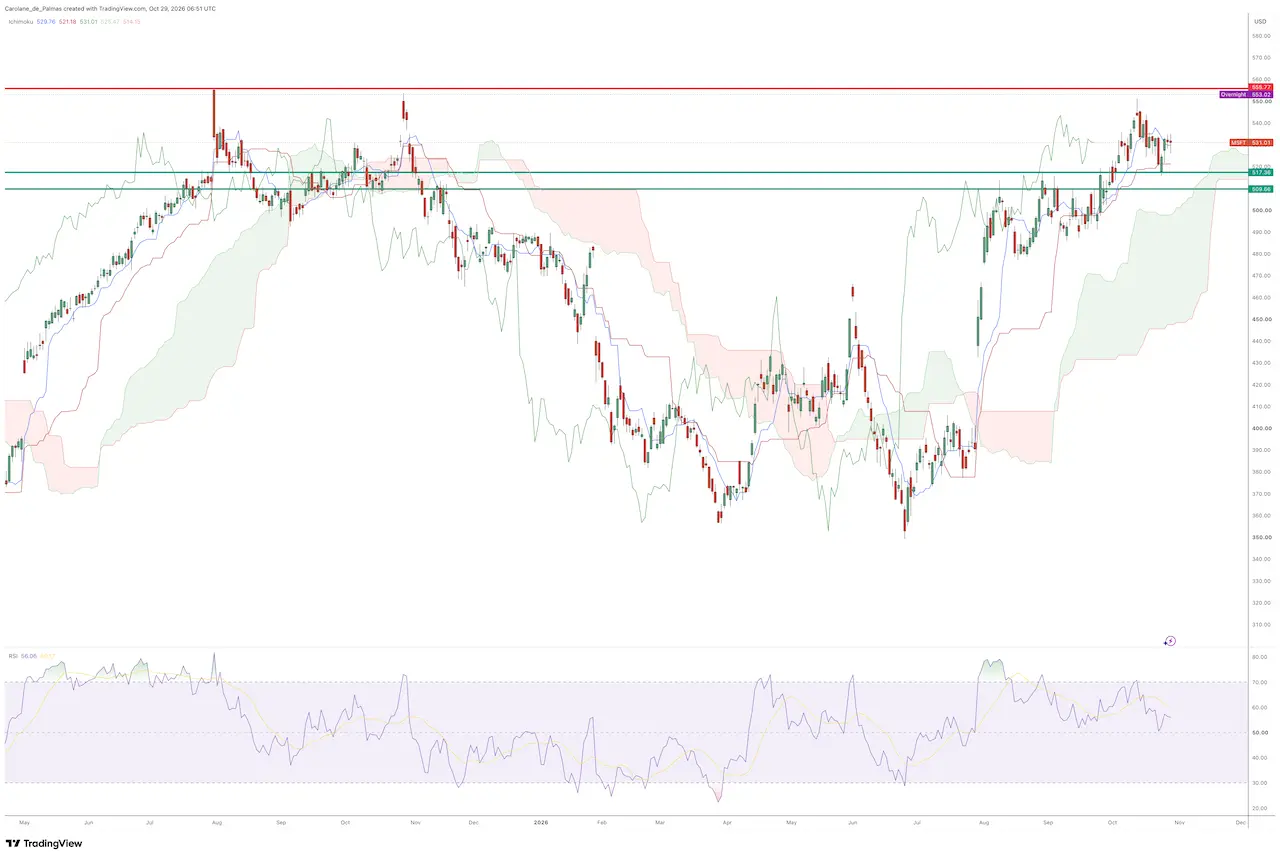
Following the release of better-than-expected quarterly results on Wednesday, October 28, 2026, buyers’ interest was immediately revived and Microsoft’s stock price jumped in after-hours trading. The Microsoft stock now trades around $553, nearing its all-time high near $555.
This positive reaction reflects renewed market confidence: investors now believe Microsoft is capable of maintaining the strong AI-related activity while preserving robust financial health. The market likely welcomed Microsoft’s trimmed CAPEX forecast for 2026, moving from about $190 billion in the prior quarter to around $175 billion, demonstrating the company’s ability to streamline capital allocations without throttling its innovative capacity.
Technically, a sustained breakout above the major resistance at $555 would open the door to new all-time highs. Conversely, if the market faces legitimate profit-taking after this rally, or if sector-wide consolidation hits the tech giants, a pullback of Microsoft stock toward the first key support zone around $517 would be worth considering, followed by a second level near $509.
Should you buy Microsoft stock by the end of 2026? ActivTrades view
Thanks to its position in cloud computing, the integration of AI into its software, and its solid financial position, Microsoft presents favorable arguments for a long-term investment. The group seems better prepared than some rivals to turn AI spending into recurring revenues, thanks to its diversified activities and its ability to generate cash flow.
Azure is a major growth engine. In the first quarter of fiscal 2027, ending September 30, 2026, its revenue grew 48% year over year to $33.2 billion. Microsoft’s total revenue reached $92.3 billion, up 19%, while Microsoft Cloud revenues rose 30% to $63.9 billion. These performances testify to strong demand for cloud services, even if growth does not come exclusively from AI.
Microsoft also benefits from its portfolio of professional software. With Microsoft 365 Copilot, GitHub Copilot and its enterprise solutions, the group can market AI features to an existing customer base, expanding paid subscriptions and cloud service consumption.
Its financial strength is another asset. Operating income rose 21% to $45.9 billion, and adjusted earnings per share rose 18% to $4.89. Microsoft also generated about $18.6 billion in free cash flow despite $45.2 billion of capital expenditures.
This ability to fund its growth sets Microsoft apart from some competitors. Alphabet and Meta have reported negative free cash flow in their latest quarters. Note, however, that these differences do not preclude their future profitability.
ActivTrades commentary :
“While Microsoft stock trades near its all-time highs, adopting a Dollar Cost Averaging (DCA) strategy through a savings plan allows for a gradual position in Microsoft while mitigating the impact of near-term volatility.”
Outlook remains favorable, but massive infrastructure investments, competitive risks, and stock valuation must be considered. For the investor, the challenge will be to verify that revenue and earnings growth can sustainably monetize the AI outlays.
6 reasons to invest in Microsoft stock by the end of 2026
- Diversified exposure to artificial intelligence
- Strong Azure growth
- Sustained earnings growth
- Significant ability to generate cash
- Diversified business model (cloud infrastructure and software already used by many companies)
- Ability to monetize AI with an existing customer base
6 reasons not to invest in Microsoft stock by the end of 2026
- Very high investment spend
- A risk of reduced profitability if AI demand slows, prices fall, or infrastructures are not sufficiently utilized
- Intense competition, notably from Amazon Web Services, Google Cloud, and AI specialists
- A partial dependence on technology partnerships, notably with OpenAI
- A risk of substantial stock valuation
- Uncertainty about converting revenue growth into sustainably higher free cash flow, given the need to renew infrastructures
Discover our weekly newsletter

Some questions about Microsoft stock
Microsoft’s potential primarily rests on the momentum of the Azure Cloud division and the rapid monetization of AI via its Copilot suite, ensuring recurring and high revenues. Investors could potentially anticipate long-term appreciation driven by this dominant position, while benefiting from steadily rising dividends.
Yes, investing in Microsoft stock carries risks, despite the group’s financial strength and AI prospects. The high investment outlays required to develop AI infrastructures could weigh on cash flows if the revenues generated do not grow sufficiently to monetize them. Competition is also a major challenge, likely to pressurize prices and margins. Finally, a high stock valuation could amplify corrections if results or outlook disappoint market expectations.
Yes. Microsoft pays a quarterly dividend, although it is not among the U.S. firms with the highest dividends. In Q1 of fiscal 2027, it was $0.98 per share, rising steadily from prior years (0.91 in 2026, 0.83 in 2025 and 0.75 in 2024).
The information from Cafedelabourse.com and its publications is provided for educational purposes. They do not constitute investment recommendations in any way. Readers should study the risks before making any transaction. They are solely responsible for their investment decisions.
Past performance is not indicative of future results. Investing in stocks involves the risk of capital loss.
All of our information is, by its nature, generic. It does not take into account your personal situation and does not constitute personalized investment recommendations or an invitation to buy or sell financial instruments. The reader is solely responsible for using the information provided, with no recourse against Cafedelabourse.com’s publisher. The publisher cannot be held liable for any error, omission, or inappropriate investment.
