
Despite solid financial results and a well-filled order book, Airbus’ stock has fallen 4.57% since the start of 2026. A situation that may surprise since the European aerospace giant continues to grow, with revenue up 7% in the first nine months of the year and still encouraging prospects.
But amid production difficulties, supply chain tensions, and economic uncertainties, should one take advantage of the Airbus stock decline to invest in the market?
Discover in this article our analysis of Airbus stock, its latest financial results, its key fundamental indicators, our technical analysis and our view on the prospects for Airbus shares by the end of 2026, not to mention how to buy Airbus stock.
Who is Airbus? History and key figures
Airbus’ history begins in 1970, when several European manufacturers decided to pool their resources to compete with American aircraft manufacturers, notably Boeing. The launch of the A300, the world’s first twin-aisle wide-body aircraft, marks the start of an industrial adventure that would progressively transform the global market for commercial aviation.
Over the decades, Airbus established itself as one of the two main producers of commercial aircraft in the world. The success of the A320 family, followed by the development of the A350 and A220, allows the group to diversify its offering and strengthen its position against Boeing.
For investors, this story is also one of an economic transformation. Airbus progressively developed its activities in helicopters, defense, and space, while building a model based on long-term industrial programs. Its order book today constitutes a major asset for the visibility of its future revenues.
Key information about Airbus
| Key Information | Data |
| Company | Airbus SE |
| Stock code | AIR |
| ISIN code | NL0000235190 |
| Main listing | Euronext Paris |
| Industry | Aerospace, defense and space |
| Creation date | 1970 (Airbus Industrie); 2000 (creation of EADS, later Airbus SE) |
| Headquarters | Leiden, Netherlands (main operational offices in Blagnac, France) |
| CEO | Guillaume Faury |
| Geographic presence | Worldwide, more than 180 sites |
| Market capitalization | €154.04 billion (as of November 2, 2026) |
| Stock index | CAC 40, DAX 40, EURO STOXX 50 |
| Number of employees | Approximately 169,000 |
What were Airbus’ latest results in 2026?
The first nine months of 2026 went fairly well for Airbus, which managed to improve its results despite the difficulties faced by the aviation industry. Deliveries of commercial aircraft are up, while the defense and space division shows better profitability, which directly benefits the group’s earnings.
Commercial results by division for the first nine months of 2026
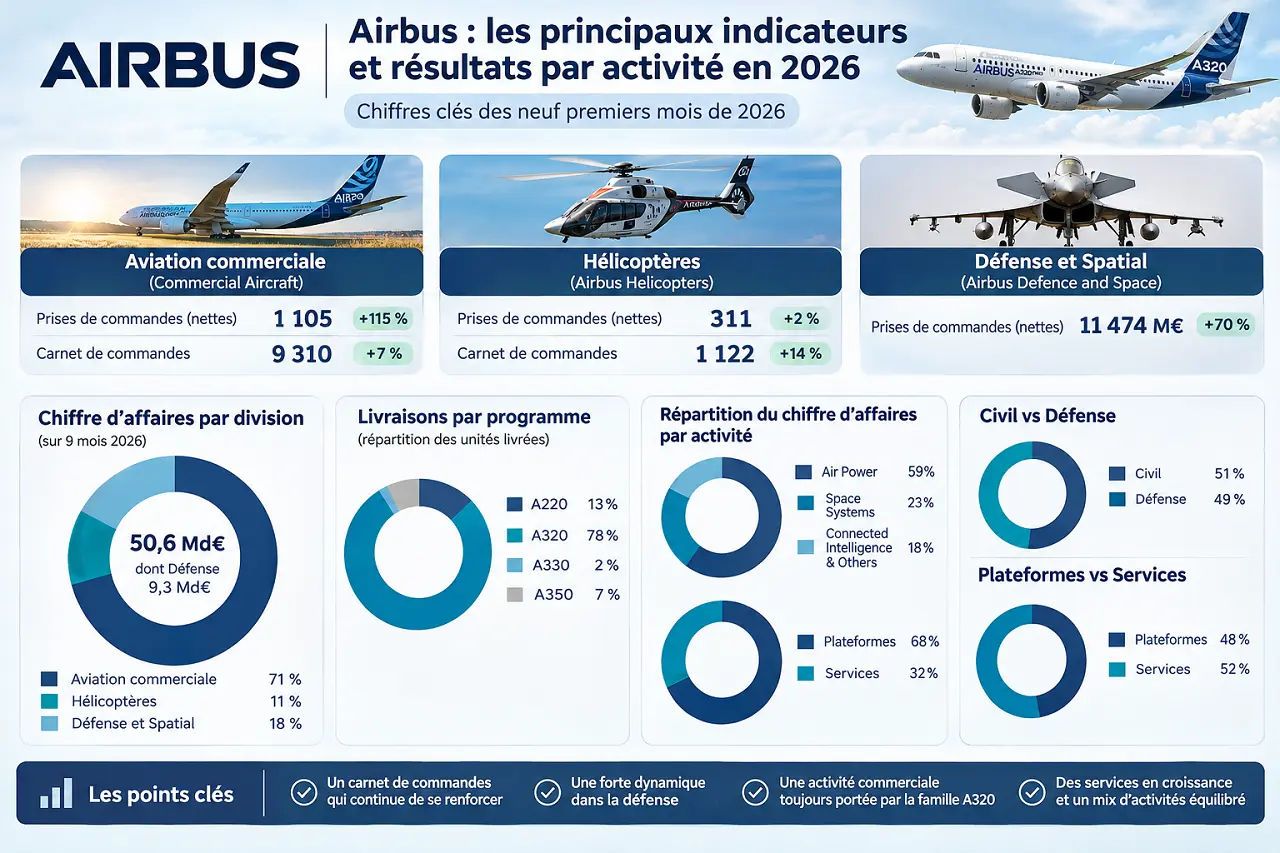
But Airbus is not yet free from its difficulties. Engine supply problems continue to complicate production, and integrating Spirit AeroSystems’ activities still requires efforts. Cash flow is also under pressure, particularly because the manufacturer must build substantial inventories to prepare the deliveries scheduled for the end of the year.
The group remains confident and has not revised its annual targets downward. The question now is whether Airbus will be able to meet its delivery schedule, a key element for its financial results and the evolution of Airbus’ stock in the market.
Key figures of Q3 2026 results for Airbus
| Metric (Q3 2026) | Value |
| Revenue | €17.469 billion |
| Gross margin | €3.132 billion (17.9%) |
| Operating profit (adjusted EBIT) | €1.768 billion |
| Reported operating profit (EBIT) | €1.805 billion |
| Net income (group share) | €1.344 billion |
| Adjusted net income (nine months) | €3.368 billion |
| Earnings per share (EPS) | €1.70 |
| Free Cash-Flow | -€65 million |
| Net debt | Net cash position of €7.0 billion as of September 30, 2026 |
Commentary by Guillaume Faury, CEO of Airbus:
These nine-month results reflect the progression of our ramp-up in civil and military activities, supported by strong demand for our products across our entire portfolio. Despite a complex geopolitical and operational environment, we remain focused on deliveries, while continuously paying attention to quality. Our plan is clear and our teams are mobilized to achieve our objectives.
What is Airbus’ position in the aerospace sector in 2026?
*Your capital is at risk. See terms on the website.
In 2026, Airbus remains the heavyweight of the European aerospace industry. In France, where its main assembly lines are located in Toulouse, the manufacturer occupies a central position alongside Safran, Dassault Aviation and Thales, which are more specialized in engines, business aircraft, defense, or equipment.
At the European level, Airbus benefits from a dominant position in commercial aviation. Worldwide, its main competitor remains Boeing, with whom it shares the bulk of the large-capacity airliner market. Brazilian Embraer and Chinese COMAC are also looking to gain ground, notably in short- and medium-range aircraft.
Honda, with its HondaJet, is developing in the market for small business jets, without directly competing with Airbus. For investors, the main strength of the group remains its order book, which provides multi-year commercial visibility.
Commentary by Guillaume Faury, CEO of Airbus :
Despite this challenging environment, we continue our progress by accelerating production rates in the civil and military activities […]. The defense sector remains strong, in Europe as well as elsewhere in the world. Our product portfolio continues to demonstrate its essential role in guaranteeing sovereignty and security.
Should one invest in Airbus stock by the end of 2026? Café de la Bourse view
In our view, Airbus stock remains attractive for building a portfolio over several years, but it is not necessarily a stock to rush into today. The main risk is not so much Airbus losing its place in the aviation market as a misalignment between investors’ expectations and the manufacturer’s ability to meet its industrial commitments.
This is likely where everything will be decided in 2027. Airbus already has strong demand, but its next step is primarily to convert its orders into delivered aircraft, then into available cash. A rise in profits may not necessarily be enough to lift the stock if markets feel results should have been even better. Conversely, an improvement in deliveries and cash generation could rekindle interest in Airbus stock, even without a dramatic acceleration of growth.
For a long-term investor, gradually buying Airbus stock can make sense, provided one accepts the volatility of the aerospace industry and does not allocate an excessive portion of their portfolio to it. A more prudent approach would be to wait for the manufacturer to provide more evidence of its ability to improve profitability and cash flows. Airbus remains a fine company, but on the stock market, industrial success and stock performance do not always go hand in hand.
How to invest in Airbus stock in practice?
To invest in Airbus stock on the market, you can go directly through the stockbroker XTB, which allows buying Airbus shares both from a regular securities account (CTO) and from a Stock Savings Plan (PEA). One of XTB’s main advantages is its pricing, as XTB offers 0% commission on stocks and ETFs up to €100,000 of monthly trading volume. Beyond that, a 0.2% commission applies, with a minimum of €10 per order.
Another interesting option, especially when a stock price seems high: the purchase of fractional shares, offered by XTB on its securities account. It is therefore not necessary to buy a full Airbus share to start investing.
Finally, to avoid concentrating your investment in a single company, you can also invest via ETFs that replicate indices such as CAC 40, DAX 40 or Euro Stoxx 50, which include Airbus among their components. ETFs focused on aerospace and defense provide another way to gain exposure to this sector while diversifying your stock portfolio. These ETFs are available within the best PEA and the best stock accounts.
The information from Cafedelabourse.com and its publications is provided for educational purposes. They do not constitute investment recommendations. Readers should assess the risks before executing any transaction. They are solely responsible for their investment decisions.
Past performance does not guarantee future results. Investing in stocks carries the risk of capital loss.
All of our information is, by nature, generic. It does not take into account your personal situation and does not constitute personalized recommendations for the purpose of executing transactions and cannot be equated with financial investment advice, nor with any invitation to buy or sell financial instruments. The reader is solely responsible for using the information provided, and Cafedelabourse.com cannot be held liable. The publisher’s liability cannot be engaged in case of error, omission, or inappropriate investment.
