
A record number of armed conflicts taking place worldwide, financial problems caused by the reduced contributions of the U.S. under the management of Donald Trump, threats about the potentially destructive power of artificial intelligence, and the widening risks of climate change to food security are some of the challenges that the next UN Secretary-General will have to face starting in 2027.
Seven names are in the running for the post, but so far no consensus candidate has emerged.
Read more: The U.S. manages to persuade more countries to oppose the UN resolution condemning the embargo on Cuba
Read more: UN: Guterres says military power alone will not guarantee peace and calls for multipolarity
There is no specific date for UN member states to decide who will replace Antonio Guterres, but that decision must be made before December 31.
Of the names put forward since last year, seven candidates remain in the race: Ivonne A-Baki (Ecuador), María Fernanda Espinosa (Ecuador), Rafael Grossi (Argentina), Rebeca Grynspan (Costa Rica), Lana Nusseibeh (United Arab Emirates), Olara Otunnu (Uganda) and Carolyn Rodrigues Birkett (Guyana).
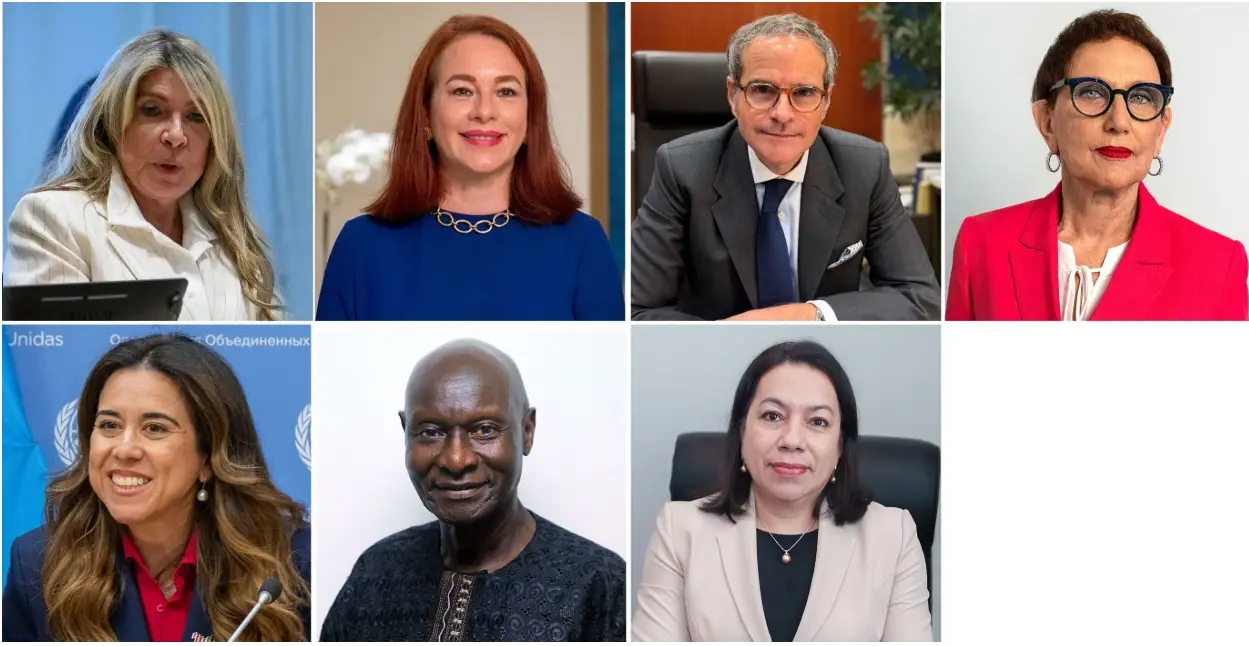
There is no fixed rule or pre-determined criterion for the selection, but a letter from the UN General Assembly at the end of last year pointed out that it was time for a woman to take the helm of the organization—and for a name that represents the regional diversity of the entity.
“With regret that no woman has ever held the post of Secretary-General, and convinced of the need to ensure equal opportunities for women and men in access to senior decision-making positions, the Member States are strongly encouraged to seriously consider nominating women as candidates. We emphasize the importance of regional diversity in the selection of the Secretaries-General.”
It is believed that, this year, the principle of geographic rotation will be observed, alternating the position among the five geographic regional blocs, which would favor the Latin American and Caribbean bloc.
The new Secretary-General, or the new leader, must meet “the highest standards of efficiency, competence and integrity, as well as a firm commitment to the purposes and principles of the United Nations Charter.”
Conflicts
And this person will have to show a great deal of political skill at a moment when the UN’s own role has been the subject of scrutiny. An analysis by the nonprofit media group The Conversation notes that international cooperation among some countries is in the process of unraveling.
“Many are turning away from international dialogue, even as the cyclical conflicts in critical points of Africa and the Middle East continue, and global threats such as climate change, health pandemics and competition in newly contested areas like the Arctic, cyberspace, outer space and the oceans persist.”
This moment can be illustrated by the worrying picture drawn by the think tank Geneva Academy; there are currently 104 armed conflicts worldwide, most of them non-international (NIACs), involving a multiplicity of non-state armed actors and foreign interventions by Western powers. There are 45 conflicts in the Middle East, 35 in Africa, 21 in Asia, seven in Europe and six in Latin America – including armed violence involving criminal organizations.
Funding Shortages
To manage these crises, the UN is going through a critical period of underfunding. This year, the organization has already operated under the threat of an almost 20% cut to its budget. One cause is the reduction of contributions by the government of Donald Trump.
The United States is behind by about US$ 5 billion in contributions related to its UN membership, with more than US$ 2 billion owed to the regular budget. And Trump recently notified Congress of his plan to contribute US$ 850 million to the organization.
The President of the United States is a longtime critic of the UN, whom he accuses of pursuing a globalist agenda contrary to American interests. The Wall Street Journal reported this week that Trump is orchestrating support with China and Russia to back Viktor Orbán, the former Prime Minister of Hungary, for the post, a development that was met in global diplomatic circles with ridicule.
How the selection works:
Candidates must be nominated by at least one UN Member State, and countries may nominate one candidate each (individually or jointly), with self-nomination prohibited.
Although the decision on the new Secretary-General rests with the five permanent members of the Security Council (China, France, Russia, the United Kingdom, and the United States), known as the P5, this group cannot present names.
Thus, the winner is the one who has the majority support in the Security Council—and receives no veto from the P5.
Get to know the profiles of the seven current candidates prepared by the Council on Foreign Relations:
Ivonne A-Baki – Former Ecuadorian ambassador to several countries, including the United States, France and Qatar, A-Baki says that the United Nations need “not another interim, but a peacemaker.” Her vision statement for the post emphasizes prevention and the end of wars, reform of the Security Council’s composition, and the rebuilding of institutional trust within the organization.
María Fernanda Espinosa Garcés – The former President of the UN General Assembly and former Minister of Foreign Affairs and Minister of Defense of Ecuador has centered her candidacy on five pillars: peace and security, development, digital and energy transformation, closing the delivery gap, and rebuilding the credibility of the United Nations.
Rafael Mariano Grossi – Grossi has been Director-General of the International Atomic Energy Agency (IAEA) since 2019. He was previously the Argentine ambassador to Austria, as well as Argentina’s representative to the IAEA and other international organizations based in Vienna. Grossi advocates for a more effective, results-oriented UN, noting in a CFR interview in April that his experience leading the IAEA has prepared him well for the role of Secretary-General, especially regarding handling complex emergencies.
Rebeca Grynspan Mayufis – The former Vice President of Costa Rica is the UN Under-Secretary-General and Administrator of UNCTAD. An economist, she says the United Nations faces simultaneously political, legitimacy, and operational crises, and she would focus her mandate on restoring trust in the organization, rebuilding “the foundations of international security” by prioritizing peacebuilding and delivering results.
Olara Otunnu – A veteran diplomat, Otunnu served as Under-Secretary-General of the UN and Special Representative for Children and Armed Conflict under Kofi Annan. He was also Uganda’s ambassador and permanent representative to the United Nations and its foreign minister. His candidacy proposal centers on promoting a “era of hope and faith” by revitalizing the UN’s moral authority, mobilizing resources for development, and deepening cooperation between the United Nations and regional organizations, among other steps.
Carolyn Rodrigues Birkett – Rodrigues Birkett has served as Guyana’s permanent representative to the United Nations since 2020. Before that, she held various positions in the Guyanese government, including Minister of Indigenous Affairs, Minister of Foreign Trade and International Cooperation, and Minister of Foreign Affairs. In her vision statement, she focuses on reaffirming the United Nations’ fundamental principles, centering human rights, and advancing global development efforts.
Lana Zaki Nusseibeh – Nusseibeh is Minister of State at the United Arab Emirates Ministry of Foreign Affairs and International Cooperation, though she has taken a leave to focus on her candidacy. Previously, she held various positions in the UAE government, including Assistant Minister for Political Affairs, ambassador and permanent representative to the United Nations, and founder and director of the Policy Planning Department at the Ministry of Foreign Affairs. Her vision statement addresses the importance of multilateral problem-solving; leveraging existing expertise, partnerships, and the UN’s field presence; and employing what she describes as quiet diplomacy to prevent conflicts from escalating.
