
For French investors, the Plan d’Épargne en Actions (PEA) stands out as a popular solution for investing in the stock market by offering a favorable tax regime. At the heart of this advantageous tax wrapper, ETFs, which are exchange-traded funds (also called trackers), appear as essential instruments to diversify one’s stock portfolio while benefiting from reduced costs.
How to invest in a PEA with ETFs? What is a PEA ETF? Which ETFs are eligible for the PEA? What are the advantages and drawbacks of PEA ETFs? In which PEA ETFs should you invest to make the most of your PEA in 2026? Discover our selection of the best PEA ETFs of 2026 and our practical tips for buying PEA ETFs.
Note that you can also invest in these ETFs via the best stock account with the best stock broker, i.e., the one offering the products you want to invest in at the best price, providing tools and services tailored to your investor profile.
What is a PEA ETF?
A PEA-eligible ETF is a type of investment fund that trades on stock markets like a regular share. The main advantage of a PEA-eligible ETF is that it provides investors with diversified exposure to a wide range of stocks, often across different sectors and geographical regions, while benefiting from the tax advantages associated with the French Plan d’Épargne en Actions (PEA).
The PEA offers tax incentives to encourage long-term investment in European companies, but we will see that PEA ETFs enable investing outside Europe while preserving the same tax advantages. After 5 years, gains realized within a PEA are exempt from income tax, but remain subject to social contributions. This makes PEA-eligible ETFs an attractive choice for long-term investors who want to optimize their tax situation while investing in the equity market.
PEA ETFs seek to replicate the performance of a specific stock index, such as the CAC 40 or the S&P 500. Depending on the case, this replication can be physical, when the fund actually holds the index’s constituents, or synthetic, when it uses derivatives such as swaps to reproduce the index’s performance. This allows investors to benefit from the same index returns, minus the fund’s management fees, which are typically low for ETFs.
By combining the simplicity of buying an individual share with the diversification offered by an investment fund, PEA-eligible ETFs provide a convenient solution for investors who want access to a passive investment strategy with programmed contributions (e.g., DCA). They can buy or sell ETF shares throughout the trading day at prices that reflect the fund’s net asset value in real time, offering price flexibility and transparency for investors.
In short, PEA ETFs are appealing financial instruments for investors seeking long-term growth of their savings while reducing their tax burden.
Which ETFs are eligible for the PEA?
PEA-eligible ETFs must comply with precise eligibility rules, notably based on a quota of investment in European securities. In practice, this generally means they must invest at least 75% of their assets in eligible securities of companies headquartered in the European Economic Area.
This constraint aims to encourage investment within the European Union while allowing French savers to benefit from the highly attractive PEA tax regime. Indeed, gains generated within a PEA held for more than 5 years are exempt from capital gains tax, which makes it a very attractive tax optimization tool. Note that social contributions remain due. They amount to 18.6% in 2026.
However, thanks to the synthetic replication technique, some ETFs can bypass this geographic limitation. Synthetic replication is a method where the ETF uses derivative instruments, such as swaps, to reproduce the performance of an index. This means the ETF does not need to hold the index’s stocks physically, especially if they are located outside Europe.
For example, an ETF aiming to track an index predominantly composed of U.S. stocks can enter into a swap agreement with another party, often an investment bank, which agrees to provide the performance of that index. In exchange, the ETF provides the performance of a basket of European stocks that it actually holds. Thus, even if the ETF does not invest directly in non-European stocks, it can still offer investors exposure to those markets.
This synthetic replication method for ETFs offers several advantages:
- Geographic diversification: investors can gain exposure to global markets while staying within the advantageous tax framework of the PEA.
- Flexibility : synthetic-replication ETFs can adapt quickly to index changes or investment strategies without needing to buy or sell large quantities of stocks.
- Cost efficiency: transaction costs are often reduced since there is no need to physically buy and sell the index’s stocks.
In conclusion, PEA-eligible ETFs with synthetic replication offer a unique opportunity for savers to participate in the growth of global financial markets while benefiting from the PEA’s tax advantages. They represent an innovative investment solution that combines flexibility, transparency, and lower costs, making stock market investing accessible and tax-efficient for a wide range of investors.
Why invest in a PEA ETF?
Investing in a PEA-eligible ETF offers a multitude of advantages that attract many French investors. First, portfolio diversification is a major asset. Indeed, an ETF can include dozens, or even hundreds, of different stocks, which helps reduce company-specific risk and provides greater stability. Moreover, easy access to stock markets is another notable advantage. Like stocks, ETFs are listed on exchanges and can be bought or sold at any time during trading hours.
The tax advantages offered by the PEA are also significant. Gains realized on a PEA held for more than 5 years are exempt from capital gains tax, which can represent substantial tax savings, especially for long-term investments. This makes PEA-eligible ETFs particularly attractive for those seeking passive management of their investments via a plan, for example, where the objective is to track a market index rather than beat the market through active stock picking.
In terms of costs, ETFs generally have lower management fees compared with actively managed traditional funds. This is because ETFs aim to replicate the performance of a stock index and thus require less intervention from fund managers.
However, there are not only advantages; there are also drawbacks to consider. One of the main limitations of the PEA is the relatively constrained exposure to markets outside the European Union, as PEA rules require the majority of investments to be in EU-based securities. Although synthetic replication can offer a workaround to this limitation, it can introduce additional complexity and counterparty risks associated with swaps.
Market risks inherent to equities, such as volatility and the possibility of capital loss, are also present in ETF investments. Markets can fluctuate in response to economic, political, or social factors, and the ETF’s value may decline, resulting in a capital loss for the individual investor.
Finally, the PEA’s tax advantages may be less relevant for non-resident investors in France. Indeed, non-residents cannot open a PEA but may keep an existing PEA.
In conclusion, PEA ETFs are a powerful investment option that combines convenience, low costs, and tax advantages. They are particularly suitable for individual investors seeking a long-term approach and who are willing to accept the risks associated with stock markets.
How to choose the best PEA ETF to invest in?
*Your capital is at risk. See conditions on the site.
When considering investing in a PEA ETF, it is crucial to perform a thorough analysis to ensure the fund matches your needs and investment strategy. Here is a detailed development of the key criteria to consider.
First, it is important to evaluate the PEA ETF’s historical performance. While past performance is not a guarantee of future results, it can give an indication of how the PEA ETF has performed under different market conditions. Compare the ETF’s performance with its benchmark index to see whether it has successfully replicated it.
Second, management fees are a non-negligible factor. Lower fees mean less money taken from your investments, which can have a significant impact on long-term returns. Look for PEA ETFs with competitive annual expense ratios.
Third, liquidity is an essential aspect. Higher liquidity means you can buy or sell shares of the PEA ETF quickly and at a price close to the fund’s net asset value (NAV). Low liquidity can lead to larger bid-ask spreads, which can affect the profitability of your trades.
Finally, the reputation and expertise of the asset management company offering the PEA ETF are indicators of fund quality. A management company with a long track record and a good reputation can provide greater confidence in the management of your investment.
In conclusion, choosing the right PEA ETF involves analyzing its historical performance, considering management fees, evaluating liquidity, and carefully selecting the management company. By adopting a methodical approach and conducting thorough research, you increase your chances of selecting a PEA ETF that matches your investment objectives and risk profile, while maximizing your portfolio’s growth potential.
How to buy a PEA ETF in practice?
To buy or invest in a PEA-eligible ETF, start by opening a Plan d’Épargne en Actions with a bank or online broker. Once your PEA account is opened, identify the PEA ETF that aligns with your investment goals, taking into account its composition, historical performance, management fees, and liquidity.
Consult the PEA ETF’s documentation to understand its investment strategy and the associated risks (KID, Fact Sheet). Then log into your client space on your broker’s or bank’s platform, search for the ETF by its name, ticker, or ISIN code, and place a buy order specifying the number of shares you want to acquire and the type of stock order (market, limit, etc.).
Regularly monitor your investment and adjust your strategy if necessary, bearing in mind the PEA’s specific withdrawal and closure rules for the Plan d’Épargne en Actions.
Best PEA 2026 comparison
Discover the best PEAs in our broker comparison table offering this envelope.
| Top Stockbrokers | Current Offers | View Offers |
|---|---|---|
| Invest in 70 European equities with no trading fees + 100% transfer手续费 reimbursed until 31/12/2026. Risk of capital loss* | ||
| Up to €500 in fees offered. Risk of capital loss* | ||
 |
XTB PEA with 0% commission (0.20% beyond €100,000 invested/month). Risk of capital loss* | |
| Invest from €1 on stocks, ETFs and programmed investment plans. Risk of capital loss* | ||
| Invest with confidence in eligible stocks, options, ETFs and mutual funds for the PEA. Risk of capital loss* | ||
| 100% of PEA transfer fees reimbursed until 30/06/26. Investing carries a risk of loss* | ||
 |
From €0.99 per stock order + transfer fees reimbursed and free training. Risk of capital loss* | |
 |
Transfer fees reimbursed 2x. Investing carries a risk of loss* |
*See conditions on the site.
What are the best PEA ETFs? Our Top 4 PEA ETFs 2026
There are a total of 218 PEA-eligible ETFs in 2026, while an investor will often only need to invest in 3 to 5 PEA ETFs. It is therefore important to take the time to determine which PEA ETFs are the best. Discover our selection of the best PEA ETFs in 2026.
This presentation is intended for educational and informational purposes only: it does not constitute investment advice or personalized recommendations. Each investor should assess this information in light of their financial situation, objectives, and risk profile.
ETF Amundi Euro Stoxx Banks UCITS
The Amundi Euro Stoxx Banks UCITS ETF is designed to reflect the EURO STOXX® Banks index, which measures the performance of the European banking sector (30% Spain, 21% Italy, 15% France, 8% Netherlands and 7% Germany…). It is therefore of course eligible for the PEA.
With a total expense ratio (TER) of only 0.30% per year, this PEA ETF uses a physical replication method and therefore actually holds all the index’s stocks it replicates. In addition, the dividends generated by this PEA ETF are reinvested, contributing to the investment’s growth.
This PEA ETF, managed by Amundi, is considered sizeable with €4.5 billion of assets under management. It was launched on December 12, 2013, and is registered in Luxembourg.
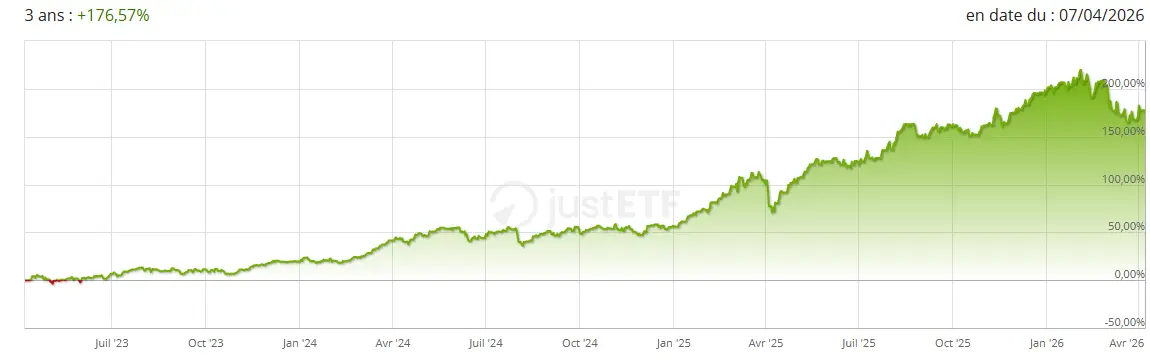
Performance table of the Amundi Euro Stoxx Banks ETF
| Period | Performance |
| 6 months | 8.01 % |
| 1 year | 61.94 % |
| 3 years | 176.57 % |
| 5 years | 256.59 % |
| Since inception | 199.25 % |
| 2025 | 89.81 % |
| 2024 | 31.24 % |
3-year performance of the Amundi Euro Stoxx Banks ETF
ETF Amundi IBEX 35 UCITS Acc
The Amundi IBEX 35 UCITS ETF Acc aims to reproduce the performance of the IBEX 35 index, which groups the main companies listed in Spain. Practically, this provides investors with exposure to the biggest Spanish firms in one line, with a market quite concentrated around a few heavyweights, notably in the banking (Banco Santander), energy (Iberdrola), and industrial (Industria de Diseño Textil) sectors.
With management fees at 0.30% per year (TER), it sits in the higher end of the cost range for index ETFs. The Amundi IBEX 35 UCITS ETF Acc uses physical replication, meaning it directly holds the index’s constituent stocks. It is also accumulating, so dividends paid by the companies are automatically reinvested, allowing the benefits of compounding over time.
Finally, the Amundi IBEX 35 UCITS ETF Acc remains relatively new to the market. Launched on April 4, 2024, it currently has about €419 million in assets under management. Its portfolio comprises 35 holdings, in line with the index’s composition.
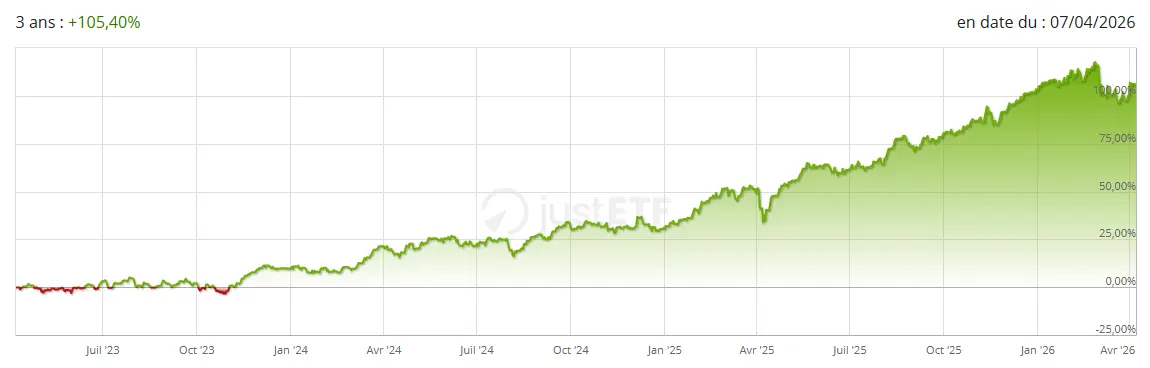
Performance table of the Amundi IBEX 35 ETF
| Period | Performance |
| 6 months | 13.77 % |
| 1 year | 53.29 % |
| 3 years | 105.40 % |
| 5 years | 142.07 % |
| Since creation | 185.26 % |
| 2025 | 54.76 % |
| 2024 | 19.49 % |
3-year performance of the Amundi IBEX 35 ETF
ETF Amundi PEA Japan (TOPIX) UCITS EUR Hedged
The Amundi PEA Japan (TOPIX) UCITS ETF EUR Hedged Acc aims to replicate the TOPIX index’s performance, a broad index covering the major companies listed in Japan. It thus provides exposure to the entire Japanese equity market, with substantial diversification across the country’s large-cap companies. Notably, the Amundi PEA Japan (TOPIX) UCITS ETF EUR Hedged Acc is currency-hedged, which limits the impact of euro-yen fluctuations for European investors.
In terms of characteristics, this is a somewhat different ETF from the previous ones. The management fee is 0.48% per year, a slightly higher level explained in particular by the presence of currency hedging. The Amundi PEA Japan (TOPIX) UCITS ETF EUR Hedged Acc uses synthetic replication via swaps, which means it does not hold the index’s stocks directly but uses a mechanism to reproduce its performance, thereby enabling eligibility for the PEA.
Like other Amundi PEA ETFs, it is accumulating: dividends are automatically reinvested into the fund, boosting long-term performance.
Finally, it is still a relatively small ETF on the market. Launched on April 25, 2019, it currently totals about €51 million of assets under management. It is domiciled in France and follows a simple and effective approach to exposure to the Japanese market while incorporating currency risk management.
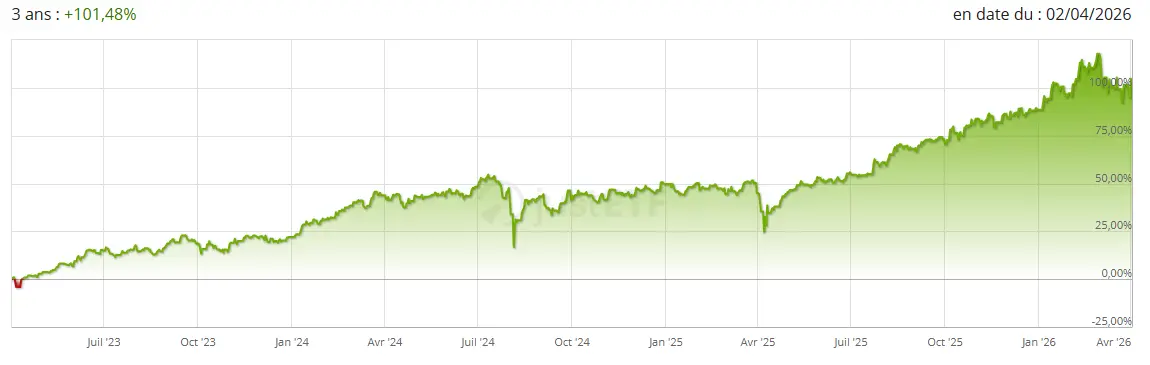
Performance table of the Amundi PEA Japan (TOPIX)
| Period | Performance |
| 6 months | 18.18 % |
| 1 year | 39.40 % |
| 3 years | 101.48 % |
| 5 years | 110.95 % |
| Since inception | 158.10 % |
| 2025 | 25.85 % |
| 2024 | 22.71 % |
3-year performance of the Amundi PEA Japan (TOPIX) EUR Hedged
ETF iShares Diversified Commodity Swap UCITS

The iShares Diversified Commodity Swap UCITS ETF aims to replicate the performance of the Bloomberg Commodity index, a broad index that provides exposure to major global commodities. Specifically, this includes several large categories such as energy, precious metals, industrial metals, and agricultural commodities, making it a useful tool to diversify a portfolio beyond stocks and bonds.
In terms of features, the iShares Diversified Commodity Swap UCITS ETF stands out from classic equity ETFs. The management fees are 0.46% per year. It uses synthetic replication via swaps, meaning it does not hold the commodities directly (which makes sense for this type of asset, especially to be eligible for the PEA), but uses derivatives to reproduce the index’s performance. Like other ETFs of this type, it is accumulating, with income automatically reinvested into the fund.
Launched on August 7, 2007, the iShares Diversified Commodity Swap UCITS ETF totals about €280 million in assets under management. It is domiciled in Germany and provides a simple way to gain global exposure to commodities, with diversification across several key sectors of the real economy.
Performance table of the iShares Diversified Commodity Swap ETF
| Period | Performance |
| 6 months | 33.19 % |
| 1 year | 37.63 % |
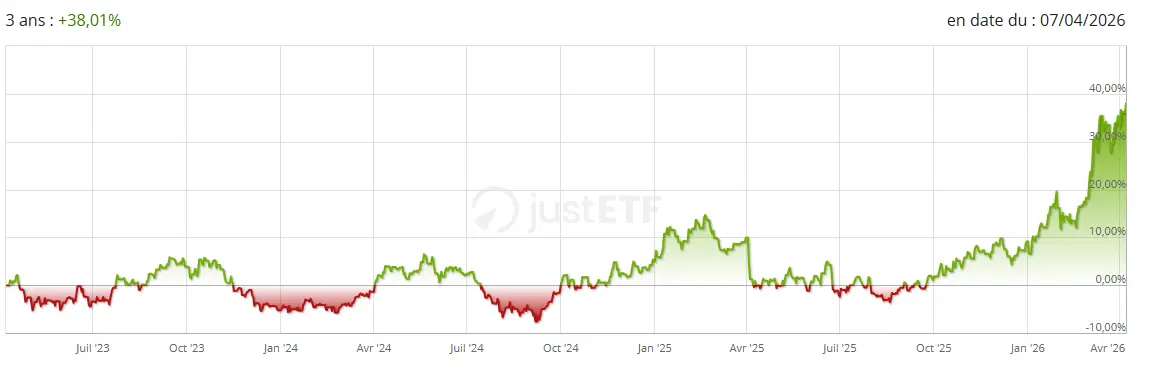
| 3 years | 38.01 % |
| 5 years | 94.02 % |
| Since inception | 6.51 % |
| 2025 | 3.98 % |
| 2024 | 10.83 % |
3-year performance of the iShares Diversified Commodity Swap ETF
Past performance is not indicative of future results. Investing in equities carries a risk of capital loss.
All of our information is, by nature, generic. It does not take into account your personal situation and does not constitute personalized investment recommendations or advice for executing transactions, nor can it be construed as financial investment advisory services or any invitation to buy or sell financial instruments. The reader is solely responsible for using the information provided, and no recourse can be made against the publisher of Cafedelabourse.com. The publisher’s liability cannot be engaged in the event of error, omission, or inappropriate investment.
