
The Paris Stock Exchange has been treading water for several weeks. The CAC 40 now shows a 12.3% drop from its high on August 10, 2026, and investors have reason to question what comes next. It must be said that the context isn’t helping much, with geopolitical tensions still present, oil remaining expensive, and concerns about the evolution of inflation and French debt—so many elements weighing on the markets and making the prospects for the end of 2026 rather uncertain.
So, can the CAC 40 still lose ground in the coming weeks? Have some French stocks become interesting after this correction in the CAC 40 index?
Discover in this analysis our explanations for the current decline of the CAC 40, the CAC 40 price levels to watch at the end of 2026, and our advice for those considering investing in the stock market in this difficult context.
Why is the CAC 40 price currently falling?
The current climate in France is not really reassuring for investors.
Yet, it should be remembered that the companies in the CAC 40 are for the most part large international groups, whose activity does not depend solely on the French market. However, this does not shield them from the turbulence the country is experiencing.
Also, contrary to what one might think, the CAC 40 is not mainly held by French investors. According to the latest data from the Bank of France, 50% of the capital of French CAC 40 companies was in foreign hands at the end of 2024. Thus, the way the situation in France is perceived abroad, notably social movements and student protests currently disrupting the country, can also weigh on investors’ decisions and on the CAC 40’s price.
The rise in oil risking aggravating inflation that is already back
The rise in the price of oil worries investors, with a barrel of Brent exceeding $104 at the start of October 2026, amid tensions in the Middle East. And the problem is that inflation has already started to rise again. It increased from 2.8% in June to 3.8% in October 2026, i.e., an increase of one percentage point in just a few months. With oil becoming even more expensive, prices for fuels, transport and energy could continue to climb, with consequences for households’ purchasing power and for the margins of French companies.
The depreciation of the euro heightens economic concerns
The euro is under pressure as well. The European currency has slipped below the 1.12-dollar mark, a level unseen since May 2025. While this euro-dollar decline can benefit large exporting firms on the CAC 40, it also makes imports more costly, especially oil and many commodities priced in dollars. For France, the risk is therefore twofold: paying even more for already expensive energy in euros, with possible repercussions on inflation and consumption.
The French debt remains a source of concern
French debt continues to make headlines, and not for good reasons. Deficits accumulate, debt keeps rising, and a question remains: how will France manage to put its public finances in order?
From the investors’ side, these budgetary difficulties do not go unnoticed. Some investors might prefer to turn to other European markets, considered less risky, rather than taking positions in French companies.
The 2027 presidential election adds uncertainty
As the 2027 presidential election approaches, it is hard to know what French economic policy will look like in a few months. Between tax proposals from different candidates, debates on public spending, and possible regulatory changes, investors lack visibility. And in the stock market, uncertainty is rarely appreciated. Some investors therefore prefer to wait until there is more clarity before returning to French equities, especially CAC 40 stocks.
Which CAC 40 stocks were the most affected by the decline at the end of 2026?
Not all CAC 40 companies were affected equally by the decline on the Paris Stock Exchange. Some stocks even registered losses that were twice as large as those of the CAC 40 index. This is particularly the case for luxury groups, which sit among the largest declines in the last three months. The automotive and construction sectors were not spared either, as shown by the performance of Stellantis or Eiffage, for example.
Here are the five CAC 40 stocks that suffered the most over the last three months, according to data recorded on October 8, 2026.
The 5 biggest CAC 40 declines over 3 months
| CAC 40 stock | 3-month decline | Reason for the decline? |
| Hermès International | -25.79% | Concerns about global demand for luxury goods and high sector valuations |
| Stellantis | -24.35% | Automotive sector difficulties, increased competition, and margin uncertainties |
| LVMH | -23.93% | Concerns about luxury consumption, notably in China |
| Eiffage | -19.67% | Concerns about construction outlook and project funding costs |
| Kering | -19.13% | Brand-specific difficulties, notably Gucci, and weakness in the luxury market |
What stands out from this ranking is above all the strong presence of luxury, with Hermès, LVMH, and Kering among the five most penalized CAC 40 stocks at the end of 2026. A noteworthy observation for a luxury sector that has a significant weight in the CAC 40 and whose prospects largely depend on international consumption.
How far can the CAC 40 fall by the end of 2026? Technical analysis and Café de la Bourse view
The technical situation of the CAC 40 has clearly deteriorated in recent weeks.
With the CAC 40 trading around 7,700 points, the trend remains clearly bearish and there is still no sign of a genuine turnaround. The CAC 40 is dangerously approaching its next support at 7,665 points, a threshold that could be decisive for what comes next. If broken, the decline could extend to new lows.
Several technical levels are therefore worth watching on the CAC 40 index:
- 7,665 points: the next major support, now very close to the current level, whose ability to hold will be decisive
- 7,895 points: an initial intermediate resistance to watch in case of a short-term rebound
- 8,000 to 8,065 points: a significant zone, both psychologically with the 8,000-point level and technically around 8,065, an old support likely to become a resistance
- 8,250 points: a more distant resistance, which could be a target in case of a more durable recovery
- 8,425 and 8,620 points: additional resistance levels, but which still seem quite difficult to envisage in the current conditions
CAC 40 technical analysis October 2026

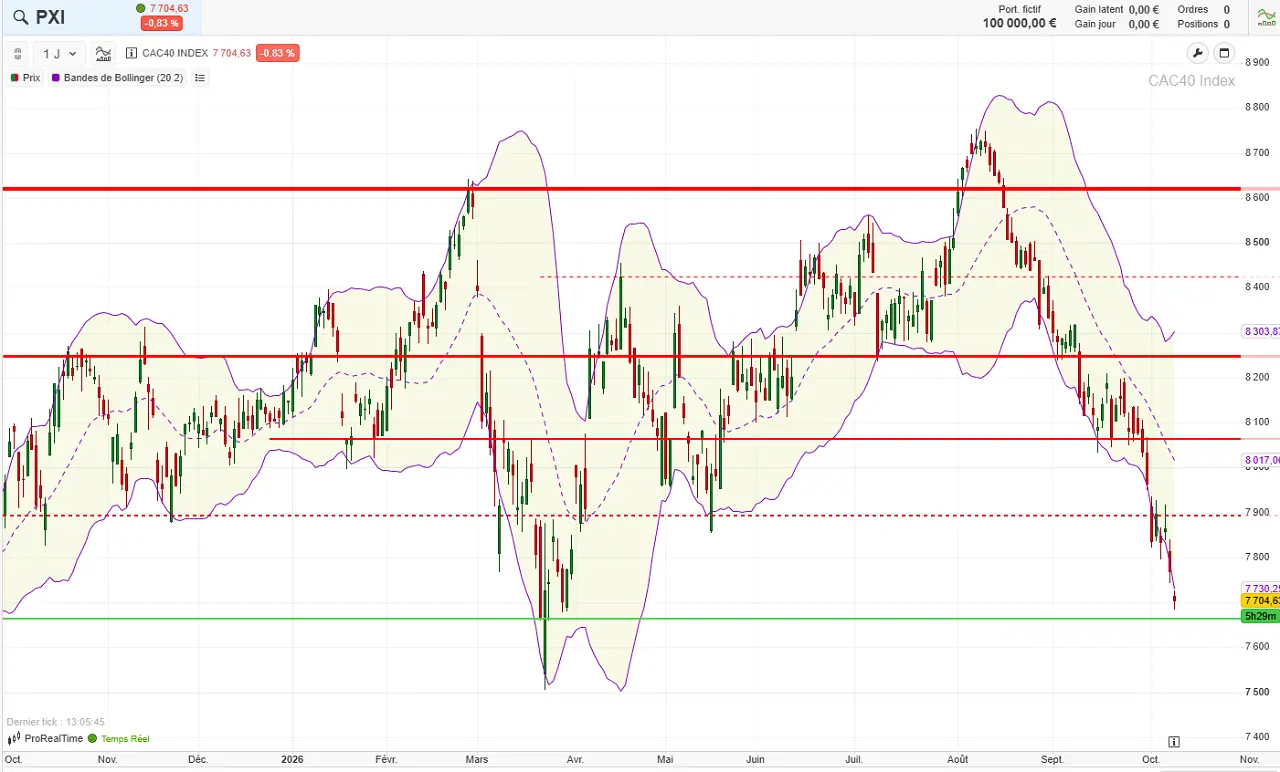
Another element to watch on the chart is that Bollinger bands are widening sharply, indicating a clear increase in volatility. The CAC 40 price even moves in contact with its lower band, a sign of strong selling pressure.
This situation could favor a short-term technical rebound in the CAC 40, but it would not be enough to overturn the current downtrend. For the moment, caution remains warranted.
Should you take advantage of the CAC 40’s decline to invest in the stock market? Café de la Bourse tips

With such a drop in the CAC 40, some investors might be tempted to take advantage of it to buy cheaper stocks. But it is not because a stock has lost 20% of its value that it cannot drop another 20%. This is, in fact, a fairly classic trap in the stock market—the belief that a sharp decline automatically equals a good deal.
Of course, a technical rebound remains possible, but as long as the economic and political situation does not show real signs of improvement, it is wiser to avoid trying to “catch a falling knife”.
However, for investors who regularly invest with a DCA strategy, the question is different. Continuing scheduled purchases during downturns can be quite justified, without trying to guess where the market bottom lies.
How to profit from the CAC 40’s decline in practice?
*Your capital is subject to risk. See terms on the site.
For investors who want to profit from the CAC 40’s decline over the long term, the simplest approach remains to invest in an ETF tracking the CAC 40 index. It is particularly possible to invest in ETFs through stockbrokers like XTB, Trade Republic, eToro, or Freedom24, via a normal securities account or a PEA when the online broker offers it.
But it is also possible to look to profit directly from the CAC 40’s decline, without waiting for a potential rebound in the index. For this, more experienced investors can turn to derivative products, notably options, offered by stockbrokers such as ProRealTime with Interactive Brokers, Saxo Bank, IG, or XTB, which now also offers options trading. However, these derivative instruments are complex and can lead to substantial losses, especially when leverage is used.
The information from Cafedelabourse.com and its publications is provided for educational purposes. It does not constitute investment recommendations in any way. The reader should study the risks before carrying out any transaction. The reader is solely responsible for their investment decisions.
Past performance is not indicative of future results. Investing in stocks carries a risk of capital loss.
All our information is, by nature, generic. It does not take into account your personal situation and does not constitute personalized recommendations aimed at executing transactions and cannot be considered as financial investment advice. The reader is solely responsible for using the information provided, and no recourse against Cafedelabourse.com’s publishing company can be sought. The publisher’s liability cannot be engaged in any event for errors, omissions, or ill-timed investments.
