
The quiet military routine on the island of Diego Garcia, operated jointly by the United States and the United Kingdom, was shaken when the Iranian regime attempted to attack the facility. According to information released by the international press, Tehran launched two intermediate-range ballistic missiles toward the base on the night of Friday the 20th.
However, the attack failed. One of the missiles failed in flight, while an American warship fired an SM-3 interceptor at the other, though it was not possible to determine whether the interception was successful, according to The Wall Street Journal.
Although the attack did not cause damage, the incident set off alarm bells in the West. Diego Garcia is about 3,780 kilometers from Iranian territory. Until then, Western estimates indicated that Iran’s ballistic missile arsenal was limited to a maximum range of 2,000 kilometers. The attempt to strike the island highlights a worrying expansion of Tehran’s military capability and reinforces diplomatic tension among Iran, the United States, and the United Kingdom.
Fortress in the Indian Ocean
Diego Garcia is important to the Pentagon. The island is a crucial platform for projecting American power in the Middle East and in Asia. Its infrastructure is impressive in scale: the base has a runway 3.6 kilometers long, capable of accommodating strategic bombers like the B-52.
The island hosts about 20 ships permanently moored. The vessels serve as floating warehouses, with war tanks, armored vehicles, munitions and even mobile field hospitals.
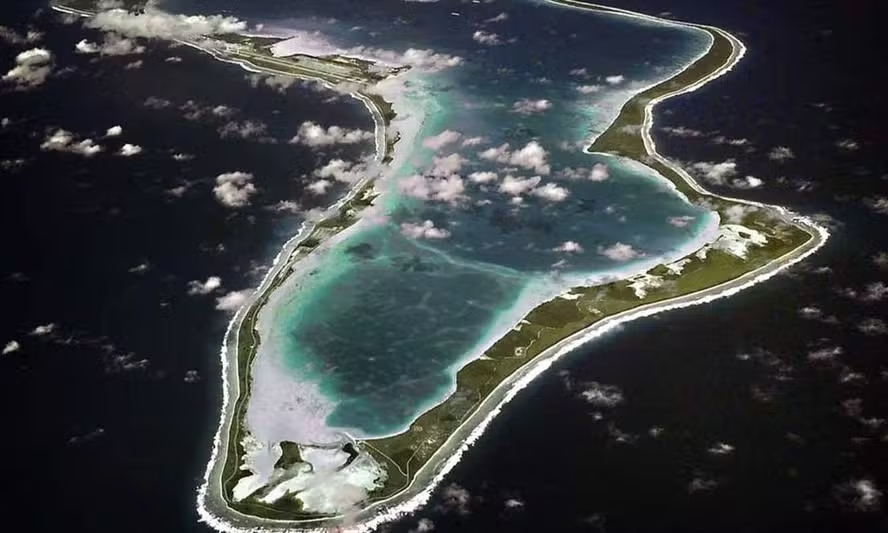
The facility houses a fuel reservoir with a capacity for 213,000 cubic meters and dozens of freshwater wells.
The island is not merely a military outpost; it hosts one of the four ground stations essential worldwide for the operation of the Global Positioning System (GPS).
It was from this base that American military forces launched decisive operations in Afghanistan and Iraq.
Until the 1960s, Diego Garcia was inhabited by the Chagossian people. Between 1967 and 1973, the British government expelled the entire native population. The inhabitants were forced to board cargo ships and were taken to other territories, such as Mauritius and Seychelles, where many ended up living in extreme poverty.
Historical accounts report that even the island’s pets were exterminated to prevent people from having any reason to return. The Chagossians continue a lengthy battle in international courts, fighting for the right to return to the territory that was taken from them.
