
What is a cryptocurrency? What is it used for? How are they created? What determines their value? What are the different types of cryptocurrencies? How to invest in crypto assets despite their high volatility? What trends in crypto for 2026? Discover in this guide how to invest for the long term in cryptocurrencies, especially for beginners, with all our explanations to get started in crypto asset investing.
How it works, uses and recommendations, taxation, discover everything you need to know before investing in digital currencies such as Bitcoin, Ethereum, Dogecoin, Binance Coin, Ripple… which now occupy a distinct place in the financial universe.
Investing in cryptocurrency: the 5 key elements to remember
- Crypto-assets are based on blockchain technology, a decentralized and secure digital ledger.
- Cryptocurrencies today are more used as financial assets than as payment methods.
- The crypto universe groups thousands of tokens with very different uses: finance, AI, gaming, stablecoins or meme coins.
- Cryptocurrencies offer high upside potential, but with no guarantees of profit.
- Crypto-assets are highly volatile investments that carry a significant risk of capital loss.
Comparison of the best crypto platforms for investing in cryptocurrency in 2026
Find our selection of the best crypto platforms, all of which hold PSAN status (or a MiCA license), to choose your crypto exchange or crypto broker according to your investor profile.
| Top crypto brokers | Current offers | View offers |
|---|---|---|
| €15 offered in Bitcoin after your first transaction. Risk of capital loss* | ||
| Get up to $500 of free assets. Risk of capital loss* | ||
 |
More than 600 crypto assets available on Bitpanda. Invest from €1. Risk of capital loss* | |
 |
2.00% interest on your cash + invest from €1 in cryptos with no commission via a recurring investment plan. Risk of capital loss* | |
| Welcome bonus of €25. The market’s cheapest USDC pairs (0.05%). Risk of capital loss* | ||
| €20 in Bitcoin. Up to 93% lower fees to invest in cryptos. Risk of capital loss* | ||
| Up to $100 in rewards upon signup. Risk of capital loss* |
*See terms on the site.
Cryptocurrency and crypto assets: what are they?
Definition of a cryptocurrency
A cryptocurrency is a digital currency that enables value exchange on the Internet. Unlike the euro or the dollar, it does not exist in the form of notes or coins and operates without a central bank.
That is precisely what makes it distinctive. When you hold euros in your bank account, you trust your bank and, more broadly, the European Central Bank. With a cryptocurrency like Bitcoin, there is no central institution guaranteed to uphold its value or proper functioning.
Another important difference: cryptocurrencies are generally not backed by any real asset. Bitcoin, for example, is not guaranteed by gold, by a state, or by a bank. Its price depends solely on supply and demand, as well as the trust that investors and users place in it.
To secure exchanges, cryptocurrencies rely on the blockchain, a kind of large shared digital ledger among network participants. Each transaction is recorded and verified, enabling value transfer without a traditional intermediary.
Created in 2008, Bitcoin opened the door to a sector that today includes thousands of crypto-assets with very different uses, ranging from payments to decentralized finance, including stablecoins, video games, and artificial intelligence.
Definition of a crypto asset
A crypto-asset is a generic term that designates the entire set of digital assets based on blockchain technology.
Cryptocurrencies, such as Bitcoin or Ethereum, are thus crypto-assets, but not all crypto-assets are cryptocurrencies.
The term is also used to designate tokenized assets, i.e., tokens representing real assets on a blockchain. These can be shares, bonds, or commodities like gold, such as Pax Gold (PAXG).
More broadly, a crypto-asset can refer to any digital asset registered on a blockchain, whether backed by a real asset (real estate, equity, bonds) or not (NFTs, tokens).
Blockchain: the underlying technology of cryptocurrency
Cryptocurrencies rely on a technology called Blockchain.
To simplify, a blockchain can be compared to a large digital accounting ledger shared among all network participants.
Its operation rests on a few simple principles:
- Each transaction is recorded in a data block.
- Blocks are linked to each other in chronological order, forming a chain of blocks (“blockchain”).
- Each new transaction must be validated by the network before being added to the blockchain.
- Once recorded, the data become extremely difficult to modify or falsify (and sometimes impossible).
- The entire ledger is shared among numerous participants, without a single central authority.
Thanks to this operation, the blockchain secures exchanges while guaranteeing great transparency. It is the technology upon which almost all cryptocurrencies rely, from Bitcoin to Ethereum.
But blockchain applications are not limited to crypto. This technology could also be used to secure contracts, administrative documents, property titles, or public records, without the need for a trusted third party.
How is a cryptocurrency manufactured?
New units of cryptocurrencies are created according to mechanisms that vary from one blockchain to another. Some blockchains, like Bitcoin, rely on mining (Proof of Work), while others use staking (Proof of Stake) or other consensus mechanisms.
In all cases, the objective remains the same: secure the network, validate transactions, and guarantee the proper functioning of the blockchain. Participants who contribute to this security are generally rewarded in the cryptocurrency in question.
Bitcoin uses, for example, the Proof of Work mechanism. When a transaction is made, it is broadcast to the network. Specialized computers, called miners, then verify the transactions and attempt to solve a complex cryptographic problem to create a new data block. Once validated, this block is permanently added to the blockchain and the miner receives a reward in bitcoins.
Other blockchains, such as Ethereum, Solana or Cardano, operate under a different principle called Proof of Stake. In this case, it are not miners who secure the network, but validators who lock up a portion of their tokens to participate in transaction validation and receive rewards.
Main mechanisms for creating and validating cryptocurrencies
| Crypto | Symbol | Main mechanism | Mining | Staking |
| Bitcoin | BTC | Proof of Work | Yes | No |
| Ethereum | ETH | Proof of Stake | No | Yes |
| BNB | BNB | Proof of Staked Authority | No | Yes |
| XRP | XRP | Consensus Ripple | No | No |
| Solana | SOL | Proof of Stake + Proof of History | No | Yes |
| Tron | TRX | Delegated Proof of Stake | No | Yes |
| Dogecoin | DOGE | Proof of Work | Yes | No |
| Stellar | XLM | Stellar Consensus Protocol | No | No |
| Cardano | ADA | Proof of Stake | No | Yes |
| Monero | XMR | Proof of Work | Yes | No |
How to mine a cryptocurrency?
To mine a cryptocurrency, you need to provide computational power to participate in validating transactions on a Proof of Work network. Historically, it was possible to mine certain cryptocurrencies with a simple computer equipped with a processor or a powerful graphic card. Today, mining major cryptocurrencies such as Bitcoin is mostly done with specialized hardware known as ASICs, far more powerful and energy-intensive. For an individual, it’s become difficult to compete with large professional mining farms.
However, the major cryptocurrencies have become too difficult to mine for individuals on their own. Mining for many of them has largely professionalized and occurs partly in farms, in buildings of thousands of square meters where tens of thousands of servers run day and night to mine cryptocurrencies (Bitcoin, Litecoin, etc.).
Faced with sector professionalization, cloud mining options have developed. Their principle is to rent computing power operated by a specialized company rather than buying one’s own equipment. However, investors must remain particularly vigilant: many cloud mining offers have historically been associated with disappointing returns, or even scams. Before subscribing, it is essential to verify the operator’s seriousness and never rely solely on promised returns.
Some specialized companies, such as the French company Feel Mining, offer solutions allowing indirect exposure to mining revenues. However, it is important to carefully study the risks and conditions of these offers.
Which cryptocurrency to mine?
For an individual, mining today has become very difficult to profit from. The main networks still mined are Bitcoin, Litecoin, Monero, and Dogecoin (via merged mining with Litecoin). In practice, most investors now prefer to buy crypto-assets directly or participate in staking when available.
Comment by Clémence:
Nonetheless, it is very difficult today to make money by mining a crypto-asset. It is often much more advantageous to invest in cryptocurrency to hope for gains.
In the case of Ethereum or other cryptos operating with Proof of Stake, we will not talk about mining but staking, and the process is different.
What is crypto staking?
Crypto staking is a method that allows participation in securing a blockchain operating under the consensus mechanism called Proof of Stake (PoS). Unlike mining, which relies on computing power, staking involves locking up a certain amount of tokens to contribute to validating transactions and creating new blocks.
Participants, called validators or stakers, are selected according to rules specific to each blockchain, generally based on the number of tokens locked up. In exchange for their participation in the network’s proper functioning, they receive rewards that can take the form of new tokens, transaction fees, or a combination of both.
Less energy-intensive than mining, staking has in recent years become the preferred mechanism for many major blockchains, including Ethereum, Solana, Cardano or Avalanche.
How to stake a crypto?
To stake a cryptocurrency, simply hold tokens of that crypto and lock them in a staking-compatible digital wallet.
Many crypto brokers, such as Coinbase, Bitvavo, Finst, Bitpanda, facilitate this process by offering integrated staking services. These platforms allow users to stake their cryptocurrencies in a few clicks, without dealing with technical aspects.
There are also many specialized apps offering staking services today, such as Ledger Live, Feel Mining or Trust Wallet, which offer simplified or pooled staking solutions where users can combine their funds with those of other investors to maximize rewards. In short, staking has become accessible to a broad public thanks to these tools, allowing everyone to participate in transaction validation and earn cryptocurrency rewards.
Miner / developer: who creates the cryptocurrency?
The role of miners, validators and stakers is to contribute to the security and proper functioning of a blockchain. Depending on the consensus mechanism used by the network, they participate in validating transactions and creating new blocks. In return, they can receive rewards in the form of tokens or transaction fees.
The role of the developer is very different. They design and improve the software protocol that underpins the blockchain. They participate in defining the network’s operating rules, its consensus mechanism, its economic model, and its technical evolutions. In this sense, the developer can be considered one of the project’s architects.
Very often, developers of a blockchain or creators of a new cryptocurrency allot themselves a certain amount of the cryptocurrency they created to pay themselves, reward their efforts, and fund future developments.
What makes a cryptocurrency valuable?
Why does a cryptocurrency fall? Why does a crypto price drop? How does a cryptocurrency gain value? Discover the factors that influence crypto prices.
Trust in cryptocurrencies
As with any financial asset or currency, trust plays a central role in valuing cryptocurrencies. Investors must believe in the network’s robustness, the project’s longevity, and its ability to attract new users before committing capital to it.
Additionally, for a price to rise, a crypto must have a favorable regulatory framework and a permissive approach from regulators. Trust can also arise from a public figure’s endorsement of a particular cryptocurrency or of crypto in general.
Trust can also be influenced by the positions of certain public figures. A simple tweet, a message, or even a mention by Elon Musk on social networks can sometimes trigger large upward or downward movements in certain cryptocurrencies, illustrating the market’s sensitivity to investor psychology.
The number of users of the cryptocurrency
What also drives value is the size of the network and the number of people using it around the world.
Comment by Clémence:
Generally, an increase in the number of users tends to boost a cryptocurrency’s attractiveness and can support its valuation. However, the price of a crypto asset also depends on many other factors such as liquidity, regulation, speculation, or macroeconomic conditions.
Two essential factors will push people to buy a digital asset: its penetration rate into the real economy (i.e., how easily one can buy real-world goods and services with that cryptocurrency) and the prospect of taking a position in a crypto-asset to realize a relatively significant gain.
Speculation remains the main growth driver for cryptocurrencies and their prices vary greatly depending on traders’ expectations of easy profits on a given token, sometimes creating bubbles like in 2017-2018. Intrinsic value does not play a major role. And the situation is likely to persist as long as real-world demand remains relatively weak.
Still, note that the number of cryptocurrency users is growing. Cryptocurrencies are no longer niche financial assets but represent a real trend in the sector. Their importance in the economic and financial sphere is increasing.
Crypto assets now count hundreds of millions of users worldwide. Even if adoption is growing at a slower pace than before, cryptocurrencies are no longer considered a niche market and they occupy an increasingly important place in the global financial ecosystem.
Curve showing unique blockchain addresses used
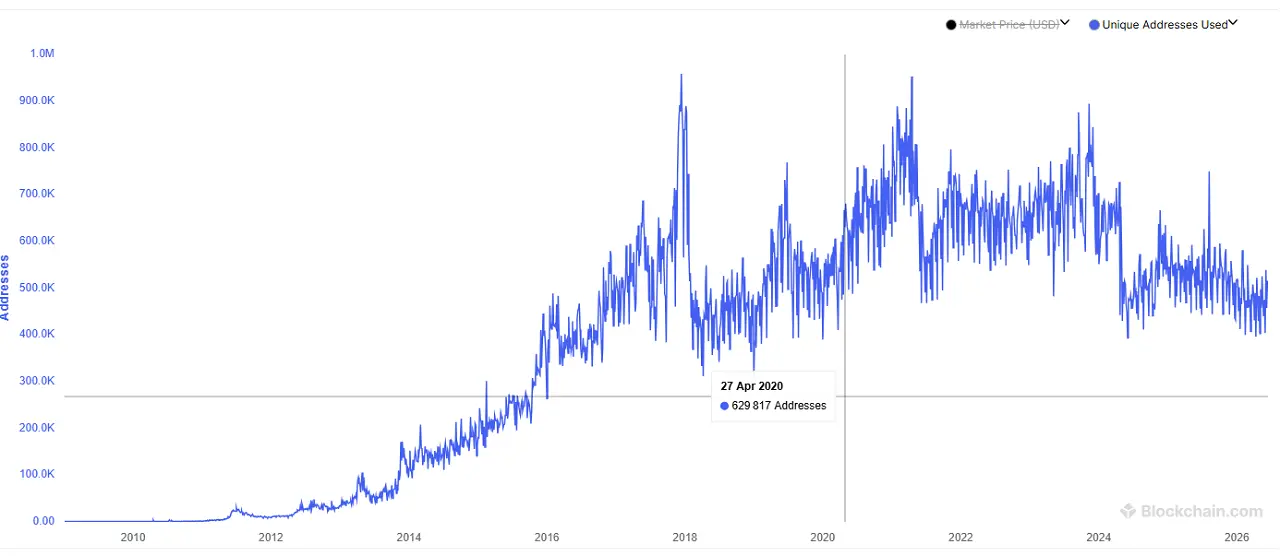
The growing adoption of crypto assets supports their development
The democratization of cryptocurrencies demonstrates growing public trust in this type of asset. Individuals will now be able to settle more purchases of goods and services via cryptocurrencies with a simple wallet or crypto apps linked to a payment card.
Governments and regulators are paying increasing attention to crypto assets. The introduction of regulations like MiCA in Europe helps structure the sector and strengthen investor protection. Meanwhile, several central banks are working on central bank digital currencies (CBDCs), a project distinct from decentralized cryptocurrencies like Bitcoin or Ethereum.
Financial markets have now largely integrated crypto assets thanks to Bitcoin and Ethereum spot ETFs, but also through futures, options, and various financial products allowing institutional investors to gain exposure to the sector.
Many brokers now offer crypto investments, whether through derivative products or directly. Several large investment banks have a dedicated crypto assets unit, and more traditional funds and hedge funds are positioning themselves in crypto assets.
Increasingly, investors view crypto assets as growth assets akin to technology stocks. Cryptocurrencies regularly show a strong correlation with Nasdaq, although this relationship is neither perfect nor permanent.
The project behind the cryptocurrency: when token utility contributes to token success
As the crypto ecosystem evolves, many cryptocurrencies no longer aim to directly compete with traditional currencies like the euro or the dollar. Their purpose is not simply to act as a universal payment currency or to replace traditional banking services, but to enable access to goods, services, or specific features, often within a dedicated ecosystem. These are called “utility tokens.”
These tokens are not designed as stores of value or a payment method, but as access keys to a specific application, platform, or service. For example, the BNB (Binance Coin) reduces transaction fees on the Binance exchange. The BAT (Basic Attention Token) is used in the Brave browser to reward users who view advertisements. The MANA is used to buy virtual goods in the Decentraland metaverse.
Originally, early cryptos like Bitcoin aimed to become an alternative to fiat currencies, with a strong proposition: a decentralized currency, inflation-resistant and outside the control of central banks. Ethereum, for its part, pushed the concept further by enabling smart contracts, with a native token, Ether (ETH), used to pay transaction fees within this vast network.
Thus, while the first cryptocurrencies aimed to reinvent money, utility tokens represent today a new generation of digital assets, serving concrete and often specialized use cases.
Today, innovation in the crypto-asset space is no longer limited to payment methods. Many projects are developing applications in decentralized finance (DeFi), stablecoins, artificial intelligence, or even the tokenization of real assets (RWA). These uses are now one of the sector’s main growth drivers.
What influences the price of cryptocurrencies?
Beyond the many factors already discussed that explain a cryptocurrency’s value, there are many other catalysts for price increases or decreases. We detail some here.
Movements of large investors, often called “whales,” can still influence the prices of certain cryptocurrencies from time to time. However, their impact is generally less significant than before due to the rise of institutional investors and crypto ETFs.
Nevertheless, in a market that is now largely institutionalized, where daily volumes reach hundreds of millions, the term “whale” loses its force because a purchase or sale of 50 to 100 million dollars in Bitcoin today represents flows comparable to ordinary ETF issuer movements.
However, the crypto sector can also suffer brutal declines when a major actor encounters difficulties, when a protocol is hacked, or when a scandal undermines investor confidence.
Regulatory tightening can also cause crypto declines, while good news on adoption or democratization (for example, the approval of a BTC or ETH ETF by the SEC) will trigger a price surge.
Also note that scandals, hacks, and scams can be detrimental to the price of the crypto(s) involved, or to the ecosystem as a whole.
Finally, the crypto market is increasingly correlated with financial markets overall. Persistent inflation and rising central bank policy rates are detrimental to cryptos, for example. They are, as we have seen, increasingly correlated with tech equities.
Bitcoin, Ethereum: what are the main cryptocurrencies?
How many cryptocurrencies exist? This commonly asked question may seem simple, but in reality it is very hard to know the exact number of cryptocurrencies. No site lists them all.
Today there are several thousand crypto-assets listed on major specialized platforms. However, only a small portion of them achieve meaningful adoption and significant capitalization.
There are indeed many crypto currencies but only a few dozen can be labeled popular cryptocurrencies. There is often a tendency to classify promising cryptocurrencies based on their market capitalization, rightly so.
Bitcoin, the first of the cryptocurrencies
The Bitcoin cryptocurrency, created in 2008 by Satoshi Nakamoto (the person or people behind the alias remain unknown), is the first of cryptocurrencies. It is somewhat the gold standard of the crypto sector, the reference in the field. In August 2017, Bitcoin underwent a fork. A disagreement in the Bitcoin community over transaction speed led to the birth of a new currency: Bitcoin Cash. Note, however, that Bitcoin Cash never managed to rival Bitcoin.
Bitcoin is now among the world’s most valued financial assets and remains the indispensable benchmark of the cryptocurrency market.
Ethereum, Bitcoin’s challenger
Another reference cryptocurrency is Ethereum, which also experienced a fork in the summer of 2016, giving rise to Ethereum Classic. Ethereum, more complete than Bitcoin, supports all blockchain applications because it can not only process transactions but also smart contracts and complex programs. Technically more advanced and faster than Bitcoin, Ethereum is both a decentralized exchange protocol enabling users to implement smart contracts and a native cryptocurrency on the Ethereum network, more commonly called Ether.
The strengths of this cryptographic network contributed to the dramatic rise of Ethereum since 2020, which has maintained its place on the second step of the podium among cryptocurrencies for many years.
The main difference between ETH and BTC lies in the type of blockchain each token relies on. BTC is based on a Proof of Work (PoW) blockchain, i.e., work proof. With a PoW blockchain, all validators try to authenticate and validate the transaction on the network, and this operation is carried out by the miner who finds, as quickly as possible, a way to insert a transaction into a new block by solving a complex mathematical problem. As for Ethereum, since The Merge (the merge) on September 15, 2022, it now relies on a Proof of Stake (PoS) blockchain, i.e., stake proof. With a PoS blockchain, the validator is randomly selected and all validators have a chance to validate a block, but this chance is weighted by the number of tokens held. The process is therefore faster and less energy-intensive but more centralized.
Ripple, Binance Coin, Dogecoin: what are mid-cap cryptocurrencies?

But there are many other cryptocurrencies. Among mid-cap cryptocurrencies, representing more than 15% of total crypto market capitalization, one can cite Ripple, which is not only a cryptocurrency (XRP) but also a transfer system operating independently of the XRP token. It is primarily a digital payment protocol designed to facilitate interbank payments. Binance Coin, Dogecoin, Toncoin, Cardano, Tron, Avalanche, USDT and USDC, or Solana, are also cryptocurrencies regularly among the top 10 largest cryptocurrencies.
Since the MiCA regulation came into effect, the use of certain non-compliant stablecoins with European requirements, including USDT on some platforms, has been heavily restricted within the European Union.
What are the small cryptocurrencies and the shitcoins?
Small cryptocurrencies occupy a special place in the crypto-asset universe. They are extremely numerous, and new projects appear every year. Some aim to solve a specific technological problem or develop a new use of the blockchain. Others, however, rely mainly on speculation and their community’s enthusiasm.
Even though many investors dream of discovering the next Bitcoin or the next Ethereum before everyone else, the reality is more nuanced: the majority of small cryptocurrencies will never manage to establish themselves sustainably.
Before investing in a small crypto, it is generally recommended to check several elements:
- the real utility of the project and the problem it seeks to solve;
- the credibility of the development team;
- the quality of the roadmap and announced partnerships;
- the level of user adoption;
- the liquidity of the token and its presence on major exchange platforms.
Among the thousands of cryptocurrencies created since Bitcoin, many have disappeared or fallen into oblivion. This is notably the case for some projects that investors call “shitcoins.”
This term, deliberately pejorative, generally designates highly speculative crypto-assets that rely on no solid project, no meaningful innovation, or no clearly identified business model. They tend to multiply during market exuberance and often disappear when conditions deteriorate.
Finally, note that the world of cryptocurrencies is constantly evolving. New projects may emerge and compete with established players. Disagreements within a community can also lead to a “fork,” i.e., a split giving birth to a new blockchain or a new cryptocurrency derived from the original technology but based on different rules.
Bitcoin for beginners: the essential vocabulary to start with on cryptocurrencies

The world of cryptocurrencies has its own language. Between technical terms related to blockchain and expressions used by investors, it can be hard to navigate for newcomers. To help you better understand this ecosystem and invest with greater peace of mind, here are the main words and concepts you need to know.
| Term | Definition | Key takeaways |
| Bitcoin | First cryptocurrency created in 2008 by Satoshi Nakamoto | It is the reference cryptocurrency and the one that most strongly influences the entire market |
| Blockchain | Decentralized digital ledger that records transactions | It is the technology that enables cryptocurrencies to function without intermediaries |
| Cryptography | Set of mathematical techniques to secure data | It guarantees the integrity and security of transactions on a blockchain |
| DeFi | Decentralized finance operating without a bank or traditional intermediary | Allows borrowing, lending, or direct investment via blockchain protocols |
| Distributed Ledger | Shared database among several network participants | Blockchain is a type of distributed ledger, but not all distributed ledgers are blockchains |
| Exchange | Platform to buy, sell, or exchange cryptocurrencies | Coinbase, Binance or Bitpanda are examples of exchanges |
| Fork | Split of a blockchain creating a new cryptocurrency | Bitcoin Cash originated from a Bitcoin fork in 2017 |
| Fiat Currency | Currency issued by a central bank such as the euro or the dollar | Cryptocurrencies are not fiat currencies because they are not issued by a state |
| ICO | Fundraising carried out by issuing digital tokens | Comparable to an IPO, but in the crypto universe |
| Mining | Validation of transactions through computing power | Miners are rewarded in cryptocurrency for securing the network |
| MiCA | European regulation governing crypto-assets | Aims to better protect investors and harmonize rules within the European Union |
| PSAN | Status granted by the AMF to digital asset service providers | Checking that a platform is PSAN or has a MiCA license is a good sign of credibility |
| Stablecoin | Cryptocurrency whose value is pegged to an asset | Stablecoins are often used to reduce portfolio volatility |
| Staking | Locking up cryptocurrencies to participate in network validation | Allows rewards similar to interest |
| Token | Digital token issued on a blockchain | Each project typically has its own token |
| Wallet | Digital wallet to store cryptocurrencies | Hardware wallets are generally more secure than online wallets |
| Whale | Investor holding a very large amount of cryptocurrency | Whale movements can sometimes influence market prices |
The NFTs: what are they?
The NFT (Non-Fungible Tokens) have made a lot of noise during the 2021 bull market. At that time, some digital artworks were sold for several millions of dollars, drawing public attention to this new category of digital assets.
To understand, you first need to keep in mind an essential difference between a cryptocurrency and an NFT.
- 1 bitcoin is identical to any other bitcoin
- 1 ether is identical to any other ether
- however, each NFT is unique
An NFT has its own identifier registered on a blockchain. It is somewhat like a digital certificate proving that an asset belongs to a given person.
NFTs can thus be used to represent:
- a digital artwork;
- a collectible item;
- a concert or event ticket;
- an item within a video game;
- certain rights of access to online services.
Even though speculative enthusiasm observed in 2021 has largely faded, NFTs continue to be used in numerous blockchain projects.
They mainly illustrate an important idea: the blockchain is not only used to create cryptocurrencies. It can also certify the ownership and authenticity of digital assets.
What is cryptocurrency used for?
Cryptocurrency as a means of payment for purchasing goods and services
Why use a cryptocurrency? Like any currency, cryptocurrencies allow the purchase of goods and services. Not being under the control of a central authority and escaping regulation, they long belonged to the realm of illegal transactions (ransomware, drug trafficking, etc.) but they are gradually shedding their reputation as they become more mainstream and attract a broader audience. Cryptocurrencies are now increasingly used for legitimate transactions.
Cryptocurrencies, such as Bitcoin, enable the purchase of many everyday consumer goods. It is possible to buy with Bitcoin computer hardware, of course, but also groceries, jewelry, home decor, cultural products, etc. Overstock, a general online retailer, accepts Bitcoin payments, just like Shopify. Paying for everyday goods with other cryptocurrencies is more difficult, but not impossible.
Several companies such as PayPal, as well as luxury brands, offer cryptocurrency payments.
Some exchange platforms may also allow paying everyday expenses with crypto, such as Bitpanda with the Bitpanda Card, which lets you spend your financial assets held on the exchange platform in real life. It is therefore possible to get a coffee in Bitcoin, for instance, in any store. Indeed, at the time of the transaction, the digital assets are converted into euros to proceed with the payment.
Nevertheless, it is still more difficult today to conduct everyday transactions in cryptocurrency than with the legal tender of the country in which you live. The same goes for digital payments. However, the crypto sector could eventually help lower the cost of online transactions. The financial and banking sectors are closely watching these developments. In the future, electronic payments based on cryptographic proof could become the standard, potentially putting banks in a difficult position as they would need to rethink their transaction models!
Alongside cryptocurrencies, the European Central Bank continues its work on the digital euro, a potential central bank digital currency (CBDC). This project, distinct from decentralized cryptocurrencies like Bitcoin or Ethereum, aims to offer a digital version of the euro usable for daily payments. Its deployment remains subject to regulatory and technical steps.
This digital currency, comparable to cryptocurrencies, aims to provide a digital form of cash accessible to all in the euro area. The digital euro will enable secure electronic payments, both online and offline. Currently in a preparatory phase, this ambitious project is designed to meet users’ needs while ensuring financial inclusion and a low environmental footprint.
Today, many cryptocurrencies are used to buy digital goods and services tied to the project behind the cryptocurrency. This is what we explained above with the concept of Utility Tokens.
Cryptocurrency as a financial asset to invest and realize gains
Cryptocurrencies must find a balance between a means of payment and a financial asset. Indeed, they are an asset that many investors have positioned themselves in recent years. For many people who jumped into these new-generation financial assets, cryptocurrencies are primarily a potentially lucrative investment.
Nevertheless, are cryptocurrencies an investment like any other? What is certain is that digital alternative currencies can constitute a new type of investment while contributing to the new digital economy. They are often categorized as miscellaneous assets and other unconventional investments. This classification is sensible in the sense that it encourages caution and that only a very small portion of one’s capital should be invested in such assets.
Crypto staking to earn a regular income
Some cryptocurrencies also allow generating income simply by holding them. This is the case for Decred (DCR), Cosmos (ATOM), Tezos (XTZ) or Algorand (ALGO). This is staking, a term derived from “proof of Stake,” meaning proof of possession or proof of participation. In exchange for holding tokens locked up and used to validate transactions, the individual investor who holds them receives rewards (usually interest, or sometimes token rewards).
The network’s interest is twofold: on the one hand, this practice strengthens the security of the exchange network and reduces blockchain energy consumption; on the other hand, holding the token reduces supply and drives up the price.
Since Ethereum’s The Merge update in September 2022, ETH staking has been possible. The second-largest cryptocurrency thus allows profiting from holding crypto, a major shift for the crypto ecosystem that strengthens staking’s attractiveness!
The lending and borrowing to benefit from passive income at advantageous rates
Beyond staking, there are other ways to earn money with your cryptos: via lending and borrowing.
As the name suggests, lending involves lending your cryptocurrencies. This means, like staking, that you deposit crypto on a platform and leave it untouched for a fixed period. But, unlike staking, lending income is tied to lending your crypto assets to a third party. The platform will lend them for you and pay you part of the interest.
Borrowing is the counterpart of lending. In this case, you deposit your crypto assets as collateral on a DeFi or CeFi platform to borrow cryptocurrency, often in another digital currency (for example, a stablecoin like USDT). You can then use this borrowed amount to buy more cryptos, arbitrage positions, or exploit market opportunities, possibly with leverage. Meanwhile, your pledged cryptos remain locked, and you will pay interest on the loan you took out.
Stablecoin: cryptocurrency as a support for investing in a given underlying asset
Finally, crypto assets can also serve to invest in financial assets unrelated to a currency. Thus, stablecoins are cryptocurrencies pegged to an underlying asset whose variation they replicate. Notably, Tether (USDT) pegged to the dollar (USD), as well as USD Coin (USDC). Tether Gold and Pax Gold are, as their names indicate, pegged to gold. Their relatively low volatility (in theory) helps reduce the risk of a crypto portfolio, while sometimes offering staking or lending opportunities. Finally, gains are secured and converted to stablecoins by traders. Thus, investments typically held in crypto in a trader’s portfolio can be directed toward stablecoins to neutralize risk.
Bonus: stablecoins can help secure crypto gains without triggering taxes. Indeed, to realize a crypto gain (as with Bitcoin, for example), you can convert it into a stablecoin rather than cashing out in euros. Gains realized from converting cryptocurrencies into fiat currency are currently taxed at a flat tax rate. If you stay on the blockchain, you are not taxed. This strategy, known to seasoned traders, allows delaying and reducing taxation. Note, however, that MiCA regulations could change this by giving a clearer legal (and thus tax) status to crypto assets.
Regarding this, MiCA regulation has started to regulate stablecoins since early 2025, and European investors will now only have access to stablecoins that meet certain conditions and have been issued by an entity supervised by a European regulator (AMF for France).
In addition, be careful because stablecoins are not as reliable as one might think. First, note that there are two categories of stablecoins:
- classic stablecoins that hold in reserve a defined amount of the underlying asset (fiat currency, gold, …) allowing them to issue a number of tokens corresponding to that reserve; however beware stablecoins that do not have enough fiat money in reserve relative to the number of tokens in circulation (this is the only stablecoin type currently allowed under MiCA);
- algorithmic stablecoins whose peg is guaranteed by another cryptocurrency whose price is maintained by a decentralized oracle that validates the price of the underlying asset every X blocks. The algorithm destroys tokens of the linked cryptocurrency to maintain the price in case of a drop.
If, on paper, the technique may seem perfect, in reality, in the event of a crypto crash, the situation can be catastrophic. It’s worth noting that no algorithmic stablecoin has managed to endure long-term (and they are now banned in Europe under MiCA).
For classic stablecoins, which have fiat reserves as collateral, it is crucial to ensure that the collateral is regularly audited by an independent third party. This assures transparency and investor confidence by verifying that each unit of stablecoin in circulation is indeed backed by an equivalent reserve of fiat money. Regular audits by independent third parties help prevent fraud and ensure the stability and reliability of these digital assets, strengthening the stablecoin’s credibility on the market.
Thanks to MiCA regulation, investors can invest in stablecoins more securely, because regulators will verify reserves and compliance.
Flatcoin: cryptocurrency as an inflation hedge?
Flatcoins are stablecoins created to fight inflation. They are not pegged to fiat money or gold like many stablecoins but rather track inflation. A flatcoin is thus either backed by a basket of assets that reflects purchasing power or by an algorithm that tracks the consumer price index.
Several flatcoins have already been launched, notably Nuon, a smart contract on Ethereum, but also Spot or Ampleforth. None has yet achieved the scale of major cryptos or stablecoins, and their market capitalization ranges from $5 to $30 million (and often less for Nuon). We are at the early stages of this new category of crypto assets that must overcome many difficulties, primarily the crucial question of the assets they are backed by. To counter inflation, flatcoins must have enough counterparty assets to offset losses due to depreciation or withdrawals.
This category remains marginal and no flatcoin has yet achieved large-scale adoption.
Crypto-equity crowdfunding: another use of cryptocurrency
Finally, cryptocurrencies have another function, more niche but just as important: funding projects through a fundraising from individuals and institutions or business angels. You might ask: what is a crypto fundraising? It is simply a fundraising in crypto-currencies.
Cryptocurrencies can indeed also be used to fund companies via crypto-equity crowdfunding. The process, which has greatly developed since 2014, involves funding equity crowdfunding with crypto assets. This practice is referred to as an ICO or Initial Coin Offering.
What are the advantages and risks of investing in cryptocurrencies?

Although cryptocurrencies generate increasing interest due to their potential for return and innovation, they, like any investment type, present advantages as well as risks that it is essential to understand and manage.
Advantages of investing in cryptocurrencies
- High potential returns: some cryptos have shown spectacular long-term performance.
- Accessibility: buying and selling 24/7 from a mobile app
- Diversification: an asset class whose behavior may differ from traditional assets across market cycles
- Transparency and security (blockchain): each transaction is immutably recorded
- Technological innovation: opportunity to invest in disruptive projects (DeFi, NFT, Web3…)
- Decentralization: operation of cryptocurrencies without a central authority, limiting the influence of governments or financial institutions on their functioning
Risks of investing in cryptocurrencies
- Extreme volatility: price drops sometimes very sharp, in a matter of hours
- Risk of total loss: fraudulent projects, hacks, manipulation errors
- Lack of clear fundamental valuation: difficult to determine a “fair value”
- Technical complexity: difficulty for novice investors to understand how cryptos, wallets, private keys, or smart contracts work
- Dependence on technology: risks related to exchanges or digital wallets
Crypto currency: what trends and perspectives for 2026?
If there is a level that all crypto investors watch in 2026, it is undoubtedly Bitcoin’s $100,000 level. More than a round number, this threshold has over time become a true market sentiment barometer. A Bitcoin sustainably above $100,000 would send a strong confidence signal and could attract new capital to the entire ecosystem. Conversely, a retreat below this level could be interpreted as a sign of exhaustion after years marked by the massive entry of institutional investors and spot Bitcoin ETFs.
But contrary to what is sometimes heard, Bitcoin’s future does not depend solely on the crypto world. For several years, the world’s leading cryptocurrency has become a financial asset in its own right, increasingly sensitive to major macroeconomic trends. When central banks inject liquidity into the economy and interest rates fall, investors tend to take more risks, which generally benefits tech stocks and cryptocurrencies. Conversely, when inflation rises again or central banks maintain high rates, capital tends to move away from the most speculative assets.
The coming months could therefore be decisive. Between inflation evolution, central bank decisions and flows that continue to feed Bitcoin ETFs, the market has several catalysts that could restart the trend. One thing is certain: more than ever, Bitcoin has become a crossroads asset between technological innovation, capital market finance, and global macroeconomics.
In short, because Bitcoin continues to set the pace for the crypto market, we should closely monitor its key technical levels as well as investor sentiment by the end of 2026:
- Bitcoin’s ability to move back above $100,000,
- Ethereum’s return above $3,000,
- trading volumes on crypto ETFs,
- and market reactions to rate announcements.
Which cryptos to invest in 2026?

In 2026, cryptocurrencies continue to make headlines. Some attract with their solidity, others with their innovation, and a few bolder ones rely on buzz to exist. In this context, it is essential to sort carefully before investing.
The essentials like Bitcoin and Ethereum remain market pillars. Their age, growing adoption and central role in the crypto ecosystem make them values often preferred by long-term investors. To dive deeper into promising cryptos for 2026, you can read our article on the 10 cryptos to watch in 2026.
But the sector evolves quickly. Projects like Solana, Avalanche or Polygon seek to solve the technical limits of traditional blockchains. More on the fringe, cryptos like Render or Celestia draw attention with innovative, concrete use cases. For more details on the most promising cryptos of 2026, please read our article on the 7 Promising Cryptos for 2026.
And then, there are meme coins. Less serious? Perhaps. But their popularity and potential for rapid gains, like Dogecoin, Shiba Inu, or Floki, keep them on the radar of more speculative investors. If this type of investment interests you, you can check out our Top 5 meme coins.
How to invest in cryptocurrency in 2026?
The latest annual study by Adan and Deloitte shows that crypto-assets have now firmly established themselves in the French financial landscape, and reveals that:
- 10% of the French population holds crypto-assets, a level that confirms the durable integration of cryptocurrencies into the investment landscape;
- 33% of the French plan to acquire crypto-assets in the future;
- one third of the French would now like traditional banks to offer more crypto-asset related services.
More than a trend, investment in cryptocurrencies seems to be a long-term trend. In this context, Café de la Bourse aims to support investors in this very particular sector.
Are you among the many French people who don’t know how to buy cryptocurrency but are eager to get started? Here are our explanations and tips to position yourself in crypto assets.
How much to invest in cryptocurrencies?
Volatility and speculation are the watchwords. Crypto investment carries a very high risk of capital loss.
Cryptocurrency belongs to the family of alternative or exotic investments, which should represent 5% to 10% maximum of your financial holdings, depending on your risk profile.
Note, this percentage should reflect your entire alternative investments. This means that if you are very risk-averse and you want to invest in both crypto and gold, you should not hold 5% in crypto and 5% in gold, but gold and crypto together should not exceed 5% of your financial capital.
When to invest in cryptocurrencies?
Crypto volatility is very high and is often accompanied by a temptation to time the market. Caution: while tempting on paper, bear in mind that the market is impossible to time. You risk heading straight for disaster.
Two far more prudent methods can be applied:
- DCA (Dollar Cost Averaging) which consists of investing at regular intervals with the same amount;
- buying on dips by averaging entries downward when prices crash or when crypto prices are below their 12- or 24-month average, for example.
Should you invest in cryptocurrencies after a crash?
Crashes are part of the history of cryptocurrencies. Since the creation of Bitcoin, the market has experienced several major corrections, sometimes over 50%, even 70%. These retracements can last a few weeks, but also several months, or even several years in some cases.
Not long ago, after reaching an all-time high around $125,000 in autumn 2025, Bitcoin saw a correction of over 50%, dropping below $60,000. This drop reminded investors that despite growing institutional adoption and the success of Bitcoin ETFs, the market remains extremely volatile.
Nevertheless, history also shows that periods of steep declines have often been attractive entry points for long-term investors—provided they are willing to take on high risk and invest only sums they are prepared to see fluctuate, or even lose partially.
These dramatic price drops can provide a privileged entry point into the crypto market. However, keep in mind that these assets are highly volatile and the next drop will likely occur at your expense.
Nevertheless, if you are particularly risk-tolerant and invest in cryptos with a long-term perspective, it can be interesting to re-enter the market after each crypto crash. The most convinced by crypto’s potential can opt for a scheduled, ongoing investment by investing the same amount every month or quarter, ignoring crashes.
Be aware that these sudden and spectacular declines in crypto should remind investors that investing in these assets with leverage is particularly risky!
Two ways to buy your cryptocurrency
There are two ways to obtain crypto currencies:
- by selling a good or service and demanding payment in the cryptocurrency of your choice;
- by converting traditional currencies (euros, dollars, etc.) into cryptocurrency.
Platforms like Kraken, Bitstamp, Bitvavo, Coinbase, Coinhouse, eToro, Swissborg or Circle, for example, allow you to easily convert euros into Bitcoins, or even other cryptocurrencies.
To convert your euros into Bitcoins, you must necessarily register on a crypto exchange platform by providing a scanned copy of an identity document and a recent bill (gas, electricity, internet) to prove your address.
Choosing your crypto exchange platform or crypto broker
Crypto exchange platforms like Coinbase, Bitpanda, Coinhouse, Bitvavo, Swissborg or Binance allow you to acquire and exchange crypto assets directly, without going through derivatives products.
To avoid scams and to see more clearly in the crypto-intermediary offers, the French Pacte law set up a new regime governing these digital asset service providers (PSAN). According to the AMF, these PSAN group all “financial intermediaries proposing various services related to crypto-asset investment.” Beyond the PSAN status, the European regulation MiCA now governs crypto platforms across the EU.
Before any investment or transaction, make sure the actor you plan to deal with is not on the AMF blacklist, is registered with the Financial Markets Authority, and, if you were contacted, that this actor has the authorization to do so.
Creating a cryptocurrency wallet
Regardless of how you obtain it, you will need to create a “wallet” to receive, send and store your cryptocurrencies.
A cryptocurrency wallet is an address in the form of a sequence of numbers that you access with a password.
There are two types of cryptocurrency wallets: hardware wallets and software wallets.
Hardware wallets are physical devices that securely store the private keys to your crypto wallet. They are the most secure wallets, but their use can be perceived as restrictive by investors. The best known are Ledger and Trezor.
Software wallets are online platforms, either a mobile app or a website, that securely store your keys. While they are easier to use, they may be more vulnerable to security breaches. The best-known software wallets are Coinbase, Binance, Coinhouse and Kraken.
How to trade cryptocurrency
In France, individuals looking to position themselves in the crypto market can turn to an online broker that offers crypto trading via derivatives products such as CFDs. For example, eToro lets you trade Bitcoin, Ethereum, Ripple, Bitcoin Cash, and Cardano. IG lets you trade Bitcoin, Ethereum, Ripple and Litecoin. XTB lets you trade Bitcoin, Ripple, Bitcoin Cash, Litecoin and Ethereum. You are also limited in leverage. Indeed, a CFD on crypto-assets cannot have leverage higher than 2:1.
According to several studies by the AMF in recent years on retail investors in speculative markets, nearly 89% of traders lose money. While these studies do not specifically target cryptocurrencies, they illustrate the risks of active trading and the importance of strict risk management. The AMF also reminds that the intermediary marketing these CFDs must be licensed and thus appear on Regafi registers.
You can also invest in Paris Stock Exchange on Bitcoin or Ethereum via Exchange Traded Products (ETPs). These ETPs (similar to ETFs) track the price movements of Bitcoin or Ethereum. VanEck, 21Shares, ETC Group and WisdomTree now offer ETPs on Euronext Paris and Amsterdam allowing French retail investors to position themselves relatively easily in the two main cryptocurrencies by market capitalization.
Many derivatives, such as futures contracts, options, and turbos, also allow trading on cryptocurrencies. Futures contracts set a price to buy or sell a crypto at a future date. Options give the right, but not the obligation, to buy or sell the product at a predetermined price. Turbos offer leverage to maximize potential gains. These derivatives add flexibility and risk management strategies for investors and traders in cryptocurrencies.
How to invest in crypto in practice? Café de la Bourse infographic for step-by-step investing
6 key tips for investing in cryptocurrency
Find our 6 tips to invest successfully and knowledgeably in a crypto currency.
1. Truly understand Blockchain technology
Before investing in this type of currency, you must absolutely understand this innovation and especially the technology behind it. This ultimately comes down to studying Blockchain technology from which crypto currencies originate. Also pay attention to the differences between currencies: programming language, chain validation system, governance, and how well the currency can adapt to changes in demand, for instance.
2. Consider token supply limits
The unit of crypto currencies is called a token. The number of tokens created can be limited, as with Bitcoin, which will have a maximum of 21 million Bitcoins in circulation, making the asset relatively scarce and contributing to its value. But a cryptocurrency can also follow a deflationary model. In that case, the money supply is unlimited, which could over time lead to price stagnation (or even depreciation).
3. Check the transparency of a crypto
Prefer a cryptocurrency with a website where investors and developers are clearly identified, a project presentation, and possibly a roadmap showing planned tech advances. If none of this is accessible, be cautious—you could be investing in a Ponzi scheme (scam).
4. Stay informed on cryptocurrency websites
To stay up-to-date in this ultra-niche and ultra-geek domain, and thus ensure a good investment with all the information on the asset, look for information where it is found: on the web! Many cryptocurrencies offer their own site but broaden your search to community sites like Reddit or Slack that let you post, read articles, discuss, and share problems and opinions. The Bitcointalk forum serves the same role but is dedicated exclusively to cryptocurrencies (not only Bitcoin, as it has an altcoins section).
5. Research the quality of the developers and their funding
What makes a crypto currency successful above all is the quality of the developers behind the innovation. Check their experience, training, professional track record, etc. Do they form a cohesive team with good relations? You can verify that their Slack or Reddit exchanges are cordial and constructive.
Finally, you must know who pays the developers: a company or an external venture capital fund? Are the developers paid with their own cryptocurrency? The key is to assess the developers’ motivation and any potential conflicts of interest.
6. Limit investments in these highly volatile, high-risk assets
Volatility is one of the main characteristics of cryptocurrencies. Thus, the value of a crypto currency—the price—can rise or fall very rapidly and unpredictably. This is due to a young economy, unusual nature, and especially sometimes illiquid markets. And the number of platforms further reduces token liquidity.
Investing in crypto currency is therefore not recommended for conservative profiles with a high risk aversion. For others, still consider not keeping a large portion of your savings in Bitcoin or other high-risk assets. The risk of losing a large part of the money invested is real.
If the crypto adventure tempts you, start with money you are willing to lose. It should be a very small part of your financial holdings. Crypto currency is more of an experiment to try if you feel like it than a reasoned investment for diversification. Trying to make money very quickly is never a good reason to invest in crypto currency.
Crypto taxation 2026: how to calculate capital gains and declare crypto asset gains?
Capital gains generated by buying and selling cryptocurrencies have been taxable under “digital assets” since January 1, 2019. A flat tax of 31.4% applies to gains from cryptocurrency trading. Taxpayers, however, benefit from a €305 annual capital gains allowance.
Since January 1, 2023, it is possible to opt for taxation under the income tax scale plus 18.6% social contributions if this is more advantageous for you.
From 2023, professional investors are taxed under non-commercial profits (BNC) and no longer under industrial and commercial profits (BIC).
Note: transactions are taxable only when converting virtual currencies into traditional currencies such as euro, dollar, or Swiss franc, even if the money remains on the exchange platform without moving.
The amount of capital gains must be declared in the income tax return, in the box “Capital gains or losses on digital assets,” to which Form 2086 must be attached providing the details of taxable operations.

A few questions about cryptocurrency?
The term cryptocurrency designates both the currency and the peer-to-peer payment system that accompanies it. They are digital currencies with no physical backing, not regulated by a central authority.
You can invest in a cryptocurrency by buying tokens via a specialized platform. You can also trade crypto currencies via an online broker like eToro, by investing in a derivative product with a cryptocurrency as the underlying. Be careful to allocate only a very small portion of your wealth to this type of investment in all cases.
The price of a cryptocurrency is linked to the confidence it inspires in investors, its technical characteristics, how easily one can buy things in real life with it, and the potential capital gain the currency might deliver.
There are several reasons to use cryptocurrency: to buy goods and services, to realize a short-term capital gain for speculation, or to invest long-term in an innovative technology that could revolutionize digital transactions.
All our information is, by nature, generic. It does not take into account your personal situation and does not constitute personalized recommendations for executing transactions, nor constitutes financial investment advice or an incentive to buy or sell instruments. The reader is solely responsible for using the information provided, with no recourse against the publishing company Cafedelabourse.com. The publishing company’s liability cannot be engaged in case of error, omission, or unsuitable investment.
