
For a long time regarded as the unquestioned benchmark of sporting equipment, the American brand has seen its growth pace slow in recent years due to softer consumer demand and increasingly aggressive competition. Nike’s stock has thus faced a difficult market trajectory since the end of 2021.
Nevertheless, Nike possesses solid strengths. Its brand remains one of the most powerful in the world, and the 2026 World Cup could provide an exceptional showcase thanks to its numerous partnerships in the world of football.
So, should one take advantage of the current valuation levels to invest in Nike stock? Are the difficulties encountered in recent quarters temporary, or do they reflect a deeper shift in the group’s dynamics? Discover our full analysis and view on Nike stock and its stock market prospects for 2026.
*Your capital is at risk. See terms on the site.
Who is Nike? History and key figures
Founded in 1964 under the name Blue Ribbon Sports by Phil Knight and Bill Bowerman, Nike has become over the decades the largest sportswear brand in the world. Based in Beaverton, Oregon, United States, the company sells footwear, apparel, and sporting equipment in more than 190 countries.
Nike’s strength rests as much on innovation as on marketing. The company built its reputation by partnering with some of the world’s greatest sports stars. Michael Jordan, whose collaboration gave birth to the Air Jordan line, remains one of the most emblematic partnerships in the history of sports marketing. More recently, athletes such as Kylian Mbappé, Cristiano Ronaldo, or LeBron James have helped strengthen the brand’s image across multiple generations of consumers.
Listed on Wall Street since 1980, Nike remains today one of the global leaders in the sporting goods sector despite increasingly intense competition.
Key information about Nike
| Key information | The company |
| Full name | Nike, Inc. |
| Stock ticker | NKE |
| Primary listing | NYSE (New York Stock Exchange) |
| Industry | Sporting goods and apparel |
| Founded | 1964 |
| Headquarters | Beaverton, Oregon, United States |
| CEO / President & CEO | Elliott Hill |
| Geographic presence | More than 190 countries |
| Market capitalization | $63.69 billion (as of June 5, 2026) |
| Main indices | S&P 500, Dow Jones U.S. Apparel Retailers Index |
What were Nike’s latest results in 2026?
Nike’s latest results illustrate a company still in a transition phase. For several quarters, the group has launched a broad turnaround plan aimed at cleansing its inventories, strengthening its relationships with distributors, and reorienting its strategy around its core sports, notably running and football. This transformation continues to weigh on short-term performance, but it is also beginning to produce its first effects.
Nike is notably seeing an improvement in its North American momentum, its main market, and a return to growth in certain strategic categories such as running. Conversely, several businesses remain under pressure, notably the Chinese market, the Converse brand, and certain legacy lifestyle footwear lines. The group is also continuing its efforts to curb promotions and gradually restore the quality of its revenue.
Ahead of the 2026 World Cup, Nike intends to accelerate its football push with new products, stronger marketing campaigns, and a greater presence with its distributors. Management thus believes that the foundations for a return to more sustainable growth are gradually being put in place.
Key figures for Nike’s Q3 2026 results
| Indicator | Value |
| Revenue | $11.28 B |
| Nike Brand revenue | $11.01 B |
| Nike Direct revenues | $4.50 B |
| Gross margin | 40.20% |
| Net income | $520 M |
| Diluted earnings per share (EPS) | $0.35 |
| Inventories | $7.49 B |
| Cash & short-term investments | $8.06 B |
| North America revenue | $5.03 B |
| China revenue | $1.62 B |
Commentary by Elliott Hill, Nike CEO:
By the end of the fiscal year, we expect to have completed our priority turnaround actions and to have a healthier base to resume balanced, profitable, and sustainable growth.
What is Nike’s position in the sports industry in 2026?
*Your capital is at risk. See terms on the site.
Even though Nike is currently facing a tougher period, the group remains the world’s number one provider of sporting equipment. Few brands can rival its brand awareness, its distribution network, or its ability to sign contracts with the planet’s top athletes. From football to basketball to athletics, the famous Swoosh remains omnipresent on fields and in the street.
However, the market is no longer the one of the 2010s. Adidas has managed to gradually rebound after several difficult years, while Puma continues to strengthen its presence in certain key segments. More importantly, new players such as Hoka or On Running have managed to establish themselves in the fast-growing running market, a field historically dominated by Nike.
This evolution in the sector does not undermine Nike’s leadership, but it obliges the brand to reinvent itself. Where the brand could once rely almost exclusively on its marketing power, it must now persuade through product innovation, customer experience, and its ability to anticipate new market trends.
As the 2026 World Cup approaches, Nike nonetheless has a tremendous visibility lever to remind everyone why it remains the sector’s reference in the eyes of many consumers and investors.
The major sports brands by market capitalization
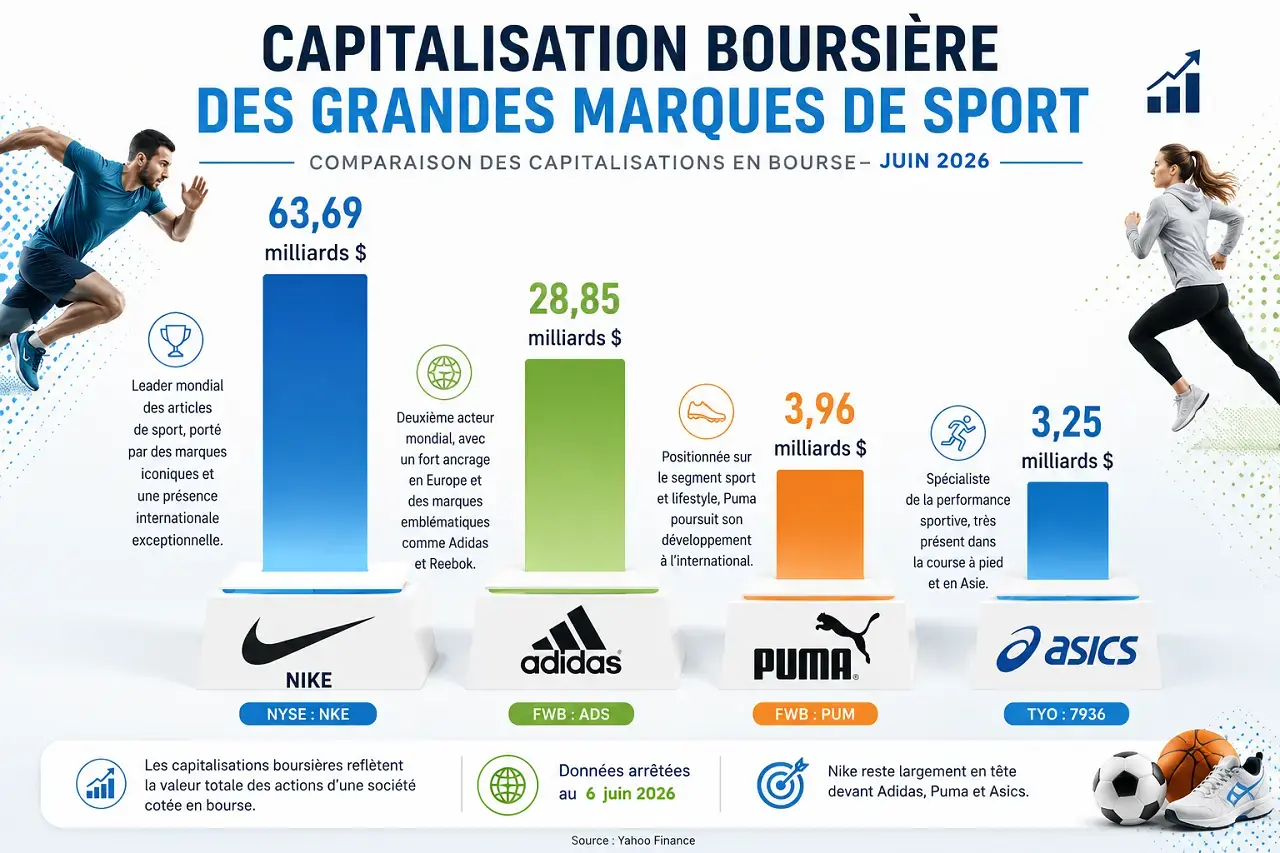
Should you invest in Nike stock in 2026? Our view and fundamental analysis
From a fundamental analysis perspective, Nike stock today presents a fairly distinctive profile. On one hand, the group remains one of the most powerful brands in the world, has an exceptional international presence, and retains an innovation capability that few sector players can claim. Its financial position remains solid and allows it to continue investing in its products, marketing, and sports partnerships.
On the other hand, Nike is undergoing a transition that still weighs on its profitability. The group must contend with more intense competition, a persistently promotional environment, and several markets that remain challenging, notably China. The efforts to cleanse inventories, reorganize certain distribution channels, and reposition the offering should nonetheless lead to a gradual improvement in margins over the coming periods.
For the investor, the main question is therefore not about survival or financial strength but about the ability to sustainably return to growth. If the turnaround plan implemented by management pays off, the current valuation could appear attractive in the long term. Otherwise, the stock could continue to move without a genuine growth catalyst.
Summary table of Nike’s key financial indicators
| Fundamental indicator | Value |
| Enterprise Value (EV) | $63.69 B (same as market capitalization) |
| Net cash | $0.03 B |
| Estimated P/E 2026 | approximately 31 |
| Price-to-Book (P/B) | approximately 4.5 |
| Shareholders’ equity | $14.09 B |
| Dividend yield | approximately 3.8% |
| Estimated payout ratio | approximately 117% |
| Shareholder return | 24 consecutive years of dividend increases |
| Financial position | Net debt essentially zero |
| Fundamental profile | Quality value in a recovery phase |
Commentary by Elliott Hill, Nike CEO:
The work isn’t finished, but the management is clear. Our priority is clear, and our comeback is within reach.
How far can NKE stock go in 2026? Our view and technical analysis
While fundamental analysis has allowed us to assess the company’s quality, financial position, and long-term growth prospects, technical analysis provides a complementary lens by focusing on the evolution of the stock price.
So, let’s now move to Nike’s chart study. This approach aims to identify the main support and resistance levels, as well as price zones that could play an important role in the stock’s evolution over the coming months.
Medium- and long-term technical analysis of NKE stock
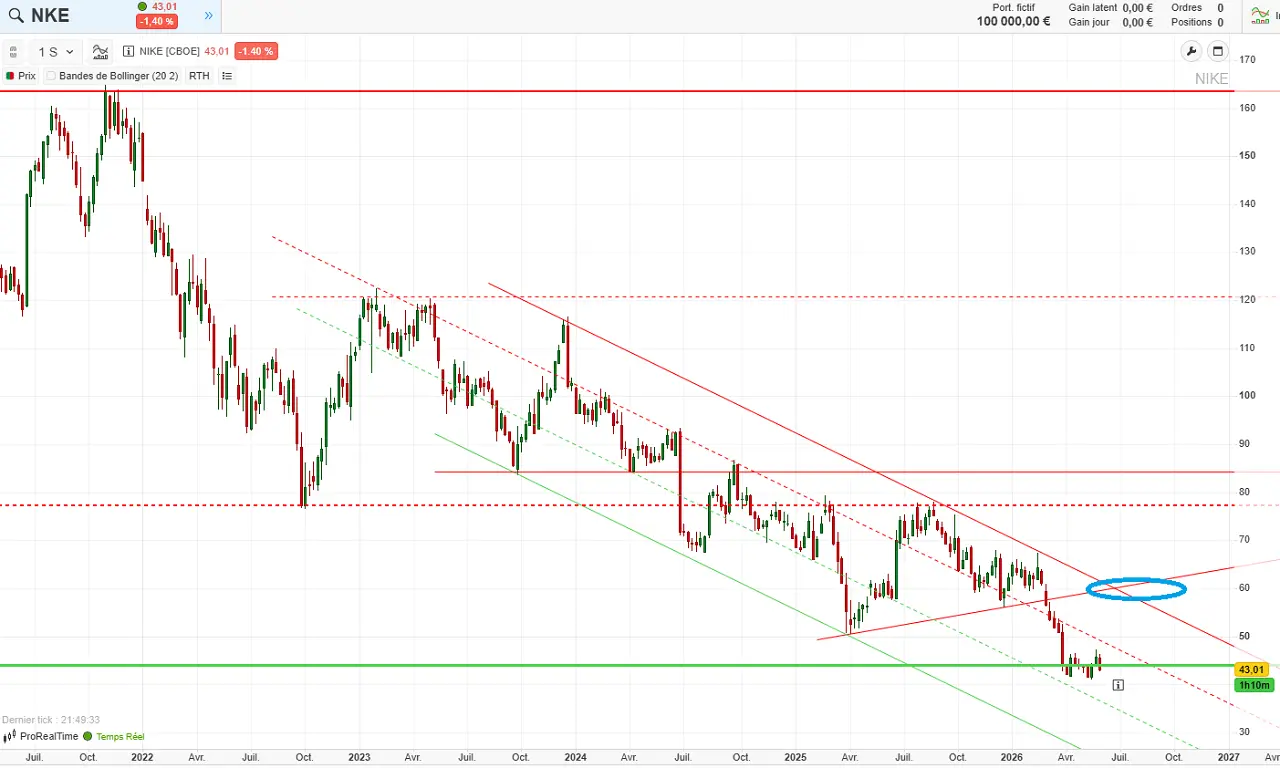
On a weekly chart, it is possible to trace back to Nike’s all-time high reached in November 2021 near $164. Since that peak, the underlying trend has been clearly downward, as shown by the downward-sloping channel on the chart. As long as prices stay within this pattern, a true long-term bullish reversal will be difficult to envisage.
Nevertheless, the situation warrants close watching. Nike stock is currently trading in an important support zone around $44. This level seems to be curbing selling pressure for now and could serve as a base for a technical rebound. In this scenario, a move back toward the upper boundary of the downward channel, around $60, could be considered.
This $60 level is also an especially important zone since it corresponds to both the upper boundary of the downward channel and a long-term trend line, shown in blue on our chart. A bullish breakout of this zone would be a strong technical signal and could open the way to a return toward the next resistances at $77 and $85. Beyond that, the next targets for Nike would be around $120 and, in the longer term, a return to the near all-time high of around $164.
Nike stock technical analysis in the medium to long term (weekly)
Nike stock short-term technical analysis
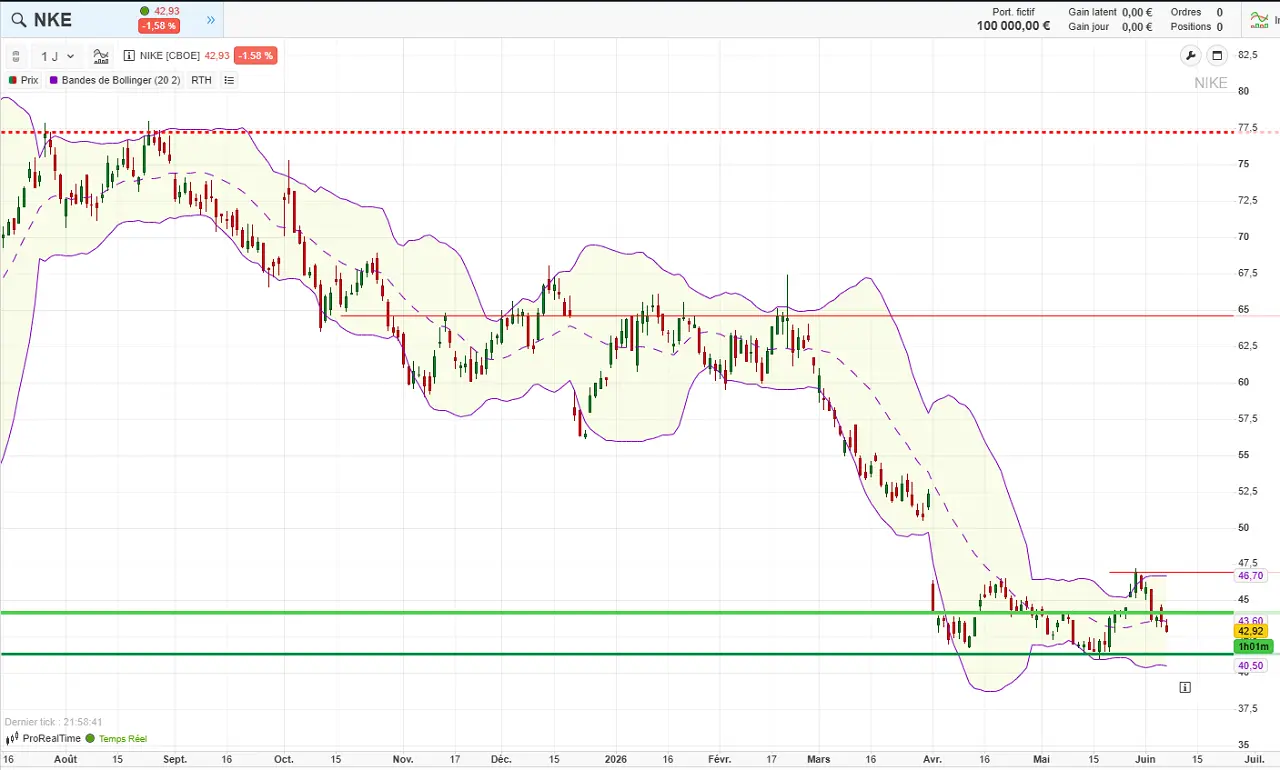
The daily data analysis of Nike stock refines the technical levels identified on the weekly chart. Notably, the major resistance at $77, already visible in the long-term analysis, is present. On the other hand, the short-term study reveals an intermediate level around $65, which could serve as an important step before considering a further move toward higher resistances.
In the even shorter term, investors should monitor the $47 zone on Nike stock. This immediate resistance could represent a first objective if the rebound seen in recent sessions continues. Indeed, Nike stock is currently attempting to break out from a major technical zone between $41 and $44. This zone, heavily tested by the markets in recent weeks, now constitutes the main level to watch. Prices seem to gradually reposition below this support zone (44 $), but the last line of sellers remains around $41.
On the technical indicators side, the Bollinger bands also provide interesting information. After narrowing sharply between late April and late May, signaling a drop in volatility, they are starting to widen again. This movement suggests a gradual return of volatility for Nike. However, the amplitude of movements remains relatively limited compared with the strong volatility phases seen in March and April.
Nike stock short-term technical analysis (Daily)
Key technical levels to monitor on Nike stock
| Technical level | Price ($) | Comment |
| Major long-term support | 41 $ | Last line of defense identified on charts A clean break below this level would severely degrade the technical scenario and open the way to a continuation of the long-term downtrend |
| Major support zone | 44 $ | Level currently being tested by prices As long as Nike remains above this zone, a technical rebound scenario remains feasible |
| Short-term resistance | 47 $ | First bullish objective if the rebound is confirmed A breakout of this resistance would strengthen the near-term positive momentum |
| Major / nerve center resistance | 60 $ | Particularly important level as it corresponds to both the upper bound of the long-term downward channel and a trend line A bullish breakout would be a strong technical signal |
| Intermediate resistance | 65 $ | Level visible on daily analysis Could trigger profit-taking before a potential continuation toward higher resistances |
| Major resistance | 77 $ | Former support zone turned into resistance Breaking through would confirm a significant improvement in the stock’s chart structure |
| Secondary resistance | 85 $ | Potential target after breaking 77 $ This zone could attract sellers and trigger a consolidation phase |
| Long-term resistance | 120 $ | Distant level that would only become relevant again in case of a durable bullish reversal |
| All-time high (ATH) | 164 $ | All-time peak reached in November 2021 Ultimate theoretical objective in a full Nike recovery over several years |
Should you buy Nike stock in 2026? Café de la Bourse’s view
*Your capital is at risk. See terms on the site.
In our view, Nike stock deserves close watch from long-term investors today. Indeed, the group is still undergoing a transition, and recent results show that the turnaround is not yet fully completed. Competition has intensified, particularly in running, while certain strategic markets such as China continue to weigh on the company’s growth. Nevertheless, Nike remains one of the most powerful brands in the world and still retains substantial competitive advantages.
Fundamentally, the situation appears markedly different from a few years ago. While Nike’s valuation previously incorporated a highly optimistic growth scenario, the market today seems to adopt a much more cautious stance. This drop in expectations mechanically reduces the risk of disappointment and could offer attractive upside potential if the turnaround plan implemented by management delivers the expected results.
On the technical front, caution remains warranted. An old market adage reminds us not to try to catch a falling knife. Even if the $44 support currently slows Nike’s decline, the long-term trend remains downward as long as the stock trades within its long-term downward channel. In this light, the most cautious investors might wait for technical reversal confirmation, notably through reclaiming some important resistances.
Finally, the 2026 World Cup could serve as an attractive catalyst for Nike. Thanks to its historic presence in football and its numerous partnerships with national teams and top players, the group will benefit from exceptional visibility in the coming months.
Ultimately, Nike stock seems more aligned today with a recovery scenario than with a classic growth stock. For investors willing to accept some uncertainty and with a multi-year investment horizon, the risk/reward appears more attractive than it was at Nike’s 2021 peak. However, in the short term, confirming the operational recovery and exiting the downward channel will remain essential elements to monitor for Nike.
How to invest in Nike stock in practice?
To invest in Nike stock, the simplest solution is to go through a stock broker that provides access to the U.S. markets through a securities account. Among the players available in France, XTB notably allows direct investment in Nike stock, but also on more than 12,300 financial instruments via a platform accessible on computer, tablet, and smartphone.
One of the main advantages of XTB is its pricing policy. The broker applies 0% commission on stocks and ETFs in cash up to €100,000 of monthly volume. Beyond this threshold, a 0.20% commission applies. Investors can also buy fractional shares from as little as €10, allowing to gradually build a position in Nike even with limited capital.
XTB is currently offering a promotion for new clients. From June 5, 2026 to July 20, 2026 at 16:00, individuals who open a securities account, enter the promotion code LAITCAFE, accept the operation’s terms via the mobile app, and make an initial deposit of at least €100 within 7 days of account opening, can receive a Nike share for free, subject to stock availability. The deposited capital remains available in the client’s account. The share is credited to the account within a maximum of 3 business days after validation of the offer’s conditions. This operation is restricted to new clients and limited to the first 5,000 participants.
For investors who want to gain exposure to Nike, this XTB offer could be a simple way to explore stock investing as part of a long-term approach by becoming a shareholder of one of the world’s most iconic sports brands.
Investing involves capital loss risk. Past performance does not guarantee future results. See the full terms of the offer on XTB’s website.
*Your capital is at risk. See terms on the site.
The information from Cafedelabourse.com and its publications is provided for educational purposes. It does not constitute investment recommendations. The reader should study the risks before undertaking any transaction. They are solely responsible for their investment decisions.
Past performance does not guarantee future results. Investing in stocks involves capital loss.
All our information is, by nature, generic. It does not take into account your personal situation and cannot in any way be considered personalized investment advice or an incentive to buy or sell financial instruments. The reader is solely responsible for using the provided information, and no recourse against Cafedelabourse.com’s publisher is possible. The publisher’s liability cannot be engaged in case of error, omission, or imprudent investment.
