
Driven by the explosion of artificial intelligence and the massive demand for computing infrastructure, Nvidia stock continues to impress investors in 2026. Since the start of the year, Nvidia shares have already gained more than 18%, confirming its status as a true locomotive of the American technology sector.
And the quarterly results published on May 20, 2026 were particularly awaited on the market, as investors seek to know whether the GPU giant can still maintain such a growth pace despite expectations that have become extremely high.
In this Nvidia analysis and review, we will therefore see whether Nvidia stock still has real upside potential in the market after its impressive stock market run, or whether part of the good news is now already priced into Nvidia’s share price.
Between domination of the AI market, spectacular revenue growth and ever-higher investor expectations, Nvidia stock continues to generate as much enthusiasm as debate on Wall Street. The aim here is therefore to simply decipher the strengths and risks of Nvidia, both from a fundamental and a technical perspective, in order to answer the question: is it still interesting to invest in Nvidia stock in 2026?
Who is Nvidia? History and key figures 2026
Founded in 1993 by Jensen Huang, Chris Malachowsky, and Curtis Priem, Nvidia originally specialized in designing graphics cards primarily for video games. The company quickly established itself as a key player in GPUs thanks to the development of graphical processors capable of handling complex parallel calculations, a technology particularly suited to the needs of modern video games. For many years, Nvidia was mainly associated with gaming and GeForce graphics cards. It later benefited from the cryptocurrency boom, as its graphics cards were widely used for crypto asset mining.
But Nvidia gradually took on a completely different dimension with the rise of artificial intelligence. Nvidia GPUs proved particularly effective for training AI models and neural networks, far outperforming traditional processors for these massive calculations. Thanks to its technological lead, its CUDA software ecosystem became a reference in the sector, as well as its data center infrastructures, Nvidia established itself as the big winner of the AI revolution. Today, its chips equip cloud giants as well as AI laboratories, industrial companies, and sovereign AI projects around the world.
Key information about Nvidia
| Categories | Key information |
| Company name | NVIDIA |
| Stock ticker | NVDA |
| Main listing exchange | Nasdaq |
| Industry | Semiconductors / Artificial intelligence |
| Founded | 1993 |
| Headquarters | Santa Clara, California, United States |
| CEO | Jensen Huang |
| Geographic presence | More than 50 countries |
| Customers / users | Leading hyperscalers worldwide, cloud providers, industrial companies, AI laboratories and sovereign players |
| Main markets | AI data centers, cloud computing, gaming, robotics, automotive, edge computing |
| Stock indices | NASDAQ 100, S&P 500 |
| Market capitalization | Around $5.4 trillion |
| Shares outstanding | About 24.2 billion |
What are Nvidia’s latest results in 2026?
Nvidia’s results once again confirmed the group’s dominant position in the global AI ecosystem. Despite exceptionally high expectations from investors, the company managed to sustain its growth momentum thanks to the very strong demand for its AI infrastructure, notably in data centers. Nvidia continues to benefit from massive investments by cloud giants, hyperscalers, but also from a gradual diversification of its customer base toward enterprises, industrial players, and sovereign AI projects.
The group also highlighted the mass deployment of its Blackwell architecture, now used by leading hyperscalers, cloud providers, and AI model developers. Activities related to networks and AI infrastructures continue to accelerate as well, proving that Nvidia no longer sells only chips, but a complete technological ecosystem.
Finally, the outlook for the upcoming quarter shows continued optimism from management, even as markets remain attentive to geopolitical tensions and restrictions related to China.
Key Nvidia results Q1 FY27
| Categories | Data |
| Revenue | $81.6 billion |
| Revenue growth year over year | 85% |
| Data Center revenue | $75.2 billion |
| Data Center growth year over year | 92% |
| Net income | $58.3 billion |
| Net income growth year over year | 211% |
| Diluted EPS (GAAP) | $2.39 |
| EPS growth year over year | 214% |
| GAAP gross margin | 74.90% |
| Operating cash flow | $50.3 billion |
| Amount returned to shareholders | About $20 billion |
| New share repurchase program | $80 billion |
| FY27 Q2 revenue guidance | $91 billion (roughly +2%) |
| China Data Center revenue | No Hopper revenue shipped to China in the quarter |
Comment from Jensen Huang, Nvidia CEO:
“Growth is anchored on an increasingly diversified customer base, ranging from hyperscalers to AI model developers, through AI Clouds, enterprises, and sovereign customers.”
What is Nvidia’s position in the tech sector in 2026?
Today, Nvidia holds a absolutely central position in the global tech sector, and more specifically in artificial intelligence. The company has established itself as the leader of AI infrastructure thanks to its ultra-performant GPUs, now essential for training and running generative AI models. This lead rests not only on the raw power of its chips but also on an entire software and hardware ecosystem developed over years, notably with CUDA, its networking solutions, and its data center platforms. This is what makes Nvidia particularly hard to compete with today.
Nevertheless, Nvidia faces several major competitors. Advanced Micro Devices (AMD) seeks to capture AI accelerator share with its Instinct chips, while Intel attempts to rejoin the race with its Gaudi solutions and massive investments in AI. Major cloud players like Microsoft, Amazon, or Alphabet are also developing their own chips to reduce dependence on Nvidia.
Finally, specialized companies like Broadcom or startups like Groq are also looking to profit from the AI boom.
Despite this growing competition, Nvidia still maintains a significant technological lead, notably thanks to its Blackwell architecture, CUDA software ecosystem, and the strong global demand for AI infrastructures.
Comment from Jensen Huang, Nvidia CEO:
“Nvidia’s AI infrastructure offers the lowest cost per token and the highest token generation throughput according to the latest MLPerf and InferenceX benchmarks.”
Should you invest in Nvidia stock in 2026? Our view and fundamental analysis
Regarding fundamental analysis, Nvidia stock remains an exceptionally high-quality case, but it requires true analytical discipline.
Nvidia today combines very strong growth, exceptional profitability and a generation of cash flow that few companies can match at this scale. The main engine remains the Data Center, powered by the massive demand for AI infrastructure, while Blackwell now appears as the group’s new strategic growth engine.
Nvidia is also betting on the development of agent-based AI and reinforcement learning, which the group regards as the next major growth steps for the AI market.
Nvidia no longer sells merely chips: the group provides a complete platform combining processors, interconnects, software and services, which reinforces its competitive edge.
The caveat lies mainly in valuation. Even if multiples may seem reasonable given current growth, they rest on a strong assumption: Nvidia must continue to deliver very high growth and preserve its margins.
Thus, Nvidia stock remains attractive for an investor convinced of the AI cycle’s continuation, but riskier for a cautious profile, because any disappointment in demand, margins, China, or the pace of Blackwell adoption could trigger a significant correction.
At this stage, Nvidia looks less like a speculative stock and more like a highly profitable mega-cap growth stock, albeit already richly valued.
Summary table of Nvidia’s key financial indicators
| Nvidia financial indicators | Estimated values as of May 2026 |
| Market capitalization | $5,400 billion |
| Enterprise value | $5,358 billion |
| Diluted diluted earnings per share (annualized) | $9.56 |
| Estimated P/E | 23.1x |
| Estimated annualized EBITDA | $218.1 billion |
| Estimated EV / EBITDA | 24.6x |
| Annualized dividend per share | $1.00 |
| Annualized net income | $233.3 billion |
| Cash + equivalents + marketable debt securities | $50.3 billion |
| Total long-term debt | $8.5 billion |
How far can Nvidia stock go in 2026? Our view and technical analysis
We now have a relatively clear view of Nvidia’s fundamentals, with a company that continues to show impressive growth and a still-strong dominance in artificial intelligence. But beyond the financial results, investment timing remains crucial in the stock market. To attempt to identify the current trend of Nvidia stock, the main technical levels to watch, and potentially attractive entry zones, we must move on to the graphical analysis of Nvidia’s stock.
Medium- and long-term Nvidia stock technical analysis
From a technical standpoint, Nvidia’s underlying trend remains extremely bullish, with no real surprise given the group’s fundamental dynamics.
Since October 2022, Nvidia has logged a gain of over 1,750%, a performance simply extraordinary for a company of this size over such a short period. Nvidia is clearly among the market’s most powerful names today, fueled by the AI boom and a robust buying flow.
Graphically, Nvidia stock continues to trade within an important bullish channel started in March 2024. As long as this structure remains intact, the long-term trend remains decidedly upward. Given that the stock is trading near its historical highs, there is not a major technical resistance identifiable at the moment. The analysis will thus focus mainly on key support levels.
The first major support for Nvidia’s price sits around $207, a zone that acted as a major resistance in October 2025 before being breached. Further down, there is a major support around $165, which would be an interesting zone in case of a deeper market correction. Another support remains visible around $94, though this is now relatively far from current prices. Finally, a very long-term support can be identified around $33, visible mainly on historical charts.
In this context, a long-term investment strategy could be to monitor a return of Nvidia stock to the $207 support, or even a move back toward the lower end of the bullish channel around $185. This area could represent an attractive entry point to then aim for a rebound in the direction of the upper end of the bullish channel.
Weekly technical analysis of Nvidia stock for the medium and long term
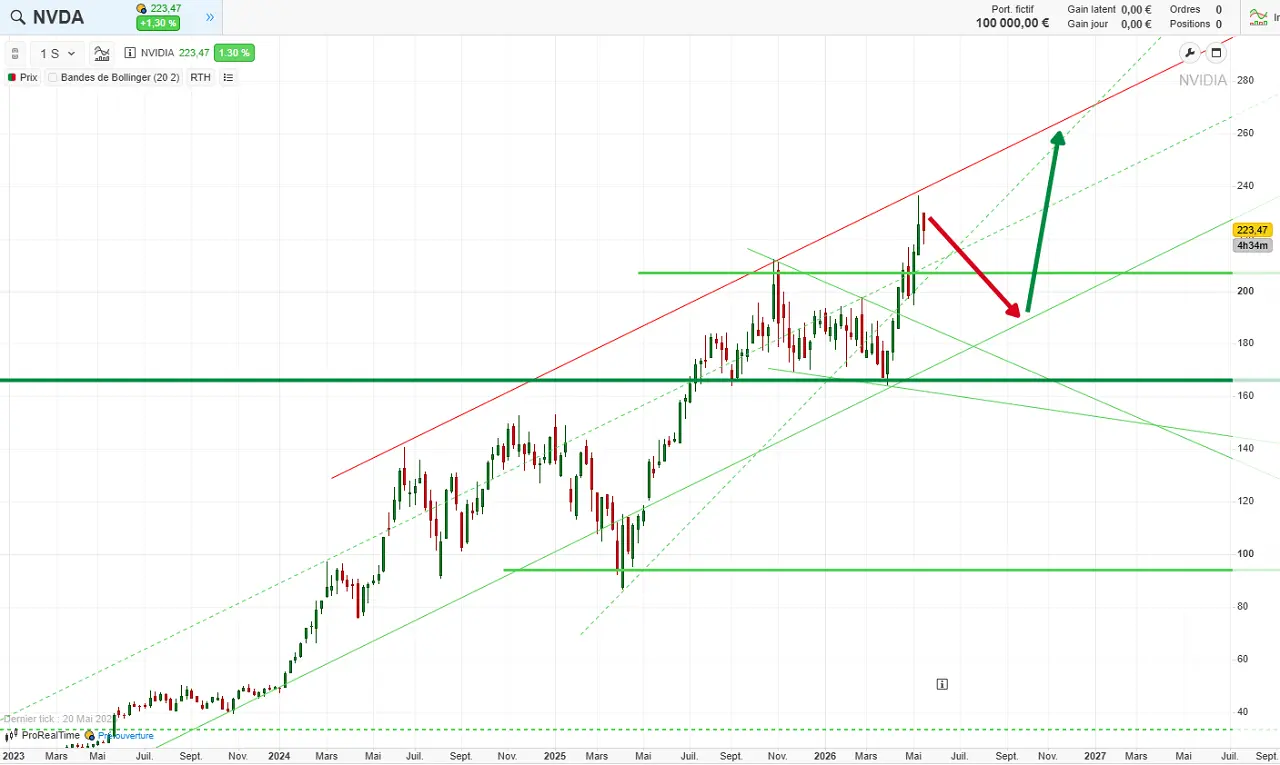
Key technical levels to absolutely monitor on Nvidia stock

| Nvidia technical level | Type of level | Importance | Commentary |
| $266 | Top of the bullish channel | Potential objective | Upper part of the uptrend channel that could serve as a long-term theoretical target |
| $207 | Support | Important | Former major resistance in October 2025 turned into a support after the breakout |
| $185 | Bottom of the bullish channel | Important | Zone corresponding to the bottom of the uptrend channel initiated in March 2024, potential long-term buy zone |
| $165 | Support | Major | Key technical level in case of a deeper market correction |
| $94 | Support | Secondary / distant | Former major support visible on long-term charts but distant from current prices |
| $33 | Support | Historical | Very long-term support only visible on historical charts |
Short-term technical analysis of Nvidia stock
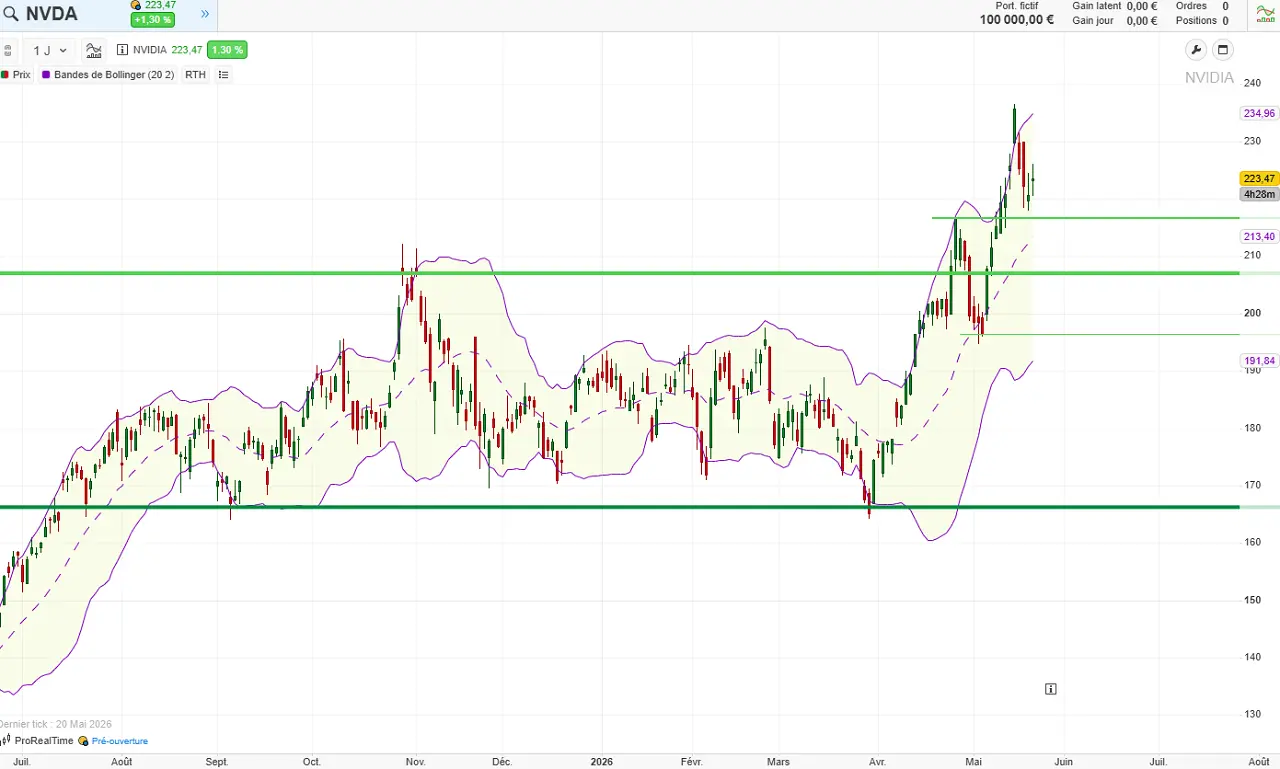
In the short term, Nvidia’s stock trend remains broadly upward in the market, but with unusually high volatility. The main technical levels identified mid-term still apply, notably the major support at $207 and the even more significant support around $165. However, the most interesting feature in recent months remains the trading range in which the stock moved between July 2025 and April 2026, with a fairly wide fluctuation zone between $165 and $207.
Nvidia stock recently broke out above this consolidation zone, which theoretically signals a positive development for buyers. However, given current market volatility in the tech sector, a return inside this range remains quite possible. In the shorter term, an intermediate support can also be identified around $216. Finally, Bollinger bands appear markedly wide, signaling ongoing high volatility for Nvidia and a market capable of rapid accelerations both up and down.
Daily chart analysis of Nvidia stock in the short term
Should you buy Nvidia stock in 2026? Cafe de la Bourse view
In our view, Nvidia remains today one of the strongest and most dominant companies in the global technology sector. Nvidia benefits from a substantial AI lead, continues to show impressive growth and profitability that few companies can match at this scale. The latest results show demand remains extremely strong, from both hyperscalers and enterprises or sovereign AI projects. Fundamentally, Nvidia thus maintains a particularly attractive profile for investors who still believe in the widespread development of AI in the coming years.
However, it’s important to keep in mind that the market already prices in a lot of good news for Nvidia. After a spectacular stock rise in recent years, volatility remains very high and any disappointment could trigger brutal corrections. In this context, Nvidia stock appears more like a long-term growth stock than a “cheap” stock. Entry timing and risk management remain especially important for Nvidia stock.
How to invest in Nvidia stock in practice?

To invest in Nvidia stock in practice, several options exist depending on your investor profile and the amount of capital you wish to commit. Investors who want to buy Nvidia shares directly can turn to traditional online brokers such as Saxo Bank, Freedom24 or ProRealTime in partnership with Interactive Brokers. These brokers allow direct investment on the Nasdaq and access to the main U.S. stocks.
For investors with a smaller portfolio or who want to avoid allocating too much of their capital to a single stock, some neo-brokers offer fractional share purchases with no commission in certain cases (trade volume below a monthly threshold, use of a savings plan). This is notably the case for XTB, Trade Republic or Bitpanda, which thus enable gradual investment in Nvidia stock with lower amounts via a DCA strategy.
Finally, it is also possible to gain indirect exposure to Nvidia through ETFs focused on artificial intelligence or semiconductors, in order to benefit from a more diversified exposure to the tech sector. For this type of investment, online brokers such as IG, eToro or Bourse Direct provide easy access to a wide selection of thematic ETFs, sometimes with no transaction fees.
Past performance is not indicative of future results. Investing in stocks carries risk of capital loss.
All our information is generic in nature. It does not take into account your personal situation and does not constitute personalized investment recommendations for the execution of transactions and cannot be equated with investment advisory services, nor any incentive to buy or sell financial instruments. The reader is solely responsible for using the information provided, with no recourse against the publisher Cafedelabourse.com. The publisher’s responsibility cannot in any case be engaged in the event of error, omission or unsuitable investment.
