
Thunderclap at Nvidia! Jensen Huang, co-founder and CEO of the American semiconductor giant since 1993, resigned on November 12, 2026, after several revelations concerning his private life, including a liaison with a woman suspected of spying for China. This affair sends a real shockwave through Wall Street, with Nvidia’s stock plunging and billions of dollars in market capitalization evaporating.
But does this governance crisis truly call into question the prospects of the world leader in AI chips? Should one buy Nvidia stock after this drop or wait for another market correction? We take stock of the company’s fundamentals, its technical analysis, and the trading opportunities arising from the high volatility in Nvidia’s stock.
Why did Jensen Huang resign and is Nvidia stock collapsing on the stock market?
After 33 years at the helm of Nvidia, Jensen Huang was forced to step down on November 12, 2026. At the origin of this crisis, several revelations about his personal relationships, including a liaison with a woman suspected of spying for China. The affair is particularly sensitive given that the United States is seeking to limit Beijing’s access to America’s most advanced technologies.
This resignation marks a historic turning point for Nvidia. Jensen Huang had co-founded Nvidia in 1993 and accompanied its ascent to become one of the world’s leading players in artificial intelligence and to make Nvidia the world’s top market capitalization.
For investors, the main risk now goes beyond the personal scandal: it is Nvidia’s ability to continue growing without its iconic leader that is in question. The investigation will also determine whether the company’s interests or American national security have been compromised.
Fundamental analysis of Nvidia: has the stock become attractive again after its fall on the stock market?
The resignation of Jensen Huang triggered a true stock market quake. While Nvidia had reached a record market capitalization of about $5,780 billion at the beginning of October 2026, the company would now weigh only $3,940 billion. This represents nearly $1,840 billion of valuation evaporated in just a few weeks, i.e., a decline of around 32%.
But does this dramatic correction automatically make the Nvidia stock cheap? To know, one must look beyond the drop in Nvidia’s share price and examine the company’s fundamentals.
According to our investment assistant Café de la Bourse Invest, Nvidia shows a CDB Score of 6.4/10, supported by exceptional growth (10/10) and remarkable financial solidity (8.5/10).
Numbers speak for themselves: Nvidia’s revenue has grown by 100% over 3 years, Nvidia’s earnings per share by more than 206%, while net margin stands at 63.66%. Debt remains particularly low, with a net debt/EBITDA ratio of only 0.01.
The Café de la Bourse Score for Nvidia Stock
On the valuation side, the situation becomes more interesting. With a P/E ratio of 21.85 and an expected P/E ratio of 18.70, Nvidia stock is now trading at more modest multiples given its growth prospects. The Cafe de la Bourse Score nevertheless assigns only 5/10 to its valuation, signaling that the stock is not yet clearly undervalued.
Café de la Bourse’s view on Nvidia: after such a significant correction, Nvidia’s valuation has become considerably more reasonable in relation to its growth and profitability. With an anticipated P/E of 18.70, Nvidia stock begins to present genuine appeal for long-term investors. However, we still deem it somewhat early to buy Nvidia. The company maintains excellent fundamentals, but uncertainties about its future direction could continue to weigh on the stock price. It is wiser to wait for the situation to stabilize, even if it means missing the early part of a potential rebound in Nvidia’s stock price.
Nvidia View: how far can the stock price fall on the market?
The decline in Nvidia’s stock has been impressive. Since its peak on October 6, 2026, Nvidia’s price has shed nearly 38% of its value. And more importantly, the various technical supports have failed to halt this fall. Price levels forming supports at $207, then $190, were breached on the downside without much difficulty. The same for the $165 level, a level that had seemed to be able to restrain sellers, but ultimately gave way during a session.
So how far can Nvidia stock still fall? On the chart, an intermediate support appears around $140. Below that, you would have to go much further back in Nvidia’s price history to find a truly meaningful support, located around $93. In case of a rebound, the $190 and $207 levels will be the first ones to reclaim for Nvidia.
Technical Analysis of Nvidia Stock at the End of 2026
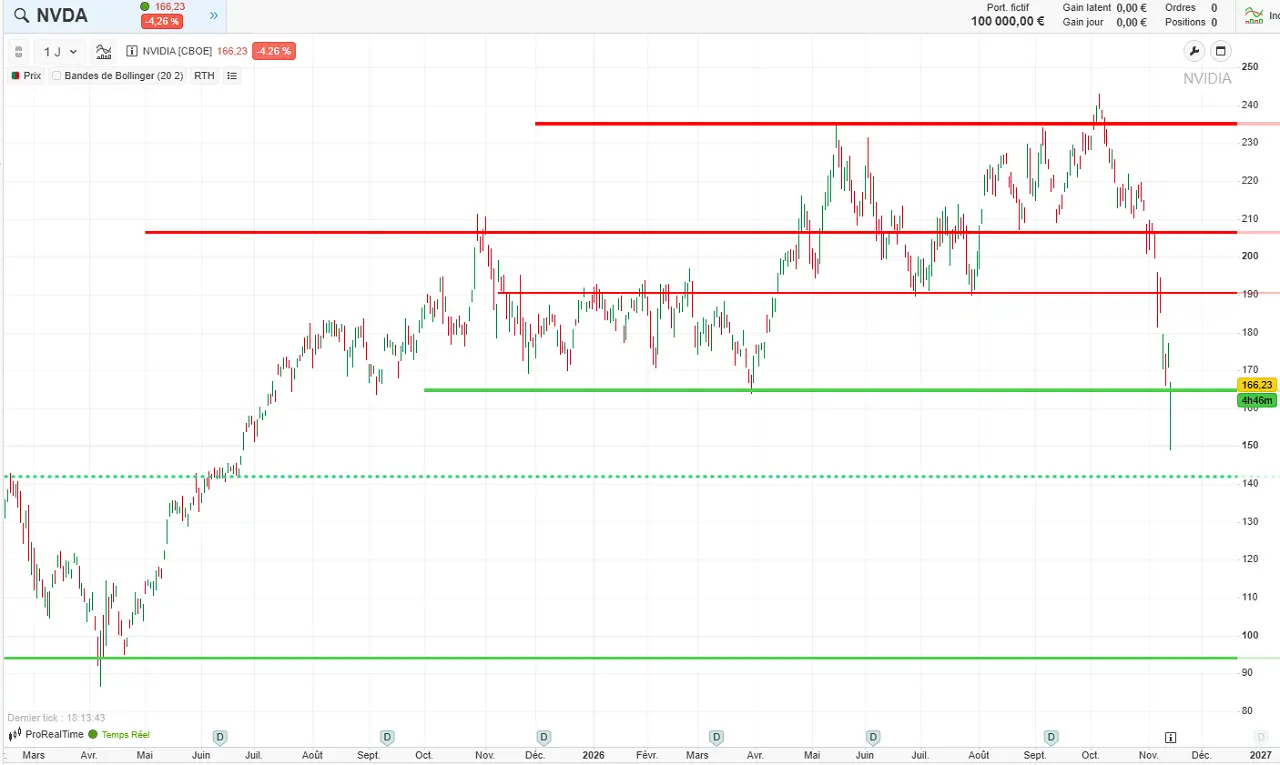

What remains, however, is that in the current circumstances, charts tell only part of the story. What matters now is mainly who will take the reins at Nvidia and how this transition will be received by the markets.
Will the new leadership manage to maintain the strategy that has driven the company’s success? Will investors regain confidence? These questions are likely to weigh much more on Nvidia’s stock price than technical indicators. Technical analysis will mainly help identify potential entry or exit points, without guaranteeing that the stock’s decline is finished.
How to trade Nvidia stock to profit from the current volatility?

The strong swings in Nvidia’s stock are not necessarily bad news for traders. On the contrary, volatility creates opportunities, both to the upside and to the downside, provided that one selects the right instruments and adapts their strategy to the market context.
Depending on whether one anticipates a technical rebound, a continuation of the correction, or sizeable moves without a clearly defined direction, several financial products can be used. Options, turbos, warrants, ETFs and ETPs with leverage allow for constructing very different strategies, with varying risk levels and investment horizons.
Here are the main strategies to consider for trading Nvidia stock in the current context:
| Anticipated Nvidia stock scenario | Preferred financial products | Possible strategy |
| Nvidia stock rebounding | Call options, call turbos, call warrants, long leveraged ETFs | Position for a price rebound, possibly with leverage |
| Continuation of the decline | Put options, put turbos, put warrants, short ETFs | Seek to profit from a new correction in the stock |
| High volatility with no clear direction | Options (straddle or strangle) | Buy both call and put options to profit from a move of sufficient magnitude |
| Moderate rise or fall | Options (bull call spread or bear put spread) | Combine several options to limit upfront cost, in exchange for capped gains |
| Intraday trading on price swings | Turbos, leveraged ETFs | Multiply short-duration trades on the stock’s movements, with strict risk management |

With the moves Nvidia’s stock is currently undergoing, it is hard for traders not to be tempted to profit from this volatility. Especially since some strategies, notably those using leverage, can yield big returns in a very short time. But beware: losses can also accumulate at an impressive speed.
These operations are mostly reserved for experienced traders, who are well acquainted with the products they use and who have already faced highly turbulent markets. For an investor who is new to trading, this is certainly not the best time to discover options, turbos, or other leveraged derivatives.
How to invest or trade Nvidia stock in practice?
To invest in Nvidia on the stock market for the long term, you can directly purchase the company’s shares from a standard securities account (CTS). Several online brokers provide access to the Nasdaq, where Nvidia is listed, including XTB, Trade Republic, eToro, and Freedom24. Before choosing the broker, it can be worthwhile to compare brokerage fees, any currency conversion charges, and the features offered. Some online brokers also allow buying fractional shares, a practical solution for gradually investing without needing to buy a full share each time.
For investors who prefer short-term trading, possibilities exist as well, but the choice of broker becomes more important. Traders wanting to use options, warrants, or turbos on Nvidia can specifically turn to brokers such as ProRealTime, Interactive Brokers, IG or Saxo Bank. In any case, it will be necessary to verify the instruments actually available, the fees, and the trading conditions before opening a position.
The information from Cafedelabourse.com and its publications is provided for educational purposes. They do not constitute investment recommendations in any form. The reader must study the risks before making any transaction. The reader alone is responsible for their investment decisions.
Past performance does not guarantee future results. Investing in stocks carries the risk of capital loss.
All our information is, by nature, generic. It does not take into account your personal situation and does not constitute personalized investment advice or any form of recommendation to buy or sell financial instruments. The reader is solely responsible for using the information provided, and Cafedelabourse.com cannot be held liable for any errors, omissions, or inappropriate investments.
