
Since the beginning of 2026, Schneider Electric’s stock has risen by 8.5%, a performance all the more notable given that the CAC 40 has fallen by 2.8% over the same period. But the stock market journey of the French specialist in energy management, data centers, and industrial automation has not been smooth. After a rise of nearly 35% between January and August 13, 2026, Schneider Electric’s share price had shed about 20% of its value in the space of two months.
In this analysis, we will examine Schneider Electric’s latest record-breaking financial results published on October 16, 2026, assess the group’s 2027 prospects in light of its economic environment and sector developments, and then study Schneider Electric’s valuation based on its key financial ratios. We will complement this study with a technical analysis of Schneider Electric’s share price in the short and long term, before delivering our view on whether to invest in Schneider Electric stock by the end of 2026.
Who is Schneider Electric? History and key figures
The history of Schneider Electric begins in 1836, when the Schneider brothers acquired the Le Creusot ironworks, which at the time specialized in steelmaking and mechanical construction. It is hard to imagine then that this industrial company would, nearly two centuries later, become one of the world’s leaders in energy management and automation. It is especially from the 1980s onward that Schneider Electric took a decisive turn, gradually refocusing on the electricity-related businesses.
The acquisitions of Telemécanique in 1988, followed by the American Square D in 1991, notably marked this transformation. The group, however, did not stop at electrical equipment.
As the company grew through acquisitions and technological evolutions, Schneider Electric also developed its expertise in industrial software, smart building management, and digital solutions. This diversification today enables it to benefit from several long-term trends, notably the electrification of the economy and the development of data centers linked to artificial intelligence.
Key information on Schneider Electric stock
| Key information | Details |
| Company | Schneider Electric SE |
| Stock ticker | SU |
| ISIN code | FR0000121972 |
| Main listing exchange | Euronext Paris |
| Industry | Electrical equipment, energy management and industrial automation |
| Founded | 1836 |
| Headquarters | Rueil-Malmaison, France |
| CEO | Olivier Blum (Chief Executive Officer) |
| Geographic presence | Over 100 countries |
| Market capitalization | €148.82 billion (16 October 2026) |
| Stock index | CAC 40 |
| Number of employees | Approximately 160,000 |
What are Schneider Electric’s latest results at the end of 2026?
The results for the third quarter of 2026 confirm Schneider Electric’s solid operational health, with growth that exceeded market expectations. What is particularly interesting is that this progress does not rely solely on data centers, even though they are today the group’s main growth engine. Demand remains well oriented across most of its activities and across all major geographic regions, indicating relatively diversified growth.
Another positive element is that the rise in sales largely comes from volumes, not just price increases. This is encouraging for assessing the strength of demand. Schneider Electric also appears to have some price-setting power, an asset in an environment where raw material costs and trade tensions remain concerns.
The upward revision of annual targets is also a signal of management’s confidence. Schneider Electric now aims for organic growth of its adjusted EBITA between 18% and 21% in 2026, with a margin expected between 19.7% and 19.9%. These prospects point to an improvement in profitability beyond mere revenue growth.
For shareholders, however, it will be necessary to monitor the group’s ability to translate this commercial momentum into earnings and cash flow, particularly in the context of its significant acquisitions.
Key figures of Schneider Electric’s Q3 2026 results
| Indicator (Q3 2026) | Value |
| Revenue | €11.46 billion |
| Revenue growth (reported) | 17.90% |
| Organic revenue growth | 16.90% |
| Energy Management revenue | €9.62 billion |
| Organic Energy Management growth | 18.80% |
| Industrial Automation revenue | €1.85 billion |
| Organic Industrial Automation growth | 8.10% |
| Organic product growth | 17% |
| Organic systems growth | 22% |
| Organic software and services growth | 7% |
| Nine-month revenue total | €32.69 billion |
| Nine-month organic growth | 15.00% |
Comment by Olivier Blum, Chief Executive Officer of Schneider Electric:
As expected, data centers remain a key growth engine as we continue to execute our order book while recording triple-digit demand during the quarter, strengthening visibility for 2027 and 2028.
What is Schneider Electric’s position in the energy and data center sector?
In France, Schneider Electric holds a leading position in electrical equipment and energy management solutions. The group notably faces Legrand, another major French player, more specialized in building electrical and digital infrastructure. Internationally, competition is stronger, with groups such as Siemens, ABB, and Eaton, which also hold solid positions in electrical distribution and industrial automation. In the data center market, Schneider Electric must also contend with specialists like Vertiv.
What sets Schneider Electric apart from many competitors is mainly the breadth of its offering. The group does not limit itself to supplying electrical equipment; it also offers software, cooling systems, automation solutions, and digital services. This complementarity enables it to handle complex industrial projects, notably in data centers, a significant competitive advantage, even though Siemens, ABB, and Eaton also possess extensive expertise across several of these markets.
Commentary by Olivier Blum, CEO of Schneider Electric:
Together, we will create a unique and powerful player in software and AI, connecting the physical and digital worlds across our four end markets.
Should you invest in Schneider Electric stock by the end of 2026? Our view and fundamental analysis

Fundamentally, Schneider Electric stock presents the profile of a profitable growth stock, with solid competitive positions and exposure to several structurally favorable markets.
One of the main strengths of Schneider Electric stock lies in its ability to improve margins while expanding its business. This progression indicates some pricing power, but also good cost control, two important qualities for an industrial group of this size.
The financial position remains relatively solid, despite a significant absolute level of debt. The group retains a substantial ability to generate cash, which allows it to finance its investments and reward its shareholders. Nevertheless, one must monitor the consequences of announced acquisitions, especially the PTC deal, which could significantly increase its leverage.
It is especially the stock’s valuation in the market that our analysis calls for greater caution. Even after the recent stock market correction, Schneider Electric’s stock trades at high multiples, signaling that investors expect continued earnings growth and margin improvement. The risk is therefore less about weak current fundamentals than about a potential disappointment relative to expectations already priced into the share.
Our fundamental view is therefore positive on the quality and prospects of Schneider Electric, but more moderate on the price to pay to become a shareholder in Schneider Electric.
Summary table of Schneider Electric’s key financial indicators
*Your capital is at risk. See conditions on the site.
| Fundamental indicators | Value |
| Market capitalization (16/10/2026) | €148.82 Bn |
| Enterprise value (EV), estimated | €163.69 Bn |
| Cash on hand (30/06/2026) | €4.52 Bn |
| Gross debt (30/06/2026) | €19.39 Bn |
| Net debt excluding minority buyout obligations (30/06/2026) | €14.87 Bn |
| Group equity attributable to the group (30/06/2026) | €24.46 Bn |
| Price to Book (P/B), estimated | 6.08x |
| Dividend yield | 1.63% |
| Adjusted EBITA (H1 2026) | €4.09 Bn |
| Adjusted EBITA margin (H1 2026) | 19.30% |
| P/E on annualized H1 EPS, indicative | 29.1x |
| Fundamental profile | Growth stock with solid fundamentals, but high valuation and leverage to monitor. |
How far can Schneider Electric stock go by the end of 2026? Our view and technical analysis
A stock can have excellent fundamentals and still fall 15% to 20% in the market. This is exactly what we have just observed with Schneider Electric. If fundamental analysis informs us about the quality of the company and its valuation, it does not really tell us when to buy the stock.
For that, we will focus on chart analysis. The objective is to identify price levels where buyers and sellers have already clashed, in order to identify zones where a rebound, or conversely a new decline, could occur in Schneider Electric’s stock.
Short-term technical analysis of Schneider Electric stock
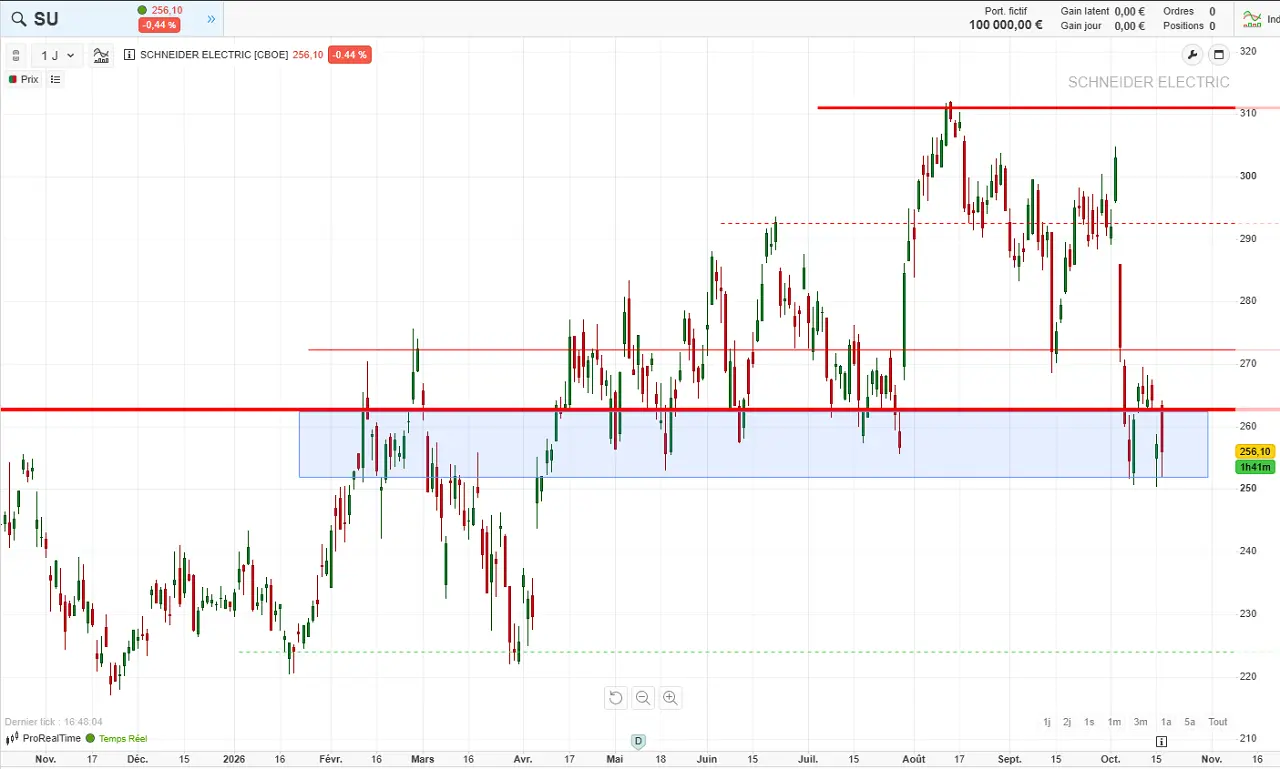
Looking at the daily chart of Schneider Electric’s stock, one level catches our attention particularly: 262 euros.
Since the start of 2026, Schneider Electric’s stock price has repeatedly touched this price level, sometimes hindering its advance, sometimes acting as support during corrections. But rather than fixating on a single price, we now prefer to monitor a broader zone, between 250 and 262 euros, which we have marked in blue on the chart.
Indeed, it is precisely in this zone that Schneider Electric’s stock is currently attempting to stabilize after having shed nearly 20% from its August 2026 highs. The coming sessions will therefore be important to determine whether buyers are still present in sufficient numbers to halt the decline.
If Schneider Electric’s stock price manages to rebound and move back above 262 euros, an initial objective could be around 272 euros, an intermediate resistance that has been tested several times this year. Beyond that, 292 euros would be the next obstacle to clear before considering a return toward 311 euros, corresponding to the historical highs visible on our chart.
Conversely, if selling pressure were to prevail and cause a durable break below 250 euros, the technical setup would become much less favorable for Schneider Electric’s stock. The next meaningful support would then be around 224 euros, implying substantial downside potential.
At this stage, we therefore consider the 250–262 euro zone to be a true pivot for Schneider Electric’s stock. As long as it holds, the rebound scenario remains feasible. But a break below 250 euros, especially on a daily close, would be a weakness signal for investors not to ignore.
Daily technical chart analysis of Schneider Electric stock
*Your capital is at risk. See conditions on the site.
Long-term technical analysis of Schneider Electric stock
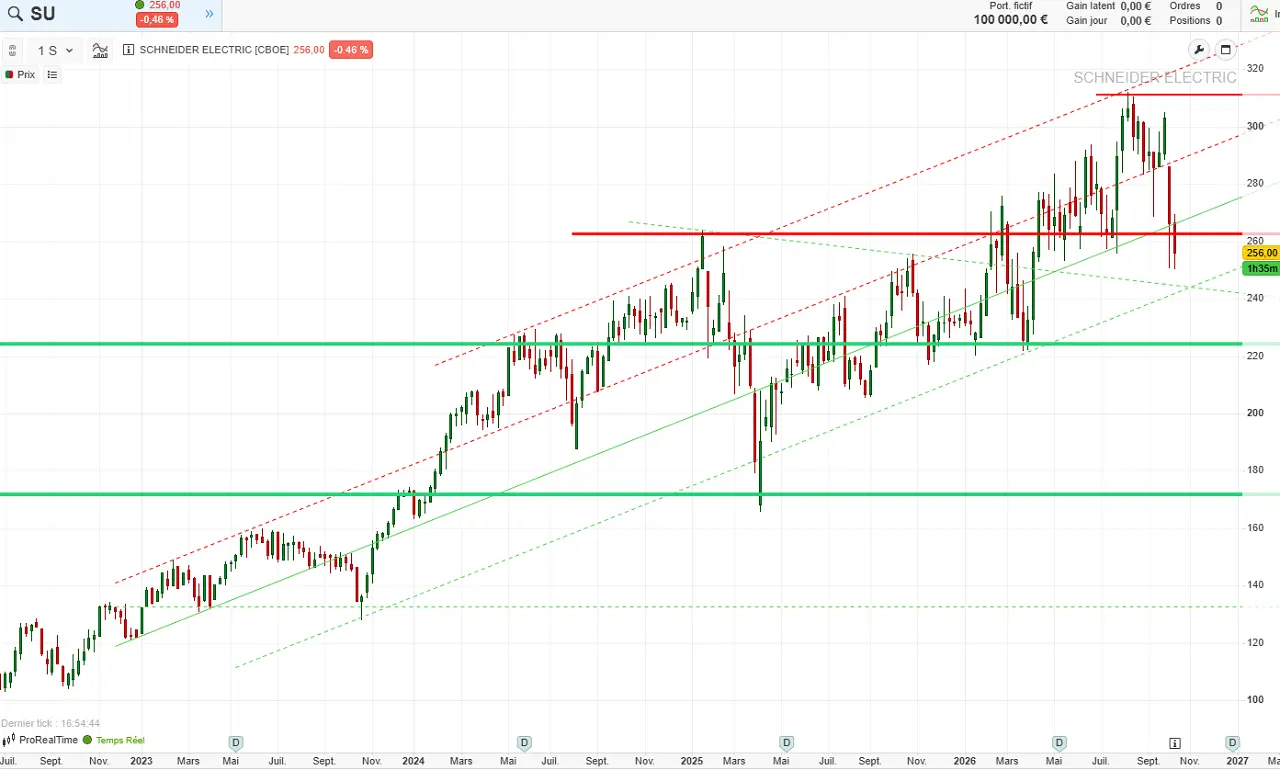
On the weekly chart of Schneider Electric’s stock, we again find the main support and resistance levels identified earlier. But this longer-term view mainly allows taking a step back from the underlying trend, which remains bullish despite the recent correction. Since 2022, prices have moved within a wide ascending channel, whose bounds have been tested several times.
This chart also reveals an additional support around 172 euros, which was not visible in our short-term analysis of Schneider Electric’s stock.
Finally, in the event of a much larger correction, the lower bound of the rising channel could constitute a last line of defense around 144 euros. However, this level remains indicative, as the position of this trend line evolves over time.
Weekly chart analysis of Schneider Electric stock
Key technical levels to watch on Schneider Electric stock by the end of 2026
| Type of level | Importance | Price (€) | Coffee de la Bourse commentary |
| Resistance | Major | 311 € | Historic high to watch A confirmed breakout could open the way to a new bullish phase |
| Resistance | Strong | 292 € | Mid-term objective in case of rebound Watch for possible price rejection or a bullish breakout |
| Resistance | Intermediate | 272 € | First rebound objective after reclaiming 262 € A breakout would strengthen the bullish scenario |
| Support / resistance | Pivot major | 262 € | Critical level to regain to confirm a rebound As long as prices stay below, caution prevails |
| Support zone | Major | 250–260 € | Potential buying zone to monitor Wait for stabilization signals before considering entry |
| Support | Strong | 224 € | First downside objective if 250 € breaks Watch buyers’ reaction at this level |
| Support | Strong | 172 € | Long-term support Could offer an entry point after a deep correction, provided a confirmed rebound |
| Dynamic support | Long term | 144 € | Indicative lower bound of the rising channel Zone to re-evaluate depending on channel date and slope, in case of a sharp decline |
Should you buy Schneider Electric stock by the end of 2026? Café de la Bourse’s view

According to our analysis, Schneider Electric stock retains an interesting upside potential in the medium to long term, but we currently favor a prudent approach. Schneider Electric benefits from favorable structural trends, notably electrification and AI-related infrastructure. Its recent stock market correction makes its valuation more reasonable, without making Schneider Electric a cheap stock.
Our preferred scenario would be a stabilization of Schneider Electric’s share price, followed by a gradual rebound of the uptrend. In this perspective, the current correction could present an opportunity to position for an investor with a multi-year horizon.
However, one should not underestimate the opposite scenario: a slowdown in data center investments, difficulties integrating acquisitions, or a deterioration of financial markets could prolong the decline. We remain favorable to Schneider Electric stock in the long term, but not necessarily assuming we must buy it immediately.
How to invest in Schneider Electric stock in practice?
To invest in Schneider Electric stock, the simplest approach remains to buy it directly on the stock market via a standard securities account (CTO) or a PEA (Plan d’Épargne en Actions), since Schneider Electric is a French company eligible for the PEA. Among the brokers offering a PEA, you can find XTB, BoursoBank, or ProRealTime x Interactive Brokers, for example. Other trading platforms, such as IG, Freedom24, or eToro, also allow investing in Schneider Electric stock via a standard securities account.
With Schneider Electric’s share price above €250 in October 2026, purchasing a full share can represent a significant amount for small stock portfolios seeking diversification. Fractional shares offered by online brokers such as Trade Republic or Bitpanda can therefore be of interest.
It is also possible to gain indirect exposure to Schneider Electric through a CAC 40 ETF, since Schneider Electric is part of this CAC 40 index. Some sector ETFs dedicated to electrification, electrical equipment, or the energy transition may also include Schneider Electric in their portfolios. This approach helps distribute your investment across several companies rather than relying solely on the performance of one stock.
Finally, investors who want a more active approach can turn to derivatives, notably options offered by brokers such as IG and Saxo Bank. These products, however, are intended for experienced investors because they carry additional risks, especially due to leverage.
The information from Cafedelabourse.com and its publications is provided for educational purposes. It does not constitute investment recommendations in any way. The reader should study the risks before making any transaction. They are solely responsible for their investment decisions.
Past performance is not indicative of future results. Investing in stocks involves capital risk.
All of our information is, by its nature, generic. It does not take into account your personal situation and does not constitute personalized recommendations aimed at executing transactions and cannot be equated with an investment advisory service. The reader is solely responsible for the use of the information provided, with no recourse against Cafedelabourse.com’s publisher. The publisher’s liability cannot be engaged in the event of error, omission, or ill-timed investment.
