
Kering published its financial results on April 14, 2026 for the first quarter 2026, and the balance sheet is not bright. The absence of growth and the crisis Gucci is going through could well worry investors. However, the outlook is not totally catastrophic, and there is still a possibility of an improvement by the end of 2026.
In this article, we will review the results announced by Kering, Kering’s positioning in the luxury universe and the recent evolution of Kering’s share price. We will also analyze the fundamentals of the Kering company, before carrying out a technical analysis of the Kering share to determine how to trade and invest in the Kering stock and give you our view on the question: should you buy Kering stock in 2026?
What are the latest results announced by Kering in 2026?
At first glance, Kering’s results are neither clearly bad nor truly reassuring. One senses a group trying to stabilise after a difficult period. There are clearly some encouraging points: certain activities are standing out and show that Kering is not dependent on a single growth engine. It is also evident that internal efforts have been undertaken, with a willingness to restore order in the offering, distribution, and positioning of the brands.
But at the same time, difficulties remain. The core of the group, namely fashion and leather goods, continues to lack dynamism. And above all, Gucci, the most important brand for Kering, has not yet regained real momentum. This is a key point, because as long as Gucci does not rebound strongly, the whole group will struggle to accelerate.
Added to this is a challenging economic and geopolitical environment, which weighs on the consumption of luxury goods. In the end, Kering appears to be in a transition phase: the worst may be behind, but the recovery remains fragile and will need to be confirmed in the coming quarters.
Key figures for Kering in the first quarter 2026
| Indicator | Q1 2026 | Reported change | Change at like-for-like (comparable perimeter) |
| Group revenue | €3,568m | -6% | 0% |
| Fashion and leather goods | €2,852m | -9% | -3% |
| including Gucci | €1,347m | -14% | -8% |
| Jewellery | €269m | 14% | 22% |
| Eyewear | €489m | 3% | 7% |
| Other activities | €30m | -7% | 10% |
Kering revenue evolution by geographic region
| Region | Change |
| North America | +9% |
| Western Europe | -7% |
| Asia-Pacific | -4% |
| Japan | -3% |
| Rest of the world | -8% |
Despite the numerous concerns around tariffs and trade tensions with the United States, the operational reality is quite different as the US market remains today the main growth driver for Kering.
In other words, even in an uncertain political context, demand in the United States continues to hold up well and represents one of the few solid pillars for the group.
What is Kering’s stock price today?

What is Kering’s position in the luxury sector in 2026?
Kering’s position in the luxury sector in 2026 appears more fragile than before, even though the group still holds a leading place.
Historically, Kering was part of the top trio alongside LVMH and Hermès, but the gap has widened in recent years. While LVMH continues to benefit from strong diversification and a relatively solid momentum, and Hermès shows steady growth driven by very high-end demand, Kering is going through a tougher period.
This situation is largely explained by the group’s dependence on Gucci, which was long a growth engine, but has been undergoing strategic repositioning for several years.
Kering’s recent results show that a transition is underway, with a clear desire to move upmarket, to rework the offering and to strengthen the brand’s desirability. At the same time, Kering is trying to rebalance its portfolio by relying more on other houses such as Saint Laurent or Bottega Veneta, as well as on fast-growing activities such as jewellery and eyewear.
In 2026, Kering remains a major global luxury player, but clearly behind the sector’s more performing leaders such as Richemont, for example. The Kering group is engaged in a strategic transformation, aiming to regain sustainable growth and reduce its dependence on a single brand.
Its ability to successfully turnaround Gucci will be decisive to determine whether it can again fully compete with the leaders of the sector in the coming years.
What are the fundamentals of the Kering stock? Our view and fundamental analysis
Regarding fundamental analysis, Kering’s stock today presents a fairly distinctive profile within the luxury sector. Where some sector values are still perceived as very premium growth stocks, Kering is more seen as a turnaround case. This perception is notably reflected in its valuation multiples.
The current P/E of Kering appears high, not because the market overpays for the Kering stock, but mainly because profits are temporarily under pressure. In other words, the market anticipates a future improvement in results rather than a performance already in place.
A deeper look at enterprise value and EV/EBITDA shows that the stock trades at more moderate levels than its direct peers, indicating a form of discount. This discount is mainly explained by uncertainties surrounding the group’s ability to sustainably relaunch its flagship brand, Gucci. At the same time, the price-to-book ratio remains relatively contained, suggesting that the market values the group’s assets cautiously, without excessive optimism.
Ultimately, Kering is no longer valued as a luxury leader, but rather as a turnaround stock. The market seems to be waiting for concrete signs of recovery before fully re-rating the Kering stock, which leaves an interesting potential but with a higher level of risk than the sector average.
Key fundamentals of the Kering stock
| Indicator | Level |
| Market capitalization | €33 bn |
| Enterprise value (EV) | between €46 and €48 bn |
| P/E (Price-to-Earnings Ratio) | Very high: 94.96 |
| EV / EBITDA | 12x |
| Price-to-Book (P/B) | 2.1x |
How far could Kering stock go in 2026? Our view and technical analysis
From a technical analysis perspective, the conclusion is quite clear: Kering’s share has been moving in a downtrend since 2021, with a loss of value exceeding 60%. We are thus facing a weakened Kering stock, embedded in a negative underlying dynamic. That said, the fact that Kering’s stock price is now below this trend requires paying particular attention to key technical levels.
On the support side, two zones stand out on the chart: first around €225, then a farther level around €152. These are important zones because they could provide a base for a potential rebound in Kering’s stock. Conversely, a break of these levels would send a very unfavorable signal for the road ahead.
In parallel, it is also necessary to monitor resistances, which play a double role: restraining the stock’s advance, but also serving as targets in case of a rebound.
Two days before the release of results, Kering’s stock traded into the €275 resistance zone, but given Kering’s disappointing results, a breakout occurred. If this breakout is confirmed, the next objective for Kering stock would be around €340-345. Higher up, other resistances exist, notably around €545, then around €700, corresponding to the all-time high. Everything will now depend on how investors digest the recent results and adjust their expectations in the coming days.
Medium-long term technical analysis of Kering stock
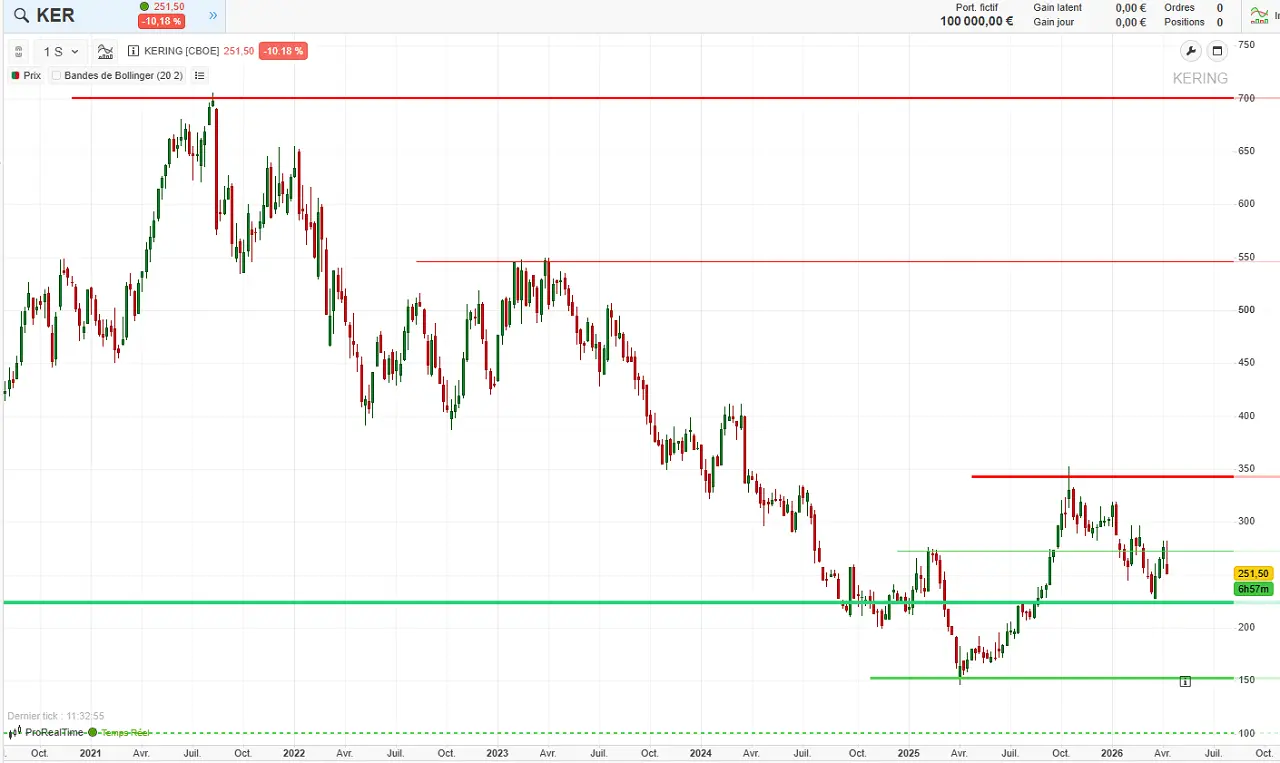
Table of the main technical levels of Kering stock
| Type of level | Price zone | Importance | Commentary |
| Support | 152 € | Long term | Major support in case of a sharp drop |
| Support | 225 € | Short- and medium-term | Potential rebound zone |
| Resistance | 275 € | Short term | Key level to surpass to resume the rise |
| Resistance | 345 € | Medium term | First objective in case of an upward breakout |
| Resistance | 545 € | Long term | Former consolidation zone |
| Resistance | 700 € | Very long term | All-time high |
Should you buy Kering stock in 2026? Café de la Bourse view
Our view on Kering stock remains nuanced. It all depends, in reality, on your approach and your investment horizon.
On one hand, it is obvious that buying today a Kering share trading around €280 (or potentially lower in case of a pullback) is far more attractive than positioning at the peak reached a few years ago. The correction in Kering’s stock price has been severe, and from a purely pragmatic point of view, the entry point is today much more attractive.
Comment by Marc:
Be careful not to fall into the classic market trap: the “falling knife.”
It is not because a Kering stock has fallen sharply that it automatically constitutes a buying opportunity. The key here lies in the confirmation of the return to an uptrend. The early signals observed at the start of 2026 are rather encouraging, but still too fragile to validate a genuine trend reversal.
In this context, a gradual approach (such as Dollar Cost Averaging (DCA) or an investment plan) seems most appropriate. Rather than an immediate lump-sum investment, it may be wise to build a position over time through a staged investment strategy, not based on a simple periodic calendar as we often recommend, but tailored to earnings releases and fundamental signals. This would help limit risk while remaining exposed to a potential rebound. In short, taking a position in Kering today could be feasible, but with a great deal of caution and discipline.
How to trade Kering stock in the short term to benefit from volatility?
In the short term, the technical read of Kering’s stock remains consistent with the long-term view. Overall, the same key levels are present as in the long-term perspective, with important zones around €225 and €152 for the supports, as well as €275 and €345 for the resistances. In other words, even when zooming into the chart, the structure remains the same, reinforcing the relevance of these key technical levels for Kering’s stock.
If we refine the analysis a bit, we can identify other levels closer to the current price. They are less important, but they can still influence very short-term moves. For example, if Kering’s stock pulls back, the market might slow down or pause around €233 or €258. Conversely, on the upside, a zone around €289 could pose a problem for the stock before aiming higher. These are not major levels, but in a slightly nervous market, they can be enough to trigger reactions.
Indeed, this nervousness is evident with the Bollinger Bands being quite wide at the moment. This indicates substantial volatility, and there is a good chance this will continue for a few more days, as the market digests Kering’s latest results.
Short-term technical analysis of Kering stock

How to invest and trade Kering stock in practice?
To invest concretely in Kering, several solutions exist, notably via online broker IG. The simplest approach remains, of course, purchasing the Kering share on the spot market, with a long-term investment logic. One of the attractive advantages offered by the IG broker is the ability to buy fractional shares starting from €10. Specifically, with a Kering share trading around €280, this allows avoiding too large exposure to a single stock, particularly for smaller portfolios. It is a more flexible and often more relevant approach to build a position gradually.
It is also possible to invest in Kering by using ETFs. It is entirely possible to gain exposure to the luxury theme via diversified products, such as the Amundi S&P Global Luxury UCITS ETF (ISIN: LU1681048630, ticker: GLUX), which groups several major players in the sector. This helps smooth risk while remaining exposed to a long-term trend.
Finally, for more active profiles and traders, IG also provides access to derivatives, such as options (vanilla or barrier). These instruments allow trading up as well as down, and to take advantage of the current volatility of Kering’s stock.
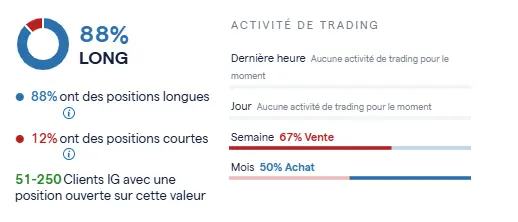
Moreover, according to IG data, a large majority of IG clients are currently positioned to buy on Kering, reflecting some optimism. However, be cautious with such indicators.
IG clients’ position on Kering stock
Les performances passées ne présument pas des performances futures. L’investissement en action présente un risque de perte en capital.
All of our information is, by nature, generic. They do not take into account your personal situation and do not constitute personalized investment recommendations for the execution of transactions and cannot be equated with financial investment advice, nor with any incentive to buy or sell financial instruments. The reader is solely responsible for using the information provided, with no recourse against Cafedelabourse.com’s publishing company. The publisher’s liability cannot be engaged in case of error, omission or inappropriate investment.
