
The French cosmetics giant continues to demonstrate its ability to stand out in a challenging economic environment. With the publication of its third-quarter 2026 results on October 22, 2026, L’Oréal confirms the solidity of its business model and shows particularly encouraging growth. This should reassure investors, even though several questions remain regarding the company’s valuation and the potential upside of L’Oréal’s stock on the market.
If L’Oréal remains a global reference in the beauty industry, is the quality of its fundamentals enough to justify L’Oréal’s current stock price? And what prospects are emerging for the coming months and for 2027?
Discover in this article our fundamental analysis and our technical analysis of L’Oréal stock, our view on its valuation, as well as the price levels to watch to invest in the stock or trade the L’Oréal title by the end of 2026.
Who is L’Oréal? History and key figures

The history of L’Oréal begins in 1909, when Eugène Schueller, a young French chemist, developed a hair coloring formula for hairdressers. This innovation gave birth to a company that, more than a century later, became the world’s number one in beauty.
Over the decades, L’Oréal has expanded far beyond hair products, notably thanks to an acquisitions strategy and sustained investments in research. The group today owns a portfolio of about 40 international brands, including Lancôme, Garnier, Kérastase, La Roche-Posay, and Yves Saint Laurent Beauté.
Present in supermarkets as well as in hair salons, pharmacies, and accessible luxury channels, L’Oréal built a diversified model capable of reaching consumers with very different profiles and purchasing power.
Key information about L’Oréal
| Key information | Data |
| Company | L’Oréal SA |
| Stock ticker | OR (OR.PA) |
| ISIN code | FR0000120321 |
| Main listing exchange | Euronext Paris, Segment A |
| Industry | Cosmetics and beauty products |
| Date of establishment | 1909 |
| Headquarters | Clichy, France |
| CEO | Nicolas Hieronimus |
| Geographic presence | Global, in more than 150 countries |
| Market capitalization | €230.9 billion (23 October 2026) |
| Stock index | CAC 40 |
| Number of employees | More than 95,000 |
What are L’Oréal’s latest results in 2026?

L’Oréal published on October 22, 2026 results that were particularly solid for the third quarter 2026, confirming the acceleration of its growth in a global beauty market that remains mixed. The group benefits notably from the dynamism of its dermatological beauty and professional products businesses, while its accessible luxury division is gradually turning around.
Another encouraging element is the rebound in demand in China, long a source of concern for investors, which seems to be confirmed. Emerging markets also constitute a powerful growth lever for L’Oréal, with particularly strong progress in India and Southeast Asia.
Not everything is uniform, however: Latin America shows some weakness, notably in Mexico. But overall, these results demonstrate L’Oréal’s ability to gain market share and to maintain high organic growth, despite an uncertain international economic environment.
Key figures of H1 2026 results for L’Oréal
| Financial indicator | Result 2026 |
| Revenue (9 months) | €35.34 billion |
| Organic growth (9 months) | 6.90% |
| Gross margin (H1) | €17.78 billion |
| Gross margin rate (H1) | 74.80% |
| Operating profit (H1) | €5.06 billion |
| Operating margin (H1) | 21.30% |
| Net income attributable to owners of the parent (H1) | €3.55 billion |
| Net income excluding non-recurring items (H1) | €3.96 billion |
| Adjusted earnings per share (EPS) (H1) | €7.40 |
| Operational cash flow (H1) | €3.12 billion |
Commentary from Nicolas Hieronimus, Chief Executive Officer of L’Oréal:
Once again, the global beauty market demonstrates its resilience in a difficult context, and we continue to outperform it strongly.
What is L’Oréal’s position in the luxury sector in 2026?
When mentioning the French luxury giants, one naturally thinks of LVMH, Hermès, or Kering. Yet L’Oréal also holds a prime place in this universe, with its accessible luxury division that commercializes, among others, Lancôme, Yves Saint Laurent, Armani, or Prada perfumes and cosmetics. A market where the French group occupies a leading position, in Europe as well as internationally.
Competition is nonetheless fierce, notably against Estée Lauder, the American owner of La Mer and MAC Cosmetics, or Japanese Shiseido, not to mention LVMH, present in beauty with Dior and Guerlain.
What sets L’Oréal apart from these competitors is that it does not depend solely on high-end luxury products. Its mass-market brands and its dermatology division allow it to reach a far broader customer base, a valuable edge as consumers cut back on luxury spending.
Commentary from Nicolas Hieronimus, Chief Executive Officer of L’Oréal:
Driven by the success of our innovation plan, and the passion of our teams, we continue to gain market share in hair care and fragrances, but also now in the key skin care category.
Should you invest in L’Oréal stock by the end of 2026? Café de la Bourse’s view and fundamental analysis
Fundamentally, L’Oréal presents several characteristics typically sought by long-term investors: steady growth, high margins, and an ability to defend its positions against competition. L’Oréal’s latest results further confirm that the group maintains solid commercial momentum, notably thanks to dermatological beauty, professional products, and the rebound of its accessible luxury division.
But the real question for stock investors concerns the price to pay for such quality. Because L’Oréal stock traditionally trades at a premium valuation relative to many consumer groups. This premium is explained in particular by the strength of its brands, its international presence, and its profitability, but it also reduces the safety margin in case of a slowdown.
Therefore, valuation multiples, as well as debt and available cash, should be watched closely. Organic growth is encouraging, certainly, but to sustainably justify a high stock price, L’Oréal’s shares will have to continue converting that growth into profits and cash flows.
Summary table of L’Oréal’s key financial indicators
| Fundamental indicators | Value |
| Enterprise value (EV) | €243.56 billion |
| Cash on hand (H1 2026) | €4.05 billion |
| Gross debt, incl. leases (H1 2026) | €16.71 billion |
| Net debt, incl. leases (H1 2026) | €12.66 billion |
| Equity attributable to group (H1 2026) | €33.84 billion |
| Price to Book (P/B) | 6.82x |
| Dividend yield | 1.66% |
| EBITDA (2025) | €10.54 billion |
| EV/EBITDA (based on 2025 EBITDA) | 23.1x |
| Adjusted P/E (TTM) | 33.2x |
Commentary by Marc:
L’Oréal presents the profile of a quality growth stock, with high profitability, strong brands, and relatively resistant activity to economic cycles. Its fundamentals remain solid, even though its debt has increased with recent acquisitions. In the stock market, this quality commands a premium: high valuation multiples leave little room for disappointment. L’Oréal’s stock therefore appears more as a long-term growth holding than as a deeply discounted investment opportunity.
How far can L’Oréal’s stock go by the end of 2026? Café de la Bourse’s view and chart analysis
Long-term technical analysis helps identify the trend of L’Oréal stock, as well as price levels of interest for buying or taking profits.
Long-term technical analysis of L’Oréal stock
Following the release of quarterly results, L’Oréal stock has shown a strong upward acceleration. The shares are now headed toward €440, a major resistance level that also corresponds to their all-time highs. For investors already long, this zone could present an opportunity to take profits, at least partially.
Conversely, a break of the €440 resistance would constitute a particularly positive technical signal, opening the path to new all-time highs. In this scenario, a target of €500, or more, could be contemplated. However, it remains difficult to precisely estimate the upside potential in the absence of historical resistance above this price level.
However, caution: the current rise is largely driven by the earnings release. A loss of momentum cannot be ruled out. In that case, a first pullback toward €414, former resistance likely to become support, would be possible.
Lower down, €397 constitutes a particularly important technical level for L’Oréal. This zone has repeatedly acted as resistance, notably in 2021, 2023, and then in 2025 and 2026. Its recent breakout could now turn it into a major support, as this price level has also served as support in January and April 2024.
Finally, in the event of a deeper correction, supports at €338 and €309 would also deserve close attention on L’Oréal stock. Although distant from current prices, these levels could offer opportunities to strengthen positions for long-term investors, provided prices stabilize.
Weekly chart analysis of L’Oréal stock
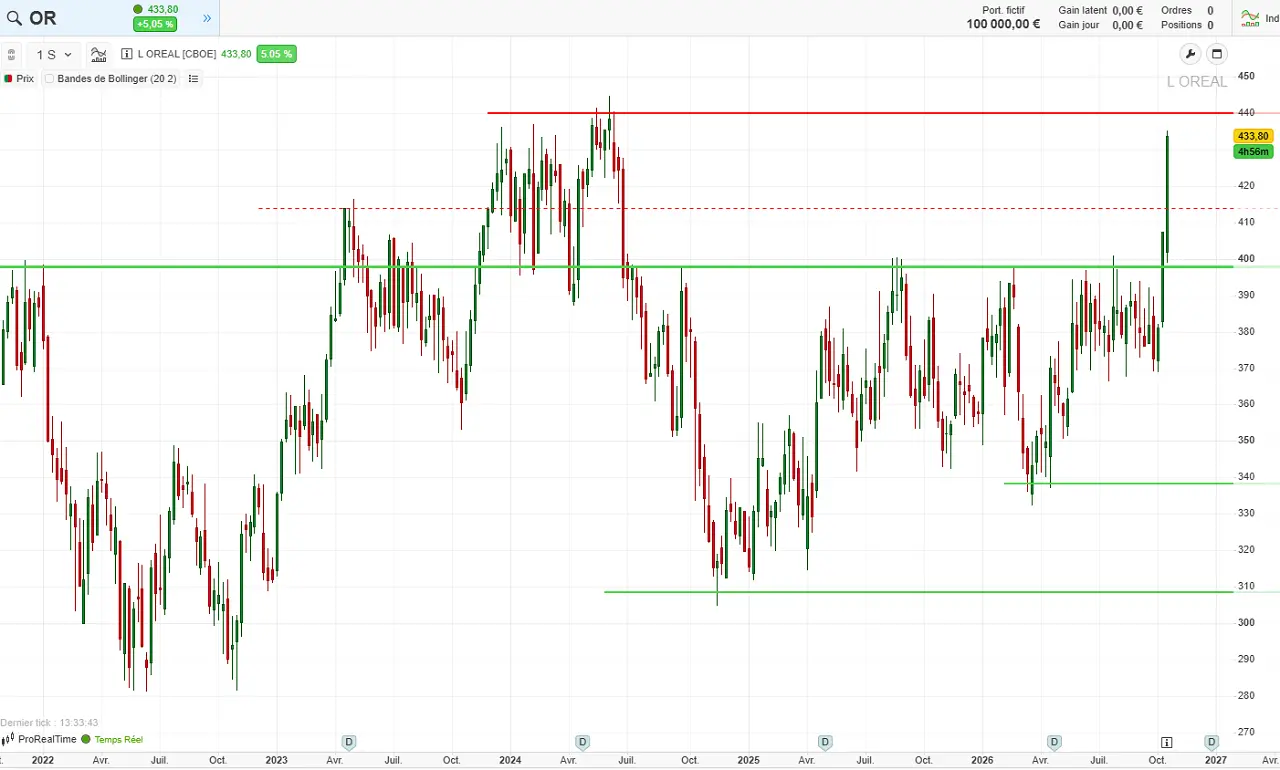
Key technical levels to watch on L’Oréal stock by late 2026
| Support / Resistance | Stock price L’Oréal | Café de la Bourse view |
| Major resistance | €440 | L’Oréal stock’s all-time high A breakout of this resistance could open the path to new records Potential take-profit zone |
| Broken resistance / Potential support | €413-414 | Recently broken resistance A return to this level would test the strength of the new bullish momentum |
| Major support | €397-400 | Former historical resistance and upper boundary of the trading range Its recent break could turn this zone into a particularly important support |
| Intermediate support | €370-371 | Former lower boundary of the trading range observed between May and October 2026 A break below would be a technical weakness signal |
| Long-term support | €338 | Historical support zone likely to curb a larger correction Level to monitor for potential strengthening |
| Major long-term support | €309 | Historical long-term support A pullback to this level would indicate a significant deterioration of the current uptrend |
Should you buy L’Oréal stock by the end of 2026? Café de la Bourse’s view
In our view, L’Oréal stock remains an interesting asset for building a stock portfolio over the long term. But should one buy now, after the stock’s sharp rise? We would lean toward exercising patience. Buying a stock in the euphoria following strong results is not always the best strategy, even for a high-quality company.
For an investor looking to position themselves, we would favor a gradual entry via a dollar-cost averaging plan (DCA), keeping some liquidity to profit from potential pullbacks. As for existing shareholders, there is nothing necessarily to justify selling abruptly.
Ultimately, our conviction on L’Oréal stock remains positive in the long term, but paying close attention to the technical analysis and trend monitoring could help optimize the timing of purchases and avoid entering at the wrong moment.
How to invest in L’Oréal stock in practice?
To buy L’Oréal shares, you can notably go through IG, which allows direct stock market investments, with no commission on buy and sell orders. It is all done from the IG mobile app, where you also find the analysis tools offered by the stock broker. And since L’Oréal shares currently cost more than €400, it is interesting to know that IG allows buying fractional shares from €10. So there is no need to pay the price of a full L’Oréal share to start investing in the stock.
Another option for investors who do not want to limit themselves to L’Oréal stock is to use a CAC 40 ETF, since the group is part of the CAC 40 index, or to choose a luxury-focused ETF in which L’Oréal is present.
How to trade L’Oréal stock in practice?
Our technical analysis shows a fairly spectacular shift in L’Oréal’s stock. After several months of moving in a trading range, L’Oréal’s shares now experience a strong upward acceleration, with volatility having markedly increased, reflecting two market conditions that do not translate in the same way.
IG offers different derivatives for trading, including barrier options, which allow traders to consider different strategies depending on market conditions:
- In a trading-range market: one can buy a barrier call option when L’Oréal rebounds from the lower boundary of the range, then close the position as the upper boundary approaches. Conversely, a trader can buy a barrier put if they anticipate a pullback from resistance.
- In a market that has become very volatile: rather than anticipating a rebound, the trader can wait for a breakout confirmation. A barrier call then helps to accompany an acceleration to the upside, while a barrier put can be used if L’Oréal’s price breaks a support and accelerates downward.
The appeal of IG’s barrier options is that you can pre-select your knock-out level, which mainly determines leverage and the maximum loss of the position.
However: these derivatives carry a high risk and the entire capital invested can be lost quickly.
The information from Cafedelabourse.com and its publications is provided for educational purposes. It does not in any case constitute investment recommendations. The reader should assess the risks before making any transaction. They are solely responsible for their investment decisions.
Past performance is not indicative of future results. Investing in stocks involves risk of capital loss.
All our information is, by nature, generic. It does not take into account your personal situation and in no way constitutes personalized investment advice or an invitation to buy or sell financial instruments. The reader is solely responsible for using the information provided, and no recourse against Cafedelabourse.com’s publisher can be pursued. The publisher cannot be held responsible for any error, omission, or ill-timed investment.
